
A research team from the National Graphene Institute at the University of Manchester has successfully developed a novel programmable nanofluidic memristor capable of mimicking the memory functions of the human brain, providing new ideas for the advancement of neuromorphic computing technology. This breakthrough, published in Nature Communications, demonstrates the unique potential of two-dimensional nanochannels for memory storage.
The team, led by Professor Radha Boya and including members from the National Graphene Institute, Photon Science Institute, and Department of Physics and Astronomy, constructed nanochannels using two-dimensional materials such as molybdenum disulfide and hexagonal boron nitride, filled with liquid electrolytes, successfully realizing all four theoretically predicted memristive behaviors. Professor Boya stated: "This is the first time all four types of memristors have been observed in a single device, showcasing the exceptional tunability of nanofluidic systems."
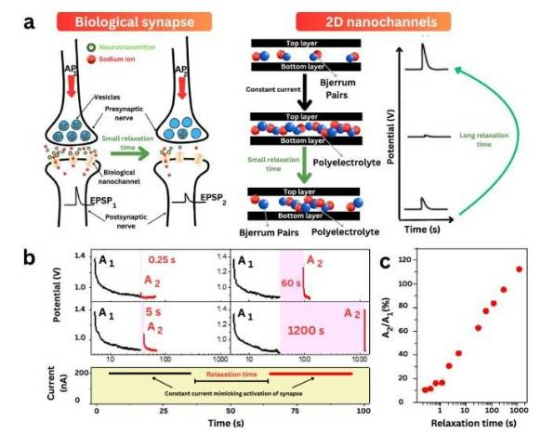
Unlike traditional electronic memristors, this nanofluidic device achieves memory functions through ion movement, offering advantages such as low energy consumption and the ability to simulate biological learning processes. By adjusting parameters like electrolyte composition, pH value, and voltage frequency, the same device can switch between different memory modes. The device also exhibits short-term and long-term memory characteristics similar to biological synapses, which are crucial for developing adaptive learning systems.
The theoretical model developed by the team successfully explains the various observed memristive behaviors. Lead author Dr. Abdulghani Ismail noted: "This research represents a major leap in our understanding of ionic memory, opening new pathways for developing low-power, brain-like computing systems." The technology holds promise for applications in artificial intelligence, robotics, and bioelectronics.