
An international team of astronomers led by the University of Texas at Austin's Cosmic Frontier Center has discovered the most distant confirmed black hole to date. It and its host galaxy, CAPERS-LRD-z9, existed 500 million years after the Big Bang. This places it 13.3 billion years ago, when our universe was only 3% of its current age. As such, it offers a unique opportunity to study the structure and evolution of this mysterious period.
"When hunting for black holes, this is about as far back as you can practically go. We are really pushing the detection limits of current technology," said Anthony Taylor, a postdoctoral fellow at the Cosmic Frontier Center and leader of the discovery team.
The study was published in The Astrophysical Journal.
"While astronomers have found some candidates that are farther away," added Steven Finkelstein, director of the Cosmic Frontier Center and co-author on the paper, "they haven't found the unique spectral features associated with a black hole."
Using spectroscopy, astronomers break light into multiple wavelengths to study the properties of celestial objects. To identify black holes, they look for evidence of rapidly moving gas. As gas orbits and falls into a black hole, light from gas moving away from us is stretched to redder wavelengths, while light from gas moving toward us is compressed to bluer wavelengths.
"Very few other things can produce this signature," Taylor explained, "and this galaxy has it."
The team used data from the CAPERS (CANDELS-Area Prism Reionization Survey) project with the James Webb Space Telescope (JWST) for the search. Launched in 2021, JWST provides the farthest views of space yet, and CAPERS offers observations of the outermost edges.
"The primary goal of CAPERS is to confirm and study the most distant galaxies," said Mark Dickinson, co-author and leader of the CAPERS team. "Spectra from the James Webb Space Telescope are key to confirming their distances and understanding their physical properties."
CAPERS-LRD-z9 was initially seen as an intriguing blob in the project's images and later confirmed to belong to a new class of galaxies called "little red dots." These galaxies only existed in the first 1.5 billion years after the universe's birth, are extremely dense, red in color, and unusually bright.
"From the early data of the James Webb Space Telescope, the discovery of little red dots was a huge surprise because they looked completely different from galaxies observed with the Hubble Space Telescope," Finkelstein explained. "Now we are figuring out what they are and how they formed."
CAPERS-LRD-z9 may help astronomers do just that.
First, this galaxy further proves that supermassive black holes are the source of the unexpected brightness in little red dots. Normally, such brightness indicates a galaxy rich in stars. However, in the era when little red dots existed, such enormous stellar mass is unlikely.
On the other hand, black holes also emit bright light. This is because they compress and heat the material they devour, producing tremendous light and energy. By confirming a black hole in CAPERS-LRD-z9, astronomers have found a striking example of this connection in a little red dot.
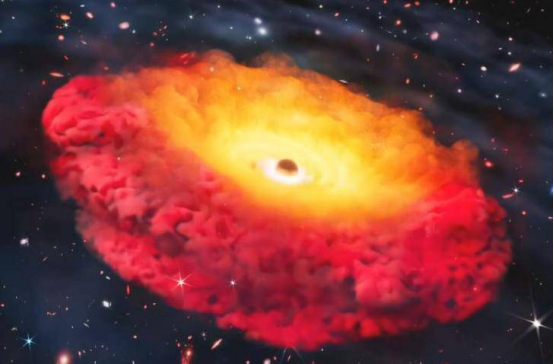
This newly discovered galaxy may also explain why little red dot galaxies appear uniquely red. This could be due to a thick cloud of gas around the black hole, causing its light to shift to redder wavelengths as it passes through.
"We've seen this kind of cloud in other galaxies," Taylor explained. "When we compared this object to clouds from other sources, they matched exactly."
The galaxy is also notable for its enormous black hole. It is estimated to have a mass of 300 million suns—equivalent to half the mass of all the stars in its galaxy. Even among supermassive black holes, this mass is quite large.
Discovering such a massive black hole so early provides astronomers with a valuable opportunity to study how these objects form. Black holes that exist in the later universe have had a variety of opportunities to grow throughout their lifetimes. But those existing in the first few hundred million years do not.
"This further shows that black holes in the early universe grew much faster than we thought. Or they started out much more massive than our models predict," Finkelstein said.
To continue studying CAPERS-LRD-z9, the team hopes to collect more, higher-resolution observations with the James Webb Space Telescope. This will help gain deeper insights into it and the role black holes play in the formation of little red dots.
"This is a great test object for us," Taylor said. "It's only recently that we've been able to study the evolution of black holes in the early universe, and we're excited to see what we can learn from this unique object."