
In collaboration with Northwestern University in the United States, the Korea Institute of Science and Technology (KIST) has successfully developed a next-generation ambient light-powered medical wearable platform. This technology breakthrough addresses the bottleneck of existing wearables relying on bulky batteries. The findings have been published in the prestigious journal Nature Communications.
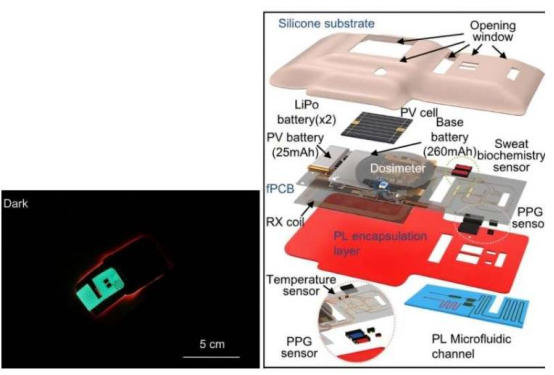
Led by Professor Kyeongha Kwon from KIST's School of Electrical Engineering, the innovation integrates three core technologies to achieve a revolutionary advance. The research team stated: "Our goal is to create a truly 24-hour uninterrupted monitoring medical-grade wearable device, making health monitoring as convenient as wearing an ordinary watch."
The first core technology is an intelligent luminosity adjustment system that automatically regulates LED brightness based on ambient light intensity. Experimental data show that under sufficient illumination, the system can reduce energy consumption by up to 86.22%. Professor Kwon explained: "Traditional sensors require constant brightness, while our system intelligently adjusts like the human eye, significantly improving energy efficiency."
The second breakthrough is the adoption of high-efficiency multi-junction solar cells in the photovoltaic system. This system not only converts various indoor and outdoor light sources into electricity but is also equipped with an advanced adaptive power management system that intelligently switches between 11 power supply modes based on environmental conditions and battery status. Team member Dr. Do Yun Park stated: "This system acts like a smart energy steward, always selecting the optimal power supply solution."
The most creative third technology is the application of photoluminescent materials. The team incorporated specially formulated strontium aluminate microparticles into the device casing, enabling it to "store energy." Tests show that the device, charged for just 10 minutes under 500W/m² sunlight, can operate for 2.5 minutes in complete darkness.
The platform has been successfully applied to multiple medical monitoring functions:
Photoplethysmography sensor: Accurately monitors heart rate and blood oxygen saturation, aiding early detection of cardiovascular diseases
Blue light dosimeter: Precisely measures harmful blue light in the environment, providing personalized protection recommendations
Sweat analysis sensor: Uses microfluidic technology for real-time detection of salt, glucose, and pH in sweat
Notably, the device incorporates on-sensor data computation technology, reducing wireless data transmission from 400B/s to 4B/s—a 100-fold decrease—further extending battery life. Clinical trials demonstrate that the device achieves medical-grade monitoring accuracy across various lighting environments.
Professor Kwon envisioned: "This technology will completely transform medical health monitoring models, shifting from passive treatment to active prevention. We expect it to play a significant role in chronic disease management, elderly care, and sports health." Currently, the research team is advancing commercialization, with mass production expected within two years.