
A collaborative research effort between the University of Leeds and University College London (UCL) has achieved a major breakthrough: researchers have developed an artificial intelligence (AI) system that allows quadruped robots to autonomously adjust their gait based on different unfamiliar terrains. This world-first achievement has been published in the journal Nature Machine Intelligence.
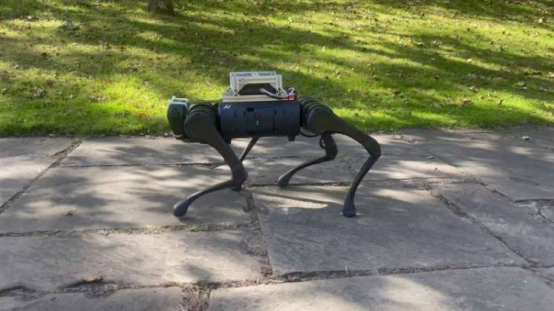
Current-generation robots need to be instructed when and how to change their stride, but this pioneering technology enables robots to autonomously alter their movement patterns. This advancement is particularly significant for the use of legged robots in hazardous environments such as nuclear decommissioning and search-and-rescue operations, where failure to adapt to unknown conditions could endanger lives.
The researchers drew inspiration from quadruped animals like dogs, cats, and horses that excel at adapting to various terrains. These animals change their movement patterns depending on the situation to conserve energy, maintain balance, or respond to threats. Building on this, the team created a framework that teaches robots to switch between actions such as trotting, running, and jumping, mimicking mammals in nature.
By embedding navigation strategies from animals in unpredictable environments into the AI system, the robot—nicknamed "Clarence"—leveraged AI's powerful data processing capabilities to learn the necessary strategies in just 9 hours, far faster than the time required for young animals to adapt to different surfaces.
First author Joseph Humphreys explained that the framework enables the robot to change its stride according to the environment, overcoming various terrains such as uneven wood, loose wood chips, and overgrown vegetation without altering the system itself. This is the first framework to simultaneously integrate three key components of animal locomotion—gait transition strategies, gait program memory, and adaptive motion adjustment—into a reinforcement learning system, allowing direct deployment from simulation to truly multifunctional real-world applications without further adjustments on the physical robot.
Deep reinforcement learning agents typically struggle to adapt to environmental changes, but the researchers overcame this challenge by injecting natural animal locomotion strategies into the system. In simple terms, the robot not only learns how to move but also decides which gait to use, when to switch, and how to adjust in real time—even on terrain it has never encountered before.
Senior author Professor Zhou from UCL's Department of Computer Science stated that the research stemmed from the vision of enabling legged robots to move instinctively like animals, aiming to endow robots with the strategic intelligence animals use to adjust gait, allowing them to select movement patterns based on real-time conditions rather than predefined rules, thereby traveling safely and effectively in unfamiliar environments. The team's long-term vision is to develop embodied AI systems capable of moving, adapting, and interacting as fluidly as animals and humans.
Robots capable of navigating unfamiliar and complex terrains open new possibilities for applications in disaster response, planetary exploration, agriculture, and infrastructure inspection. At the same time, the study proposes a promising approach to incorporating biological intelligence into robotic systems and conducting more ethical biomechanical hypothesis research using robots to study animal stability recovery responses, avoiding invasive sensors on animals or placing them in danger.
The current research focuses on achieving robust everyday locomotion, with the team hoping to add more dynamic skills in the future, such as long-distance jumping, climbing, and navigation on steep or vertical terrain. Although the framework has currently been tested only on one dog-sized quadruped robot, its underlying principles have broad applicability, and the same bio-inspired metrics can be applied to quadruped robots of various sizes and weights as long as they have similar morphologies.