
Understanding the early universe is a major goal in space science, with scientists dedicated to exploring how nature evolved from the superheated plasma after the Big Bang into a structured cosmos. Among these, the formation process of the first stars—Population III stars—is particularly crucial. These stars ignited through fusion, illuminating their surroundings and marking the universe's transition from the dark ages to light. However, observing the early universe poses many challenges; while the James Webb Space Telescope can detect light from the first galaxies, capturing the formation of individual stars more than 13 billion years ago remains difficult.
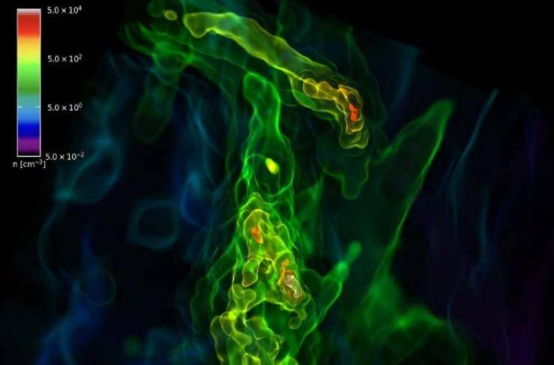
Fortunately, supercomputer simulation technology provides scientists with a new way to approach this goal. The new study used the cutting-edge GIZMO simulation code and data from the IllustrisTNG project to successfully replicate conditions during the universe's formation of the first stars. Titled "The Formation of Supersonic Turbulence in Primordial Star-Forming Clouds," the research was published in The Astrophysical Journal Letters, with first author Chen Kerong from the Academia Sinica Institute of Astronomy and Astrophysics in Taiwan. The study focuses on the dark ages, the period from about 370,000 years to hundreds of millions of years after the Big Bang, when the universe had cooled to transparency but no stars yet existed. Scientists used simulation technology to delve deeply into the cosmic environment before the first stars formed.
The research team adopted initial conditions from the large-scale cosmological simulation IllustrisTNG, spanning approximately 50Mpc, and increased resolution by about 10^5 times through particle splitting techniques, achieving extremely high simulation accuracy. The simulation results show that gas flows at high speed into the gravitational wells of dark matter minihalos, forming supersonic turbulence that subsequently fragments into dense primordial gas clumps. These gas clumps are likely to have formed Population III stars, and in greater numbers but smaller masses than previously expected. This discovery may explain the long-standing puzzle of metal abundance for scientists. Chen Kerong stated: "This simulation represents a major step in connecting large-scale cosmic structure formation with the microscopic processes controlling star birth. By revealing the role of turbulence, we are one step closer to understanding how the cosmic dawn began."