
The rock-melting drilling technology from geothermal startup Quaise breaks away from tradition and holds promise as the key to unlocking geothermal energy potential, making it viable anywhere in the world.
Geothermal power generation works best in regions with favorable geological conditions where surface heat is close, such as Iceland and the western United States. In theory, by drilling deep enough, companies can access Earth's heat from anywhere globally. However, reaching temperatures required for efficient power generation in some locations requires drilling several miles below the surface, often through hard rocks like granite—a daunting task.
Quaise proposes a completely new drilling paradigm, abandoning traditional hard drill bits that scrape into rock. Instead, it plans to use gyrotrons to emit high-frequency electromagnetic radiation to blast, melt, and vaporize rock, theoretically making drilling faster and more economical. Since its founding in 2018, the company has demonstrated the system working under controlled laboratory conditions, begun testing in semi-controlled environments, and is now bringing gyrotron drilling technology to quarries for real-world condition tests.
However, some experts warn that reshaping drilling technology will not be simple or quick. Quaise is attempting to raise large-scale funding this year, but current economic uncertainty has slowed investment, and the U.S. climate tech sector is also caught in political difficulties due to policy issues.
Quaise co-founder and chief advisor Matthew Houde stated that the energy stored in Earth's interior can meet humanity's energy needs for tens or even hundreds of thousands of years. The company aims to expand the scope of geothermal energy extraction, with the key being drilling deep enough—targeting 10 to 20 kilometers—to access superhot geothermal worldwide. There are few examples of human drilling approaching this depth; the Soviet Union's research project starting in 1970 reached slightly over 12 kilometers, taking nearly 20 years and at high cost. Quaise hopes to accelerate drilling speed and reduce costs, targeting a stable rate of 3 to 5 meters per hour through rock.
One key factor hindering drilling through hard rock is non-productive time, as equipment often needs to be returned to the surface for repair or bit replacement. Quaise's gyrotron emits millimeter waves to heat target rock, causing it to crack, melt, or even evaporate, after which the drill bit descends to scrape away debris, with airflow carrying debris to the surface to repeat the process.
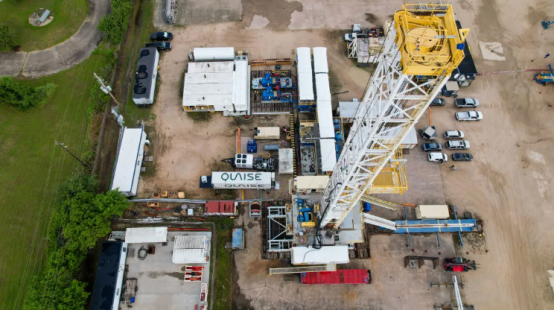
A reporter witnessed the system in operation at the company's Houston headquarters. The rig in the yard is small-scale, with the gyrotron total power at 100 kilowatts, a cooling system helping superconducting magnets reach required temperatures, and a filtration system collecting debris.
Stanford University geothermal program leader Roland Horne said Quaise is not the first company to develop non-mechanical drilling, but operations must withstand high temperatures and pressures at the bottom of the well. Currently, the company has drilled into rock columns within metal casings and conducted field tests in quarries, but there is still a long way to go from predictable environments to building geothermal wells several miles deep.
In April this year, Quaise integrated a second 100-kilowatt gyrotron into an oil and gas drilling rig from investor and technical partner Nabors. Preliminary tests were conducted in April, integrated rig testing in May drilled a 4-inch diameter, 30-foot deep hole, and another test in June reached 40 feet—these holes were drilled into basalt columns buried underground.
While testing the 100-kilowatt system on rigs and in quarries, the company's next step is to develop a 1-megawatt system with gyrotrons 10 times more powerful, capable of drilling holes over 8 inches in diameter—representing commercial scale—with drilling tests starting in 2026. This 1-megawatt system's actual total power requirement is slightly over 3 megawatts, comparable to current oil and gas drilling rig power needs.
Quaise geothermal resource development vice president Trenton Cladouhos stated that the company is building a pilot plant on the edge of a volcano in Oregon using conventional drilling technology to prove its ability to build and operate geothermal power plants. Exploration wells are being built this year, with production wells planned for drilling in 2026; the first few wells will operate on rock at about 350°C, generating approximately 20 megawatts, with earliest operation in 2028.
Quaise CEO Carlos Araque said the Oregon project strategy is to demonstrate efficient use of superhot rock for geothermal energy production; once the power plant starts, millimeter-wave drilling technology can be used to deepen holes. Drilling tests show the millimeter-wave technology can penetrate granite, and the company already has customers lined up to purchase energy, including a large tech company and a utility company, but declined to name them.
However, this startup needs more funding to complete projects and test higher-power gyrotrons. Before building commercial power plants, Quaise still has some technical obstacles to overcome, such as developing directional drilling technology. Transitioning from laboratory tests to field trials may face challenges. Cornell University professor Jefferson Tester said that for geothermal technology companies attempting operations at such depths, the key challenge is maintaining long-term well functionality. Tester stated that Quaise's technology is highly visionary, but ultimately depends on costs, and ambitious companies also face the risk of investors losing patience. Quaise project manager Steve Jeske said the company is radically transforming drilling, and there is still much to learn.