
A team of scientists from the Institute of Applied Ecology, Chinese Academy of Sciences in Beijing, has developed a new method that can more accurately quantify greenhouse gas emissions from large-scale greenhouse cultivation, addressing the long-standing challenge of monitoring the environmental costs of facility agriculture.
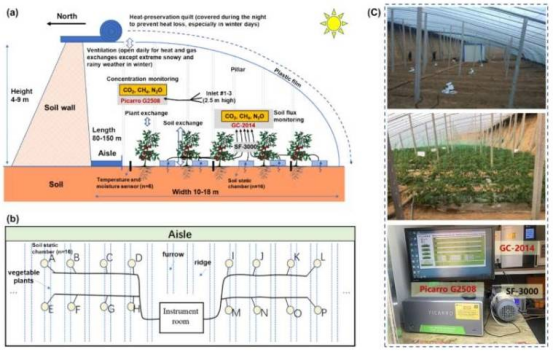
This study, published in the journal Science of the Total Environment, introduces the whole-greenhouse static chamber method. This technique overcomes the main limitations of traditional monitoring strategies by treating the entire greenhouse as a sealed measurement unit.
Over the past thirty years, greenhouse agriculture has developed rapidly, with global coverage reaching 1.3 million hectares by 2019. China alone accounts for more than 60% of the world's greenhouse area. These enclosed structures, typically made of plastic film, enable off-season or high-value crop production but require intensive irrigation and fertilization, which increases emissions of two potent greenhouse gases: carbon dioxide (CO₂) and nitrous oxide (N₂O).
However, accurately quantifying these emissions remains difficult. Traditional techniques, such as the small static chamber method, struggle to provide spatially representative data and fail to capture the heterogeneous emission characteristics of soil. Additionally, the undulating surface structure of greenhouses and discontinuous ventilation patterns hinder the application of micrometeorological methods.
To overcome the limitations of traditional technologies, the research team innovatively developed the whole-greenhouse static chamber method, treating the entire greenhouse as a closed static environment and indirectly estimating emission rates by monitoring gas concentration accumulation during nighttime sealed periods.
The method was field-tested in a commercial vegetable greenhouse in Weifang City, Shandong Province, requiring the greenhouse to be sealed between 18:00 and 24:00. During this period, photosynthesis ceases, and greenhouse gases accumulate. By tracking the concentrations of carbon dioxide and nitrous oxide during this time, researchers can indirectly calculate ecosystem respiration (Re) and nitrous oxide flux with high precision.
The researchers observed that methane (CH₄) emissions were negligible, while carbon dioxide (CO₂) and nitrous oxide (N₂O) emissions were considerable. Notably, due to plant photosynthesis absorbing carbon dioxide during the day and offsetting part of the respiration (Re), nitrous oxide (N₂O) becomes the primary direct greenhouse gas in these systems. The research team estimated that across 15 greenhouses, the annual average respiration emission was 17.8 ± 8.0Mg C ha⁻¹ yr⁻¹ per hectare, and the annual average nitrous oxide (N₂O) emission was 21.3 ± 19.7kg N ha⁻¹ yr⁻¹ per hectare.
The researchers used the average nitrous oxide (N₂O) emission rate observed in this study to estimate emissions from greenhouse cultivation areas nationwide in China. The results indicate that China's horticultural greenhouses emit approximately 16,800 tons of N₂O-N annually, accounting for nearly 8% of the country's total agricultural nitrous oxide (N₂O) emissions. In Weifang City alone, greenhouses occupy only 20% of the farmland area but contribute nearly 60% of local N₂O emissions, highlighting the emergence of regional emission hotspots.
In addition to its technical advantages, the whole-greenhouse static chamber method is particularly notable for its practicality and scalability. The method only requires passive gas sampling during nighttime closure (greenhouse sealing periods), providing a convenient and scalable solution for policymakers and researchers aiming to track emissions and optimize greenhouse management under climate mitigation goals.