
Researchers from the Institute of Forest Science of the Russian Academy of Sciences, the Obukhov Institute of Atmospheric Physics of the Russian Academy of Sciences, and other scientific institutions have discovered that some drainage ditches (artificial waterways used to drain swamps) can accumulate carbon in the pore water of bottom sediments, reducing greenhouse gas emissions to the atmosphere. Water in lowland peatland drainage ditches is rich in ions, facilitating the formation of carbonates, which can bind carbon and remove it from the biological cycle of matter. The study was funded by the Russian Science Foundation (RSF), with results published in the journal International Geochemistry.
Peatlands cover about 3% of the land area and play a significant role in the global carbon cycle, storing large amounts of carbon. However, drainage and peat extraction disrupt the natural balance, lowering the groundwater level and accelerating peat decomposition, releasing carbon dioxide, with drainage ditches becoming sources of methane. Although drainage ditches have a small area, the anoxic conditions at the bottom favor methanogenesis, which is more active during warm periods. Nevertheless, the characteristics of the carbon cycle in drainage ditches and the scale of emissions into the atmosphere in the form of carbon dioxide and methane have been insufficiently studied, making it difficult to accurately assess the impact of drainage systems on climate and the environment.
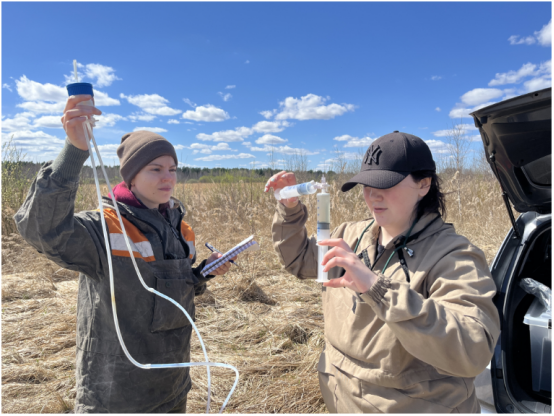
Scientists studied the seasonal dynamics of greenhouse gas emissions from the surface of drainage ditches in the Tarmansky swamp plot (Tyumen Oblast) and compared them with the chemical composition of the water body. They analyzed modern data on the chemical composition of the water in drainage ditches in 2024 and compared it with archival data from 1969 to 1971 (the initial period of the drainage system's operation). The results showed that over the past half-century, the proportions of chloride and sodium among ions have significantly increased, especially in summer, which can be explained by evaporative concentration.
Project leader funded by the Russian Science Foundation, Evgenia Soldatova, explained that the chemical composition of water in the channels is influenced by various natural processes, including the mineralization of organic matter in peat swamps, the dissolution of minerals underlying the peat swamps, ion exchange between sodium in the water and calcium and magnesium in the soil profile and underlying rocks, as well as increased evaporation due to rising summer temperatures in recent years.
One of the key findings is that carbonates can precipitate from drainage ditch water in summer. The abundant mineral nutrients in lowland peatlands, artificial drainage, and evaporative concentration provide favorable conditions for mineral saturation in the water, and carbonate precipitation excludes previously dissolved carbon from the biological cycle of matter for at least some time.
The researchers also analyzed seasonal variations in methane and carbon dioxide emissions from the surface of the drainage system. In most waterways, emissions increased in summer compared to spring, but in one drainage ditch that completely dried up in summer, surface greenhouse gas fluxes were anomalously low; the bottom sediments remained water-saturated, and methane and carbon dioxide accumulated in dissolved form in the pore water of the bottom sediments without entering the atmosphere. In summer, the surface greenhouse gas flux in this ditch was significantly lower than in spring.
Evgenia Soldatova noted that this atypical emission pattern indicates the need for more detailed study of dissolved carbon processes to more accurately assess the role of drainage ditches in the carbon balance and develop more effective measures for restoring drained peatlands. They plan to study the processes affecting the migration of dissolved carbon and its accumulation in the pore water of drained peatlands, as well as the factors controlling carbonate precipitation from aqueous solutions.