
Hydrogen fuel cells, as a "potential stock" in the green energy field, are expected to replace internal combustion engines and make a significant impact in heavy-duty vehicles such as long-haul trucks and forklifts. Their unique feature is that they do not generate energy through fuel combustion but rather by reacting hydrogen with oxygen to produce electricity, with zero carbon dioxide emissions throughout the process.
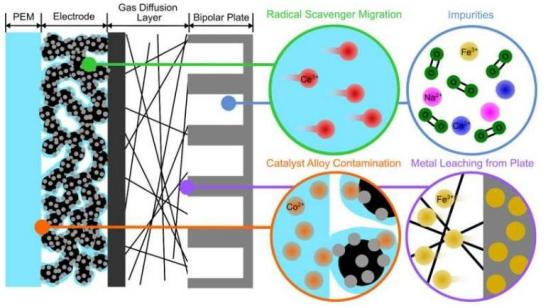
However, hydrogen fuel cells face a thorny issue during operation—they are easily contaminated by tiny positively charged metal particles (metal cations), leading to performance degradation. Chemical engineer ChungHyuk Lee from Toronto Metropolitan University pointed out that these particles have wide sources: hydrogen impurities, degradation of battery metal components, and even air could be the "culprits," making them "bad news" for fuel cells. They accumulate in the battery's catalyst layer, hindering chemical reactions.
To deeply investigate the specific behavior of cations in fuel cells, ChungHyuk Lee and his team added cobalt ions to a fuel cell and used the ultra-bright light from the Canadian Light Source (CLS) at the University of Saskatchewan to track their movement trajectory in a simplified version of the fuel cell. The related research was published in the Journal of The Electrochemical Society.
Lee stated that the BioXAS beamline at CLS played a key role in the experiment, as cations move extremely fast, and only this equipment could capture their motion in time. The team used data collected at CLS to build a mathematical model to predict the movement distance and speed of cations in real batteries under different conditions.
The study found that cations are particularly active in the humid environments common to fuel cells, increasing the difficulty of controlling contaminants. They easily get stuck in the thin and "twisted" catalyst layers, interfering with power generation reactions.
As the recipient of the 2023 CLS Early Career Researcher Excellence Award, Lee noted that a deeper understanding of the behavior of cation contaminants in fuel cells will help scientists develop new materials and new methods for operating batteries to reduce or eliminate contamination, making the next generation of fuel cells have longer lifespan and higher efficiency. He emphasized: "We need to explore materials or operational strategies that keep cations away from the catalyst."