
The Southwest Research Institute (SwRI) has reviewed data collected from near-Earth asteroids Bennu and Ryugu, supporting the hypothesis that they originally belonged to the Polana collisional family in the main asteroid belt between the orbits of Mars and Jupiter.
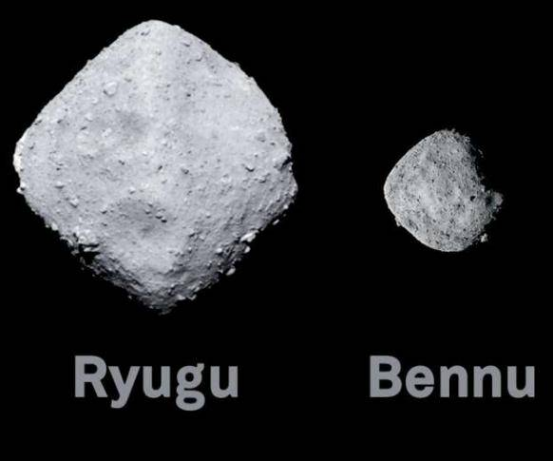
The study compared spectral data of Polana asteroids with spacecraft and laboratory data from Bennu and Ryugu asteroids, finding sufficient similarity in their near-infrared spectra to support the view that they originated from the same parent asteroid.
The paper titled "JWST Spectroscopy of (142) Polana: Links to Near-Earth Objects (101955) Bennu and (162173) Ryugu" was published in The Planetary Science Journal.
"We believe that in the early days of the solar system's formation, large asteroids collided and fragmented, forming an 'asteroid family,' with the largest one being the Polana asteroid," said Dr. Anicia Arredondo, lead author of the study and a researcher at SwRI. "Theory suggests that the remnants of that collision not only formed the Polana asteroid but also Bennu and Ryugu asteroids. To test this theory, we began observing the spectra of these three asteroids and comparing them."
Arredondo and her team applied for observation time with the James Webb Space Telescope, using two different spectroscopic instruments to observe the Polana asteroid, focusing on near-infrared and mid-infrared wavelengths. Subsequently, she compared these data with spectral data from physical samples of Ryugu and Bennu asteroids collected by two separate space missions. Japan's JAXA Hayabusa2 spacecraft rendezvoused with Ryugu in 2018 and returned samples to Earth by the end of 2020. NASA's OSIRIS-REx spacecraft encountered Bennu in 2020 and returned samples by the end of 2023.
Bennu and Ryugu are considered near-Earth asteroids because they orbit the Sun inside Mars' orbit; however, they are not considered threats to Earth, as their closest distances to Earth are approximately 1.9 million miles and 1 million miles, respectively.
Compared to Polana, both Bennu and Ryugu are relatively small. Bennu has a diameter of about one-third of a mile, equivalent to the size of the Empire State Building. Ryugu is twice as large as Bennu, but the Polana asteroid has a diameter of about 33 miles, much smaller than both Bennu and Ryugu. Scientists believe Jupiter's gravity pushed Bennu and Ryugu away from orbits near the Polana asteroid.
Arredondo said: "They are similar enough that we believe these three asteroids may have come from the same parent body."
The research group noted that there are differences in the spectral data of the asteroids, but not enough to overturn the hypothesis of a common origin.
"Since the possible collision that formed them, the Polana asteroid, Bennu asteroid, and Ryugu asteroid have each undergone their own journeys through the solar system," said Dr. Tracy Becker, co-author of the paper and a researcher at SwRI. "Bennu and Ryugu asteroids are now much closer to the Sun than Polana, so their surfaces may be more affected by solar radiation and solar particles."
"Similarly, the Polana asteroid may be older than Bennu and Ryugu, so it may have been impacted by micrometeoroids for a longer time," Becker added. "This could also alter certain aspects of its surface, including its composition."