
A joint Japanese research group has observed "heavy fermions" (electrons with significantly enhanced mass) exhibiting quantum entanglement dominated by the Planck time (the fundamental unit of time in quantum mechanics). This discovery opens exciting possibilities for developing new types of quantum computers by harnessing this phenomenon in solid-state materials. The research results have been published in the journal npj Quantum Materials.
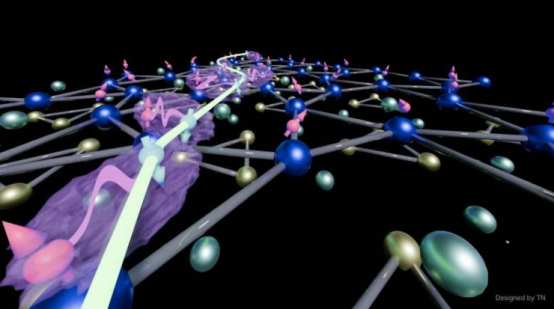
Heavy fermions arise when conduction electrons in a solid strongly interact with localized magnetic electrons, effectively increasing their mass. This phenomenon leads to unusual properties such as unconventional superconductivity and is a central topic in condensed matter physics. The material used in this study is cerium-rhodium-tin (CeRhSn), which belongs to a class of heavy fermion systems with a quasi-"kagome" lattice structure known for its geometric frustration effects.
The researchers investigated the electronic states of CeRhSn, a material renowned for exhibiting non-Fermi liquid behavior at relatively high temperatures. Precise measurements of the reflectivity spectrum of CeRhSn revealed that the non-Fermi liquid behavior persists up to near room temperature, with the lifetime of heavy electrons approaching the Planck limit. The observed spectral behavior can be described by a single function, strongly indicating the presence of quantum entanglement in the heavy electrons within CeRhSn.
Dr. Shinichi Kimura from Osaka University, who led the study, explained: "Our findings show that heavy fermions in this quantum critical state do indeed exhibit entanglement, and that this entanglement is governed by the Planck time. This direct observation is an important step toward understanding the complex interplay between quantum entanglement and heavy fermion behavior."
Quantum entanglement is a key resource for quantum computing, and the ability to control and manipulate it in solid-state materials like CeRhSn offers a potential pathway to building novel quantum computing architectures. The Planck time limit observed in this study provides critical information for designing such systems.
Further research into these entangled states could revolutionize quantum information processing and unlock entirely new possibilities in quantum technology. This discovery not only deepens our understanding of strongly correlated electron systems but also paves the way for potential applications in next-generation quantum technologies.