
Under the major trend of synergistic development in artificial intelligence and robotics technology, developing technologies that enable robots to efficiently perceive and respond to the environment has become a key task. Korean researchers have attracted significant attention with their recently achieved artificial sensory nervous system, which simulates the biological sensory nervous system without requiring complex software or circuits, and is expected to play an important role in ultra-small robots and robotic prosthetics.
On July 15, the Korea Advanced Institute of Science and Technology (KAIST) announced that a joint research team led by Chair Professor Shin-Hyun Choi from the School of Electrical Engineering at KAIST and Professor Jong-Won Lee from the Department of Semiconductor Convergence at Chungnam National University has successfully developed an artificial sensory nervous system based on next-generation neuromorphic semiconductors. The system simulates the functions of biological sensory nervous systems and realizes a new type of robotic system that can effectively respond to external stimuli. The related research was published in the journal Nature Communications.
In nature, animals (including humans) react sensitively to important or dangerous stimuli while ignoring safe or familiar ones, thanks to the "habituation" and "sensitization" functions of the sensory nervous system. Previously, although attempts were made to apply these biological functions to robots, difficulties arose in miniaturization and energy efficiency due to the need for separate software or complex circuits. Memristors, as next-generation electronic devices, have been widely used as artificial synapses, but existing memristors have limitations in simulating the complex characteristics of nervous systems, allowing only simple monotonic changes in conductance.
To overcome these limitations, the research team developed a new type of memristor capable of reproducing complex neural response patterns within a single device. By introducing an additional layer inside the memristor that changes conductance in the opposite direction, it enables more realistic simulation of the dynamic synaptic behavior of real nervous systems.
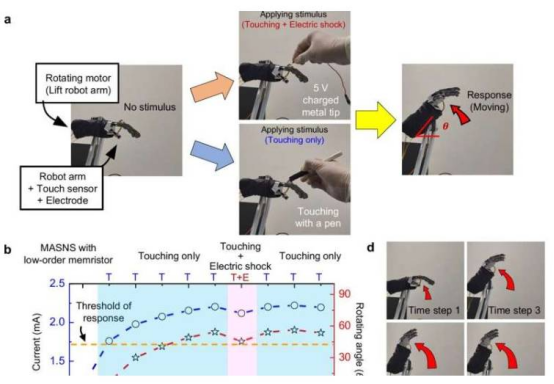
The research team constructed an artificial sensory nervous system capable of recognizing tactile and pain sensations using the new memristor and applied it to test the performance of a robotic hand. In the experiments, the robotic hand gradually exhibited habituation to repeatedly applied safe tactile stimuli and ignored them; when harmful stimuli combined with electric shocks were applied, it recognized them as dangerous signals and responded sensitively. This demonstrates that robots can efficiently respond to stimuli like humans without complex software or processors, verifying the possibility of developing energy-efficient neuromorphic robots.
KAIST researcher See-On Park stated that simulating the human sensory nervous system using next-generation semiconductors opens up possibilities for realizing new-concept robots that respond more intelligently and energy-efficiently to the external environment. This technology is expected to be applied in the fusion fields of next-generation semiconductors and robotics, such as ultra-small robots, military robots, and medical robots including robotic prosthetics.