
A study led by Royal Melbourne Institute of Technology (RMIT) has achieved a major experimental breakthrough, transforming the high pollutant load in wastewater into an advantage for producing green hydrogen, reducing reliance on scarce freshwater resources and bringing new advancements to the green manufacturing field.
Currently, over 80% of global wastewater is discharged into the environment untreated, but this research provides an opportunity to convert this environmental liability into enhanced productivity. The team used a unique approach to leverage specific pollutants in wastewater to accelerate hydrogen production, overcoming the challenge of high pollutant loads making wastewater difficult to utilize.
This research involved collaboration from the University of Melbourne, the Australian Synchrotron, and the University of New South Wales, building on previous breakthroughs such as innovative technology for rapidly removing microplastics from water using magnets and techniques for promoting hydrogen production with seawater. The related paper, "Sustainable Hydrogen Production Using Wastewater as a Catalyst Modifier," was published in ACS Electrochemistry.
Lead researcher and Associate Professor Nasir Mahmood from RMIT's School of Science explained that the team found a way to capture metals such as platinum, chromium, and nickel from water and use these elements to enhance green hydrogen yield. Compared to other green hydrogen production innovations, its advantage lies in directly utilizing inherent substances in wastewater without needing purified water or additional steps.
The key component of the experimental invention is an electrode with a surface made of adsorptive carbon that can adsorb metals from wastewater, forming a stable and highly conductive catalyst to accelerate water splitting. The material used to produce the special carbon surface is derived from agricultural waste, making it cost-effective and contributing to the circular economy.
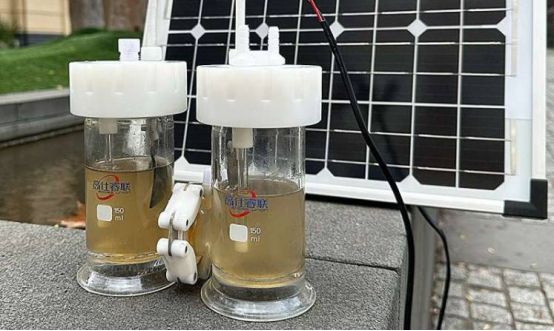
In the experiment, the research team placed wastewater samples in a container with anode and cathode electrodes, using renewable energy to power the water splitting process. As current flows through the water, it triggers a chemical reaction: water molecules gain electrons at the cathode to form hydrogen, and lose electrons at the anode to form oxygen, achieving the separation of water into its basic components of hydrogen and oxygen for collection and use. Mahmood noted that the produced oxygen can be reintroduced into wastewater treatment plants to improve their efficiency.
The device achieved 18 days of continuous water splitting in laboratory experiments with almost no performance degradation. The experiments used treated wastewater (with solids, organics, and nutrients removed).
RMIT is developing a catalytic system platform that can utilize previously difficult-to-use water sources such as wastewater and seawater, and this proof-of-concept invention is another example of that system. Co-lead researcher Professor Nicky Eshtiaghi stated that this innovation can reduce the high costs of wastewater treatment by converting it into a valuable green hydrogen source, addressing pollution issues while alleviating water scarcity, benefiting both the energy and water sectors.
The team is eager to collaborate with companies worldwide committed to addressing energy and waste costs as well as sustainability challenges, along with water utilities, to develop commercial systems for large-scale application of this technology. However, co-researcher Dr. Muhammad Haris pointed out that further research is needed to improve the catalyst process for greater efficiency and commercial suitability, and to test the method with different types of wastewater to ensure its universal effectiveness.