
A four-year (2018–2021) comprehensive farm trial led by the UK Centre for Ecology & Hydrology (UKCEH) and Rothamsted Research has found that nature-friendly farming methods can increase biodiversity and crop yields, but the transition to sustainable agriculture may require increased government subsidies to ensure profitability. The study was published in the Journal of Applied Ecology.
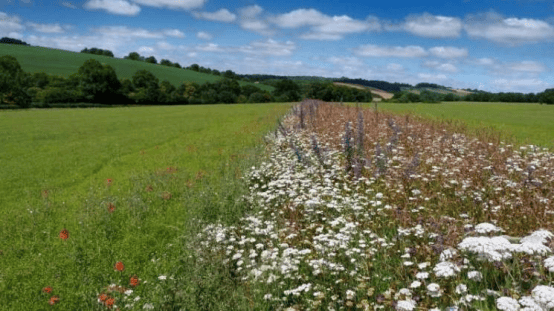
The research covered 17 conventional commercial farms in southern England, not only testing multiple agroecological methods but also assessing business financial viability for the first time. Scientists worked with farmers to establish three different farming systems on each farm: one was “business as usual” conventional intensive agriculture with no nature-friendly practices; the second was “enhanced” agroecological systems, such as planting wildflower margins and sowing overwinter cover crops; the third was “maximised ecosystem” systems, including in-field wildflower strips and adding farmyard manure to improve soil health.
The results showed that enhanced and maximised agroecological systems increased populations of earthworms, pollinating insects (bees), and natural enemies of crop pests, reducing aphid and slug numbers and boosting seed set and yield in flowering crops such as oilseed rape. Soils were healthier, pollination was more effective, and natural pest control reduced reliance on pesticides, leading to higher soil carbon content and greater overall crop yields. However, the costs of creating habitats and the loss of productive land impacted system profitability. Enhanced systems were only as profitable as conventional intensive farming when supported by agri-environment subsidies. Maximised systems delivered greater benefits but required additional subsidies for typical farms to match conventional profitability—though mixed farms could partially offset extra costs by freely accessing farmyard manure.
Lead researcher Dr Ben Woodcock from UKCEH stated that without new financial incentives, many farmers are unlikely to adopt agroecological practices and may remain locked in high-input intensive systems, which are more vulnerable to pesticide resistance, declining soil health, and climate change. While farmers need to remain profitable, more sustainable systems are better for the long-term “future-proofing” of farms. Agroecological methods support biodiversity and food security, delivering more stable incomes over time, but habitat establishment takes years, making agri-environment subsidies essential for the transition.
The authors emphasized that demonstrating the effectiveness of agroecological practices to farmers is a critical first step. Rothamsted Research ecologist Professor Jonathan Storkey noted that the study confirms that managing farmland for wildlife does not conflict with food security and can support sustainable production by increasing yields and reducing pest pressure. “Ecosystem services” have the potential to replace fertilizers and pesticides. However, realizing these benefits requires extra support for low-margin farm businesses. As input costs rise, agroecological methods may become more attractive. Training and experience-sharing can help farmers better utilize nature-supporting measures. Previous UKCEH research has also shown that training farmers in wildlife habitat creation and management improves the quality and efficiency of support for beneficial insects.
This agroecological trial is part of long-term collaboration between UKCEH, Rothamsted, research, government, industry partners, and farmers to develop sustainable and resilient farming systems that promote biodiversity and crop production.