Recently, a breakthrough was made in the construction technology of the outer containment for the reactor building of Unit 3 at CGN's Guangdong Taipingling Nuclear Power Plant project. The layered height of the first layer of the outer containment was increased from the traditional 4.1 meters to 6.5 meters, and the concrete pour was completed in one go. After formwork removal, the concrete surface quality was found to be good.
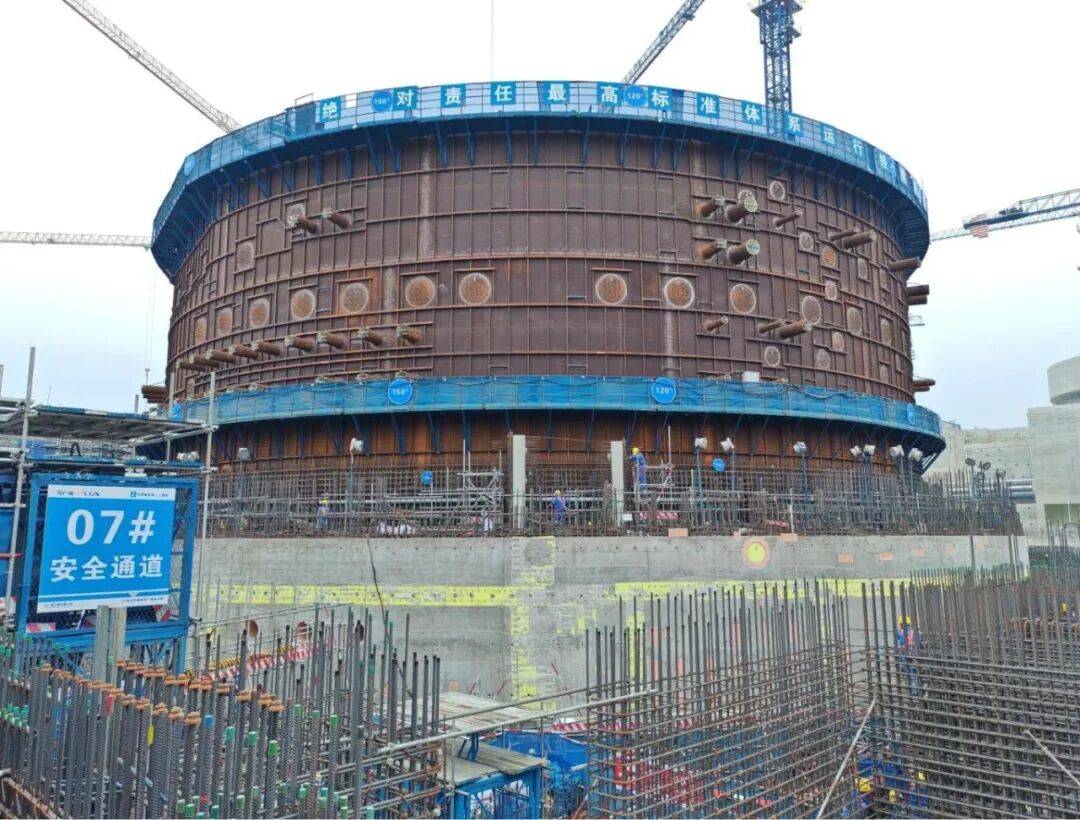
This innovative solution has resolved a long-standing industry challenge where the first three layers of the outer shell constrained the construction of the annular zones in surrounding buildings. It also sets a new record for the layered height of nuclear island containments in China's nuclear power projects, providing strong support for the balanced advancement of the reactor building and surrounding buildings, and accumulating valuable experience for optimizing the layered height of the inner containment.
The balanced advancement of the nuclear island reactor building with surrounding safety-related buildings and the fuel building has always been a key focus and challenge in the construction of standard "Hualong One" projects. Due to the narrow space of only 1.8 meters between the inner and outer shells, construction typically proceeds with the first three layers of the inner shell first, followed by the first layer of the outer shell. In traditional construction schemes, the layered height for the first layer of the outer shell is 4.1 meters. After its completion, construction can only be released for the annular zones of surrounding safety-related and fuel buildings at elevations between -9.6 meters and -4.9 meters. The construction of the annular zones for the first three layers of surrounding buildings has become a critical path for building roof closure and room handover for installation. How to better achieve "decoupling" between the outer shell and surrounding building construction is a major focus and difficulty in balancing the advancement of reactor and surrounding buildings in various Hualong projects.
Faced with this challenge, the Taipingling project team focused on "balanced advancement of the reactor building and surrounding buildings," adhering to an innovation-driven philosophy and the rigorous, prudent, meticulous, and practical work style. Through repeated construction logic simulations and scheme optimizations, they achieved simultaneous construction of the first three layers of the inner shell and the first layer of the outer shell. For the first time, the construction height of the outer shell's first layer was increased by 60% to 6.5 meters. This simultaneously released the working space for the -4.9-meter floor slab and the 0-meter floor slab in the annular zones of surrounding buildings. Compared to the traditional outer shell layered height, effective decoupling between outer shell and surrounding building construction was achieved one month earlier.
This innovative measure regarding the layered height of the reactor building outer shell for Unit 3 represents a significant breakthrough in the balanced advancement scheme for reactor and surrounding buildings in standard "Hualong One" projects. It provides valuable experience for subsequent nuclear island construction of double-shell containment units. Simultaneously, this is another important achievement from CGN Engineering's continuous efforts in technological optimization and implementing the "Five Balances" construction philosophy. It demonstrates the project team's professional capability in seeking optimal solutions under complex conditions and promoting high-quality construction.
As the outer shell construction for Unit 3 progresses steadily, the Taipingling project will continue to focus on the goals of balanced construction, safety, and quality. It will drive the coordinated development of the entire engineering construction chain through innovation, contributing the "Taipingling Solution" to the high-quality construction of CGN's nuclear power projects.