Wedoany.com Report on 9th, Low-pass electronic filters (LPF), as a core component of signal processing, continue to play a critical role in 2026 in fields such as telecommunications, automotive electronics, medical devices, and industrial automation. This technology ensures signal quality by allowing signals below a specific cutoff frequency to pass while attenuating higher frequencies.
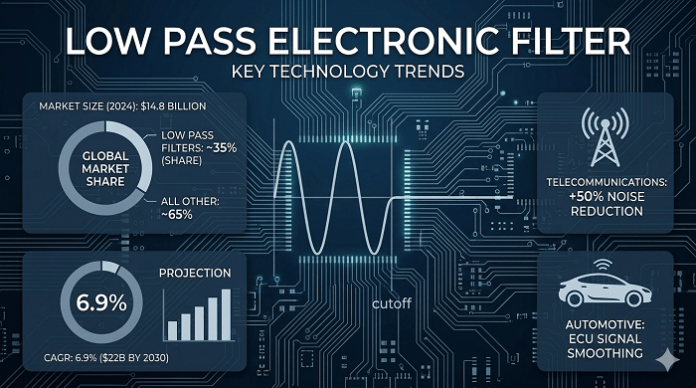
The global electronic filter market reached approximately USD 14.8 billion in 2024, with low-pass filters accounting for 32-36% of the total demand. It is projected that between 2025 and 2030, this segment will grow at a compound annual growth rate (CAGR) of 6.9%, potentially exceeding USD 22 billion by 2030. Low-pass electronic filters, with their measurable performance indicators such as cutoff frequencies ranging from 10 Hz to 10 MHz, typical roll-off rates of 20 dB/decade per order, and active LPFs consuming 5-50 mW in embedded systems, support a wide range of applications.
Data-driven insights reveal that low-pass filters in communication systems can achieve up to 70% noise reduction, improve the signal-to-noise ratio by 8-12 dB, and reduce bit error rates by 15-25%, which is crucial for the operation of 5G base stations in the 3.5 GHz to 28 GHz frequency bands. Automotive electronics applications grew by 48% between 2021 and 2025, and by 2025, approximately 63% of automotive sensor circuits integrated at least one low-pass filter for sensor signal smoothing and power supply noise filtering.
In audio systems, low-pass filters improve audio quality by filtering frequencies above 20 kHz, reducing harmonic distortion by 30-45%. In IoT devices, LPFs enhance power supply efficiency by 15-22% and reduce high-frequency switching noise by 50-60%. Medical electronic devices, such as ECG monitoring systems, also rely on LPFs to improve accuracy. Industry forecasts indicate that low-pass filters will maintain approximately a 35% market share by 2030, valued at around USD 7.8 billion. Growth drivers include 5G network expansion, IoT device deployment, and automotive electrification.
In the coming decade, low-pass electronic filters will remain crucial for ensuring clean signals, reliable performance, and optimized system efficiency, supporting applications ranging from audio systems and IoT devices to medical equipment and telecommunications infrastructure. As the electronic filter market grows from USD 14.8 billion in 2024 to over USD 22 billion by 2030, low-pass filters are expected to retain about one-third of the total market share.