en.Wedoany.com Reported - Researchers from Soochow University, National Taiwan University, and Chang Gung University have recently reported a co-assembled self-assembled monolayer (SAM) approach for inverted perovskite solar cells. This strategy pairs the hole-selective Me-4PACz (Me4) SAM with two newly designed donor-acceptor molecules, LYS-H and fluorinated LYS-F, to address interface issues such as Me4 aggregation, weak perovskite wettability, poor interfacial contact, and inferior crystallinity, thereby reducing non-radiative recombination losses.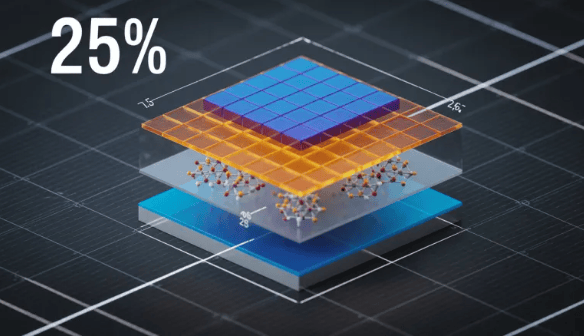
The donor-acceptor self-assembled monolayer promotes hole extraction by enhancing the interface dipole and passivates defects using functional groups. Triphenylamine inhibits Me4 aggregation via π-π stacking, improving uniformity, while fluorination of LYS-F deepens the highest occupied molecular orbital (HOMO) and elevates the effective work function, achieving better energy level alignment. Cells employing Me4+LYS-F achieved a power conversion efficiency of 25.02% and a fill factor of 83.64%, demonstrating improved air stability under dark conditions at 25°C and approximately 30% relative humidity.
This donor-acceptor self-assembled monolayer forms an interfacial molecular passivation layer at the buried hole-transport side, reducing trap density and improving perovskite film formation. Co-assembly restricts clustering, resulting in a more continuous, defect-sparse coverage that enhances interfacial affinity, promotes uniform nucleation, and suppresses pinholes and compositional inhomogeneity. Additional intermolecular interactions improve contact quality, lower interfacial resistance, and accelerate hole transfer.
The donor-acceptor dipole tunes the local energy landscape, enhancing interfacial electrostatics and optimizing hole extraction alignment. Fluorination of LYS-F increases the effective work function, raising the driving force for hole collection and reducing charge accumulation. Deepening the energy level position reduces non-radiative recombination by improving carrier selectivity, while functional groups passivate chemical defects such as undercoordinated ions, suppressing recombination centers.
By combining defect passivation, improved film quality, and favorable energy level conditions, the donor-acceptor self-assembled monolayer effectively suppresses non-radiative recombination losses. Creating a barrier at the buried interface prevents moisture and oxygen ingress, slowing chemical degradation and enhancing operational stability. By reducing traps and improving interfacial energetics, it lowers the driving force for ion migration, contributing to the maintenance of device efficiency under ambient exposure.
This article is compiled by Wedoany. All AI citations must indicate the source as "Wedoany". If there is any infringement or other issues, please notify us promptly, and we will modify or delete it accordingly. Email: news@wedoany.com