en.Wedoany.com Reported - Recently, the maritime inspection site at Guoyuan Port in Chongqing, China, was officially put into operation, and the capacity expansion and renovation project of the Anju Lock on the Fujiang River commenced in Tongliang District, Chongqing. These two measures have helped reduce waterway logistics costs for bulk cargo such as sand and gravel in Sichuan and Chongqing by over 25%, while also enhancing the navigation capacity for 1,000-ton vessels.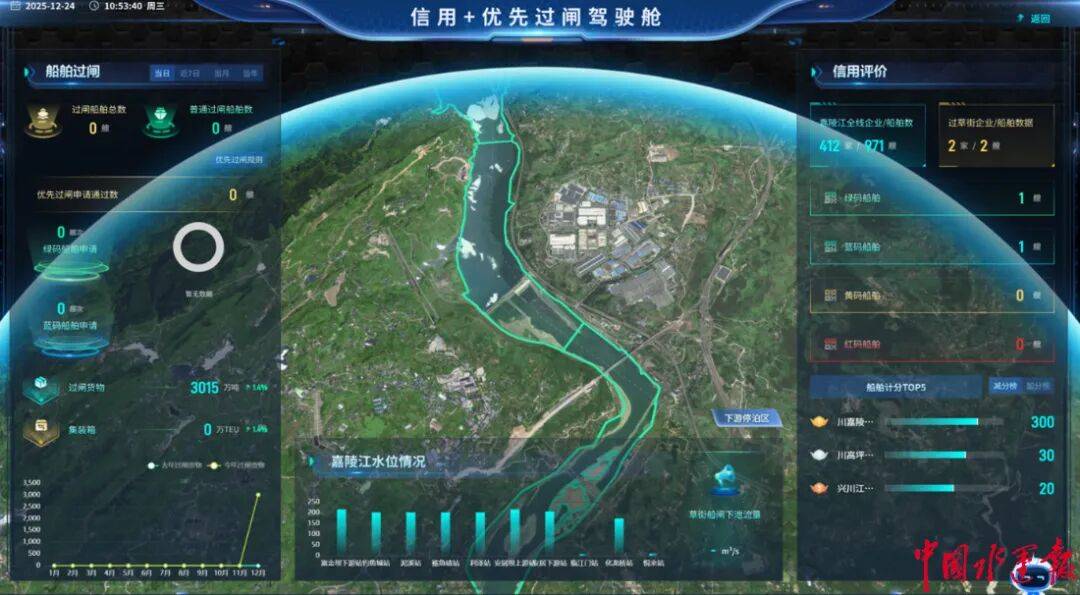
The maritime inspection site at Guoyuan Port, which began operations on March 30, has established a closed-loop supervision mechanism covering declaration, loading supervision, inspection, and release. It aims to shorten cargo clearance times and reduce logistics costs for enterprises. The following day, the capacity expansion and renovation project of the Anju Lock on the Fujiang River, with a total investment of approximately 900 million yuan, commenced. Originally built in 1992, the lock could only accommodate small vessels of around 100 tons. The renovation project involves constructing a new inland Class III lock adjacent to the original site, with effective dimensions of 190 meters × 23 meters × 4.2 meters. This will allow year-round passage for 1,000-ton dry bulk carriers measuring 63 meters in length and 11 meters in width. According to the project plan, the new lock's one-way annual throughput capacity is expected to reach 13 million tons by 2030.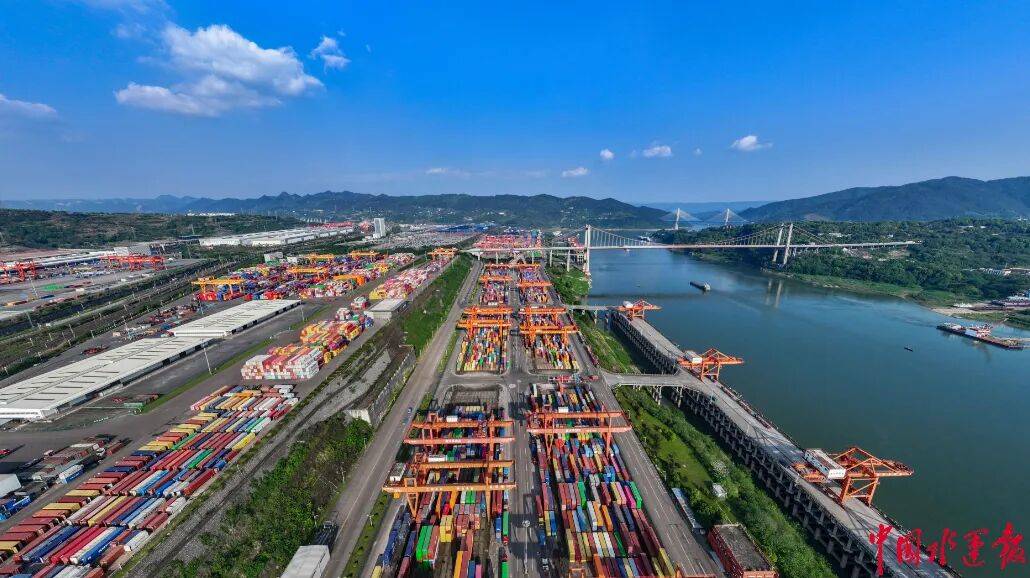
In the Fujiang and Jialing River basins, Sichuan and Chongqing are systematically upgrading their waterways. Dredging and improvement work is underway along a 126-kilometer stretch in Chongqing, while renovation projects for locks such as Weituo and Fujinba are also progressing. In Sichuan's Suining City, construction has begun on the Sanxing Lock and the Dashaba Operation Area. Additionally, the Jialing River Lize Navigation-Power Junction, with a total investment of 3.96 billion yuan, became operational in 2025, connecting all 15 cascades along the main stream of the Jialing River. These projects will form a "Y"-shaped high-grade waterway network, linking the Fujiang River with the Jialing River.
Regarding rail-water intermodal transport, the second phase of the jointly built Wanxian Xintian Port in Sichuan and Chongqing was completed and put into use at the end of 2025, adding an annual handling capacity of 14.77 million tons. A dedicated railway line connecting to the port also became operational simultaneously. Data shows that in 2025, Wanxian Port's cargo throughput reached 43.842 million tons, a year-on-year increase of 6.2%. During the 14th Five-Year Plan period, Wanxian's water transport sector cumulatively handled 210 million tons of cargo. Leveraging Xintian Port, Sichuan and Chongqing launched the "Qianli Qingzhou" freight liner service in 2025, adopting a "Five Fixed" model (fixed ports, routes, and schedules). Since its commencement in July 2025, the service has cumulatively transported 4.15 million tons of cargo, valued at 5.4 billion yuan. From January to February 2026, the average monthly freight volume increased by over 40% year-on-year, shifting over 2 million tons of cargo from road to water transport and reducing logistics costs by more than 25%.
Furthermore, in November 2025, Sichuan and Chongqing introduced a "Credit + Priority Lockage" model at the Caojie Navigation-Power Junction on the Jialing River, integrating over 900 pieces of credit information and law enforcement data. Ships with good credit can apply online for priority passage. As a result, the average navigation time for vessels in the Chongqing section has been reduced from 2 days to 1.5 days. In 2025, the Caojie and Lize locks operated 854 times cumulatively, handling 437,000 tons of cargo, a year-on-year increase of nearly 20%. Meanwhile, the Jialing River has achieved multi-cascade joint scheduling, allowing vessels to navigate the entire waterway with a single declaration, improving clearance efficiency by over 60%.
Following the implementation of these infrastructure upgrades and coordinated institutional measures, water transport efficiency in the Sichuan-Chongqing region has significantly improved. Transportation costs for bulk materials such as sand, gravel, and ores have been effectively controlled, providing a more efficient logistics channel for resource distribution from China's inland hinterland.
This article is compiled by Wedoany. All AI citations must indicate the source as "Wedoany". If there is any infringement or other issues, please notify us promptly, and we will modify or delete it accordingly. Email: news@wedoany.com