en.Wedoany.com Reported - On May 26, the left tube of the Jinyang Tunnel, the longest tunnel on the Xichang-Zhaotong Expressway, was successfully holed through. The project was invested and constructed by China Railway City Investment, designed by China Railway Eryuan Engineering Group, and built by China Railway Tunnel Group, laying a solid foundation for the full line to be completed and opened to traffic on schedule.
The Jinyang Tunnel is a key control project of the Xichang-Zhaotong Expressway. With a total length of 12,180 meters, it features a dual-direction, dual-tube separated design and a maximum burial depth of 1,723 meters, making it the longest highway tunnel in China with a burial depth exceeding 1,500 meters. Located in the hinterland of the Daliang Mountains at the junction of Sichuan and Yunnan provinces, the terrain is steep and rugged, crisscrossed by ravines and gullies, with a complex geological environment. Construction required traversing 27 sets of strata including phyllite, siltstone, sandstone, shale, and dolomite, 43 lithological contact zones, and multiple canyon fault zones, making it the tunnel that passes through the most strata in China. Grade IV and V surrounding rock accounts for 85% of the total, groundwater is abundant, and the daily water inflow reaches over 90,000 cubic meters. The construction process had to overcome numerous risks and challenges such as hard rock bursts, large deformation of soft rock, mud and water inrushes, and toxic and harmful gases, vividly described by the builders as a tunnel "geological museum."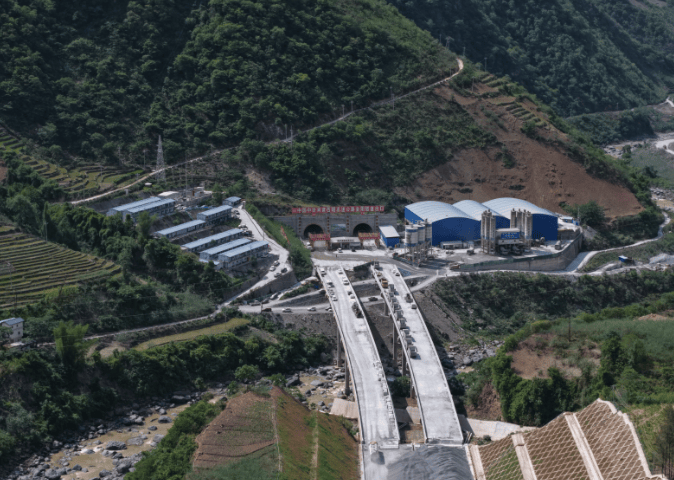
Facing the complex geological environment, the project adhered to scientific measures and technological empowerment, strictly implementing refined management requirements. Over more than five years, various construction challenges were successfully overcome. From the very beginning, the project organized multiple expert meetings to continuously optimize the construction plan. When facing high-pressure, water-rich operations, the project persisted with water drainage and pressure reduction to quickly open up the construction situation. When facing hard rock bursts, large deformation of soft rock, and dolomite and phyllite that disintegrate upon contact with water, the project adhered to the principles of "advance pipe support, strict grouting, short excavation steps, strong support, weak blasting, rapid closure, and frequent monitoring," establishing a full-process control system of advance geological forecasting, intelligent monitoring and measurement, graded support, and dynamic grouting, effectively ensuring construction progress. When facing the risk of three types of toxic and harmful gases, closed-loop management including enhanced ventilation, dual monitoring, quicklime neutralization, and special-grade protection was implemented, firmly holding the bottom line of safety and quality.
The Xichang-Zhaotong Expressway is an important component section of the Duyun-Shangri-La Expressway, connecting Zhaotong City in Yunnan Province and Xichang City in Sichuan Province. The total route length is 182.622 kilometers, and the entire line is constructed to four-lane expressway standards with a design speed of 80 kilometers per hour. After the project is completed and opened to traffic, it will form a transportation network with Jinyang as the hub, connecting to Panzhihua in the south, Yibin in the north, Zhaotong in the east, and reaching Leshan via Zhaojue in the west, and directly to Shangri-La via Xichang. This will further strengthen the connection between the Chengdu Economic Zone, the Southern Sichuan Economic Zone, and the Panxi Economic Zone, and is of great significance for consolidating the achievements of poverty alleviation in the ethnic minority areas of Liangshan Yi Autonomous Prefecture, comprehensively promoting the rural revitalization strategy, facilitating external cultural exchanges and integration, and improving the expressway network in Southwest China.
This article is compiled by Wedoany. All AI citations must indicate the source as "Wedoany". If there is any infringement or other issues, please notify us promptly, and we will modify or delete it accordingly. Email: news@wedoany.com