en.Wedoany.com Reported - On May 26, with the precise installation of the 13th steel-concrete composite beam segment and the 15th pair of stay cables, the superstructure construction of the Hanjiang Grand Bridge—the control project of the Wuhan-Jingmen-Yichang Expressway, invested by Hubei Communications Investment Group and constructed by CCCC First Highway Engineering Group—successfully passed the halfway mark. This marks a breakthrough in the bridge's construction, laying a solid foundation for the full connection of the Wuhan-Jingmen-Yichang Expressway.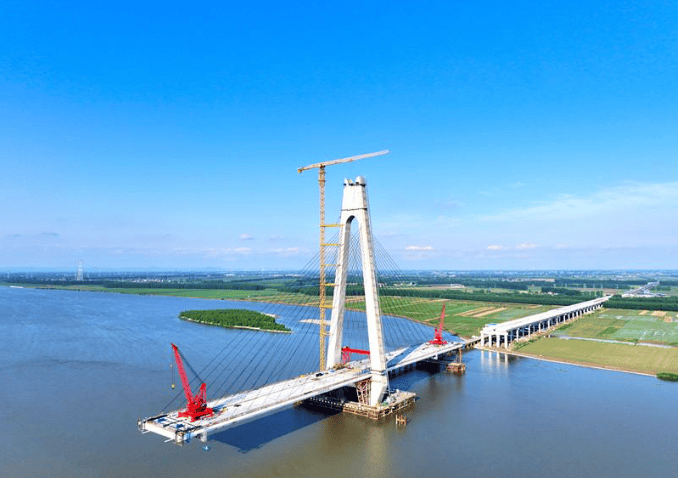
The Hanjiang Grand Bridge has a total length of 660 meters and is China's largest span single-pylon cable-stayed bridge with a composite girder and no auxiliary piers. The bridge is designed with 54 pairs of stay cables and 57 steel-concrete composite beam segments, with a maximum single-segment weight of 430 tons.
The standard bridge segment is 12 meters long and 37 meters wide, assembled from side boxes, longitudinal and transverse beams, wind fairing skirts, and six C60 high-performance bridge deck panels. The standard segment slab thickness is 26 centimeters, demanding extremely high engineering precision and quality standards.
As the most technically complex and difficult control project along the entire Wuhan-Jingmen-Yichang Expressway, the Hanjiang Grand Bridge has faced multiple challenges since construction began, including complex geological conditions in the Hanjiang River basin, stringent ecological and environmental protection requirements, and a tight construction schedule. The construction team has adhered to the philosophy of "technology-led, precision-empowered, and craftsmanship-built," focusing on construction milestone targets and concentrating efforts to overcome difficulties and advance the project.
During the construction process, the team vigorously promoted technological innovation and process optimization, precisely solving multiple industry construction challenges. To address the characteristics of multi-process cross-operation, the project coordinated collaborative operations among multiple teams and units, including steel structure processing, steel girder installation, stay cable layout, wet joint construction, and steel girder coating. They implemented refined time-sequence management, breaking down construction tasks by the hour, strictly enforced a standardized process handover form system, comprehensively standardized the construction workflow, and consolidated construction responsibilities to ensure seamless process connection.
Meanwhile, by optimizing core technologies such as the steel girder hoisting process and upgrading the UHPC wet joint curing process, the construction team increased the construction efficiency of the main girder's standard segments by 30% while strictly adhering to safety bottom lines and rigorously controlling project quality. This significantly enhanced construction quality and efficiency, achieving an "acceleration" in project construction.
It is understood that the Wuhan-Jingmen-Yichang Expressway is an important east-west corridor in Hubei. The entire route is located within Jingmen territory, with a total length of 44.14 kilometers. Upon completion, the project will seamlessly connect the Wuhan Metropolitan Area with the Chengdu-Chongqing Economic Zone, further strengthening the interconnection between the middle reaches of the Yangtze River city cluster and the western region. It will help Hubei integrate into the new "dual circulation" development paradigm and holds positive significance for promoting the high-quality development of the Yangtze River Economic Belt.
This article is compiled by Wedoany. All AI citations must indicate the source as "Wedoany". If there is any infringement or other issues, please notify us promptly, and we will modify or delete it accordingly. Email: news@wedoany.com