en.Wedoany.com Reported - On June 1, NVIDIA partnered with China's Unitree Robotics to launch the H2 Plus humanoid robot reference design. Based on the NVIDIA Isaac GR00T development platform, this robot is aimed at universities, research institutions, and robot developers to accelerate the research, development, and validation of humanoid robots.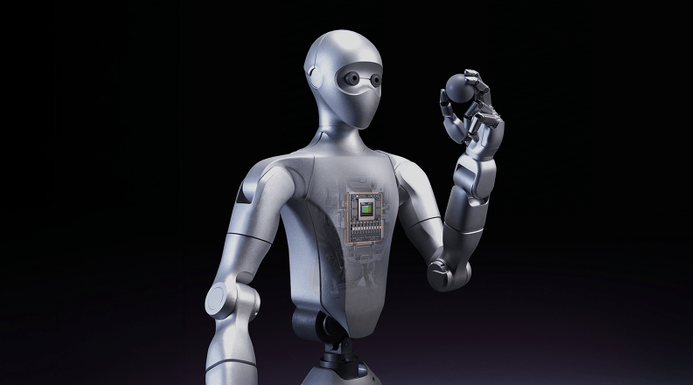
The H2 Plus utilizes Unitree Robotics' humanoid robot body, combined with the Sharpa five-finger dexterous hand, NVIDIA Jetson Thor onboard computing, and the Isaac GR00T open software and workflows, forming a complete reference platform from hardware body, edge computing, data collection, simulation training, model evaluation, to real-world deployment. According to official NVIDIA information, this reference design integrates the robot's "body" and "brain" into a single system, helping research teams shorten the cycle from robot debugging to skill development and real-world scenario validation. For universities and laboratories, the role of such humanoid robot reference designs is to reduce the workload of underlying integration, enabling researchers to focus on experiments involving motion control, environmental perception, dexterous manipulation, task planning, and physical AI model training. Research institutions such as the Stanford Robotics Center, ETH Zurich, and UC San Diego will use this reference design to advance cutting-edge humanoid robot research, indicating that the platform is primarily aimed at scientific research and development processes, rather than direct large-scale commercial sales.
Based on publicly available parameters, the H2 Plus is approximately the height of an adult human, about 1.8 meters, and weighs approximately 68 kilograms. The robot body has 31 degrees of freedom, and its hands are five-finger dexterous hands designed to enhance grasping and manipulation capabilities.
The humanoid robot industry is transitioning from a phase of competing with single hardware prototypes to competing with system platforms. In the past, R&D teams often had to separately address issues such as body selection, sensor adaptation, computing deployment, simulation environments, data collection, model training, and real robot validation. The interfaces between different stages were complex, leading to high redundant investment. By packaging Isaac GR00T, Jetson Thor, and open development workflows into the H2 Plus reference design, NVIDIA is essentially establishing a more unified entry point for humanoid robot development. Meanwhile, Unitree Robotics, leveraging its own expertise in humanoid robot bodies, joint control, and motion capabilities, is entering the international research platform ecosystem. As physical AI moves from software models to real robots, whether humanoid robots can undertake tasks in industrial assistance, laboratory operations, service scenarios, and complex environments depends on the synergistic maturity of hardware stability, edge inference capabilities, dexterous hand control, data loops, and developer ecosystems. The launch of the H2 Plus moves humanoid robot R&D from "demonstrating a machine" further towards "providing a reusable platform."
Information released by Unitree Robotics indicates that the H2 Plus is expected to begin supply by the end of 2026, and the development workflow for Isaac GR00T targeting the Unitree G1 will also be gradually released on GitHub and Hugging Face. Subsequent variables will focus on the platform's openness, actual usage feedback from research institutions, robot safety mechanisms, cost control, and the ability to generalize tasks across multiple scenarios.
This article is compiled by Wedoany. All AI citations must indicate the source as "Wedoany". If there is any infringement or other issues, please notify us promptly, and we will modify or delete it accordingly. Email: news@wedoany.com