en.Wedoany.com Reported - Google recently published a technical blog post detailing how the rise of AI is reshaping its network architecture. The post points out that as services like Gemini, Veo, Search, and Cloud AI increasingly rely on tightly integrated network systems designed for massive east-west traffic, low latency, and high resilience, the network has become a foundational layer of the AI system itself. Amin Vahdat elaborates on this transformation in the blog.
Google now views AI infrastructure as an unprecedented distributed computing platform. Training and inference workloads are spanning multiple clusters, buildings, and even campuses, requiring massive data transfer across interconnected structures with predictable latency. Google describes an architecture that integrates resources across locations, forming what it calls a large-scale AI "supercomputer." This necessitates close coordination between cluster networks, regional optical transport, and the global wide area network. Google's private backbone network already covers over 7.75 million kilometers of terrestrial and submarine cable systems, reaching more than 200 countries and regions to support globally distributed AI workloads.
The blog post notes that AI is blurring the traditional boundaries between data center networks and wide area networks. Historically, data center structures were optimized for short-range east-west traffic within buildings, while wide area networks handled long-distance connections between regions. Today, large model training generates synchronous traffic among thousands of accelerators, often extending beyond a single pod or campus. This requires bandwidth scaling, congestion management, optical capacity planning, and traffic engineering to operate as a unified system. Google views this as an architectural convergence between switching, routing, optical transport, and software-defined control.
Software plays a key role in orchestrating these networks. Google points out that the placement of AI workloads increasingly relies on intelligent traffic management across multiple layers of infrastructure. Software-defined networking is used to balance traffic, isolate faults, optimize latency, and dynamically allocate capacity among competing workloads. This is particularly important for large-scale distributed training, where the slowest link in a synchronized cluster can impact overall model performance. Google's network control plane is increasingly acting as an orchestration layer between compute and transport.
The blog also highlights the importance of hardware innovation in AI networks. Google mentions investments in custom networking chips, hardware acceleration, and direct memory access technologies to minimize latency and improve throughput between compute resources. This aligns with the trend among hyperscale cloud providers toward RDMA-based networks, optically scaled fabrics, and high-radix switching architectures designed for AI clusters. The blog stays at the system level without delving into specific product details, but reflects an industry shift where networks are co-designed with accelerators, memory systems, and storage.
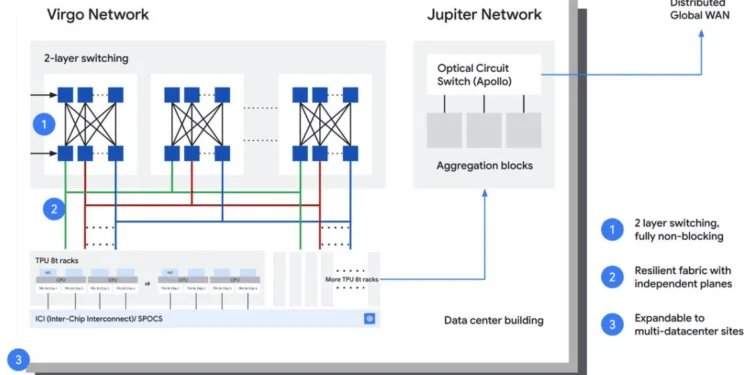
Google's architecture is closely aligned with its broader AI supercomputer initiative, including the Virgo scaling fabric launched at Cloud Next. This platform connects TPU and GPU resources at scale and allows workloads to be distributed across data center boundaries. Similar approaches are seen across the industry, including NVIDIA's NVLink and InfiniBand-based AI fabrics, Meta's large-scale AI cluster networks, Microsoft's Azure AI backbone, and AWS's work on EFA and custom optical networks. Google's contribution demonstrates how these concepts extend from clusters to metropolitan and global infrastructure.
Key takeaways from the blog include: Google positions the network as a core architectural component of AI systems, not just a supporting transport layer; AI workloads increasingly run across multiple clusters and campuses, requiring extremely high-capacity interconnects; the traditional separation between data center structures and wide area network architectures is narrowing as east-west AI traffic expands geographically; Google relies on software-defined traffic engineering to optimize performance and workload placement across network layers; network resilience remains central, with routing diversity and fault isolation built into data center, regional, and backbone infrastructure; the company continues to invest in custom networking hardware and high-performance transport to support low-latency AI communication; Google's architecture supports both internal AI workloads and external Google Cloud customers using the company's AI supercomputer infrastructure.
"AI workloads are changing the scale and shape of infrastructure requirements at every layer of the network," the Google engineering team wrote, describing an environment where data center networks and global backbone infrastructure increasingly operate as a single distributed system.
This article is compiled by Wedoany. All AI citations must indicate the source as "Wedoany". If there is any infringement or other issues, please notify us promptly, and we will modify or delete it accordingly. Email: news@wedoany.com