en.Wedoany.com Reported - STMicroelectronics, at its recent Global Imaging Media Briefing, detailed its vision for imaging technology in the AI era and launched two new products: a compact direct Time-of-Flight (dToF) 3D LiDAR module for edge AI systems, and a series of 5-megapixel CMOS image sensors. Targeting applications such as robotics, industrial automation, automotive safety, smart buildings, wearables, and the Internet of Things, these products aim to accelerate the deployment of intelligent vision systems, bringing data processing closer to the edge while enhancing privacy and reducing system complexity.
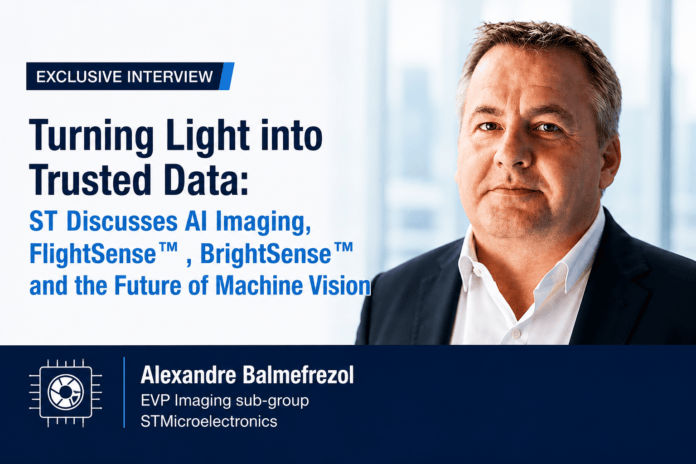
Alexandre Balmefrezol, Executive Vice President of the Imaging Sub-Group at STMicroelectronics, noted that artificial intelligence is fundamentally changing the role of image sensors. In the past, sensors were primarily used to capture high-quality images for human viewing; today, they are required to provide machine-interpretable information, enabling them to perceive their environment and make decisions in real time. At ST, imaging sensors are evolving into intelligent sensing devices capable of depth sensing, human presence detection, biometric authentication, and context awareness. The data they generate can be processed locally by AI algorithms, supporting applications such as autonomous robots, industrial inspection, and smart buildings.
ST's strategy is to avoid the highly commoditized competition of traditional RGB image sensors, instead focusing on specialized sensing technologies that offer greater system-level value. Its product line revolves around three series: FlightSense for Time-of-Flight depth sensing, BrightSense for computer vision, and SafeSense for automotive safety. Unlike other manufacturers, ST operates as an Integrated Device Manufacturer (IDM), controlling the entire process from pixel design and CMOS process to packaging, optics, and system integration. Combined with STM32 microcontrollers and software support, ST provides complete sensing solutions rather than standalone image sensors, helping customers reduce integration complexity and accelerate development.
The newly launched VL53L9 FlightSense module is ST's first fully integrated all-in-one Time-of-Flight module. This device integrates a SPAD sensor, laser source, optics, on-chip processing, power management, and factory calibration into a compact module, significantly reducing engineering complexity for customers. The module achieves an indoor ranging distance of up to 9 meters, operates at speeds up to 100 frames per second, supports 54×42 sensing zones, and offers 1-degree angular resolution, capable of detecting objects as close as 5 centimeters. The depth information it generates is low-resolution data, focusing on object shape and distance rather than personal identity, enabling privacy-preserving occupancy detection, people counting, and fall detection.
During the briefing, ST demonstrated advanced AI processing running on an STM32H5 microcontroller. Using data from the FlightSense module, the system simultaneously detects human presence, identifies falls, discerns body postures, and counts multiple people, operating at 30 frames per second while consuming limited memory and flash resources. This demonstrates that complex AI workloads are increasingly being shifted to low-power edge devices, reducing power consumption, latency, and system costs while enhancing privacy.
For machine vision, ST introduced the new BrightSense series of 5-megapixel CMOS image sensors. This series features 2.25-micron large pixels to improve sensitivity while maintaining low noise. Its most notable innovation is hybrid shutter technology, allowing the same sensor to operate in both rolling shutter and global shutter modes. Rolling shutter is used for traditional imaging, while global shutter eliminates motion distortion from fast-moving objects. The sensor also supports RGB, monochrome, and near-infrared imaging, targeting applications in industrial automation, machine vision, and smart city surveillance. ST also highlighted the key role of metasurface optics and 3D stacking technology in enhancing sensor performance and reducing system size. Metasurface optics use ultra-thin optical structures to control light, while 3D stacking separates imaging pixels from processing circuits, enabling more compact modules and integrating advanced image processing functions.
ST believes that the primary opportunities for its AI imaging technology lie in areas requiring reliable visual perception but constrained by power and computational resources, such as industrial robots, autonomous mobile robots, humanoid robots, AR/VR devices, and advanced automotive systems. Looking ahead, the company envisions that vision sensors will no longer transmit large volumes of raw image data but will instead perform data processing locally. This architecture favors lower resolution, lower power consumption, and embedded AI processing. Sensors will evolve into intelligent perception systems, passing only the most relevant information to the main processor, thereby enabling a new generation of autonomous and connected devices.