Chinese Academy of Sciences Proposes AI Planning Domain Generation and Closed-Loop Repair Method for Industrial Robots
en.Wedoany.com Reported - A research team from the Shenyang Institute of Automation, Chinese Academy of Sciences, has proposed an AI large language model-driven planning domain generation and closed-loop repair method to address the failure of planning models in industrial manufacturing robots.
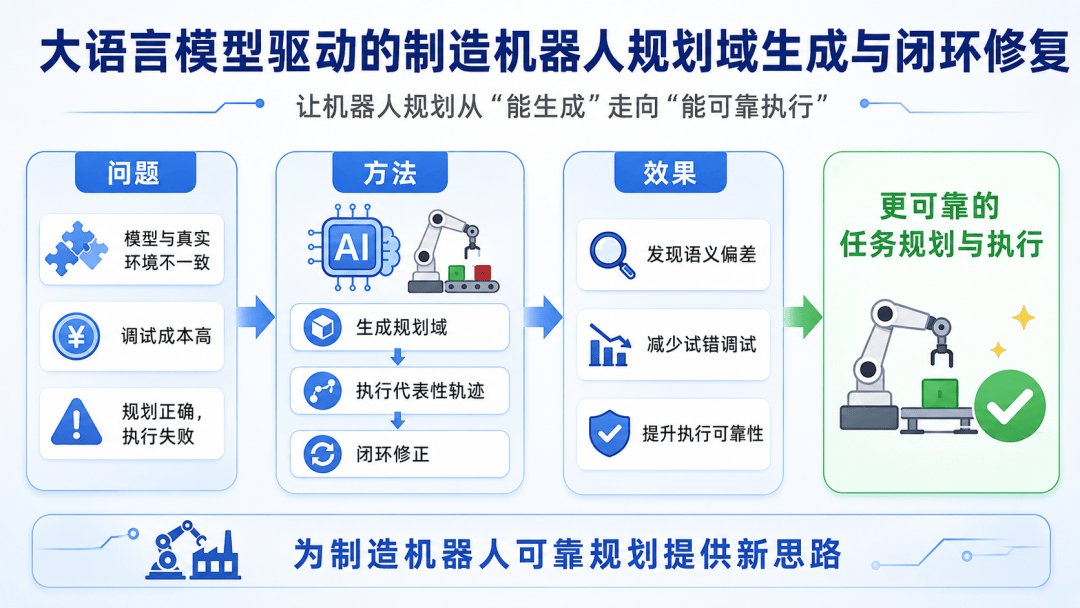
In industrial intelligent manufacturing scenarios, motion planning schemes for industrial manufacturing robots generated by AI large language models often meet logical reasoning requirements and show no obvious flaws in simulation results, yet frequently fail during actual execution. Researchers point out that the planning model acts as a task instruction manual for the robot; even slight omissions in textual descriptions can easily lead to misunderstandings and execution deviations. If subtle discrepancies exist between semantic descriptions such as preconditions and action outcomes in the model and the real-world environment, faults are likely to occur. Particularly in complex manufacturing environments with long task sequences, strong action correlations, and numerous on-site disturbances, the "understanding gap" between the planning model and the physical environment becomes a key factor affecting system stability and efficiency. Traditional methods relying on manual inspection, repeated trial and error, and experience-based patching struggle to adapt to the frequently changing task requirements in flexible manufacturing scenarios.
The new method proposed by the research team starts with the initial planning generated by the large language model, selects representative execution trajectories, and then combines execution feedback from the real environment to compare "planned predictions" with "actual execution results." This identifies "understanding deviations" in the model and guides it to gradually correct and improve. According to the research team, this method does not require the robot to "stumble" upon correct answers through extensive random trial and error; instead, it enables the model to learn "where the errors are and how to fix them" through a small amount of effective feedback, thereby improving accuracy and efficiency while meeting industrial requirements for stability, efficiency, and cost.
This research not only makes the execution of individual planning tasks more reliable but also establishes a continuous correction mechanism for industrial manufacturing robots to "adapt to real environments," shifting robots from "being able to automatically generate planning models" to "making planning models usable in real environments." This method provides a reliable technological improvement path for AI large language model-driven manufacturing automation systems and supports autonomous decision-making and task execution for robots in intelligent manufacturing scenarios.
Related Products

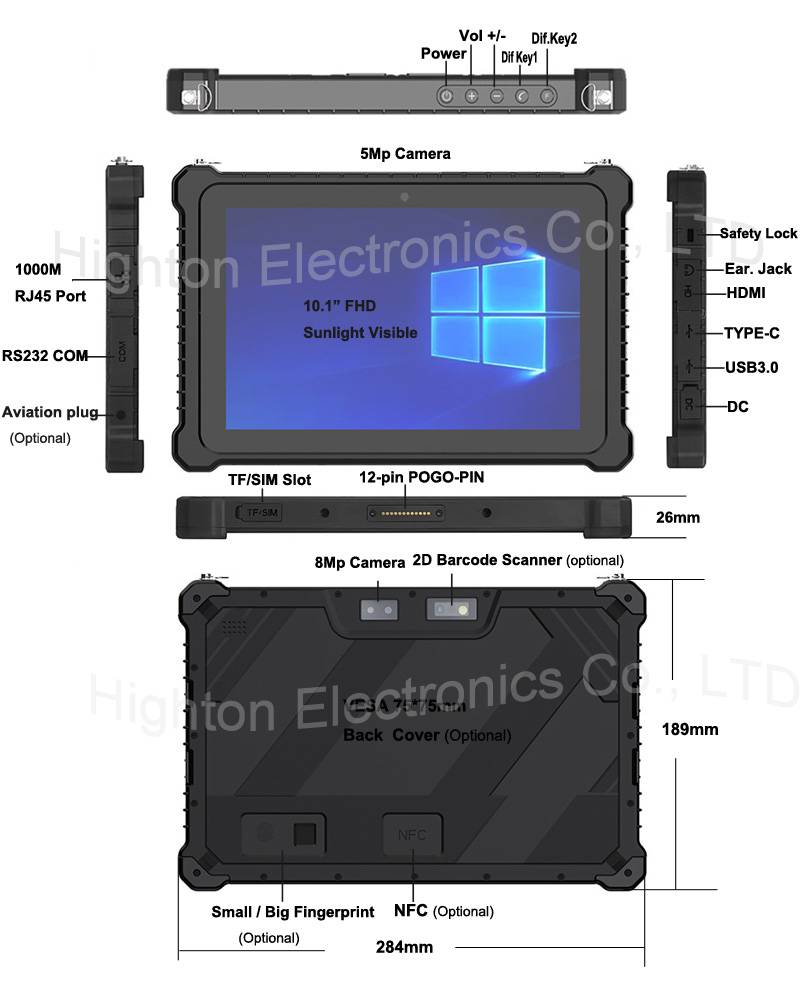
Hot Selling 10 Inch Intel N5100 I5 I7 FHD 8 +128GB 16+256GB Win10 Pro Win11 Pro 4G 5G Rugged Tablet PC Pad with NFC Barcode
Highton Electronics Co., Ltd.
GYTA Type Non-Self-Supporting Aerial/Duct Optical Cable
TONGDING INTERCONNECTION INFORMATION CO., LTD.
Mine Explosion-proof and Intrinsically Safe Industrial Ethernet Ring Network (10 Gigabit/Gigabit)
Chongqing Mas Sci&Tech Co., Ltd.
Flat Portable Satellite Terminal 0.35m Aperture Manual Portable Terminal
China Starwin Science & Technology Co., Ltd.
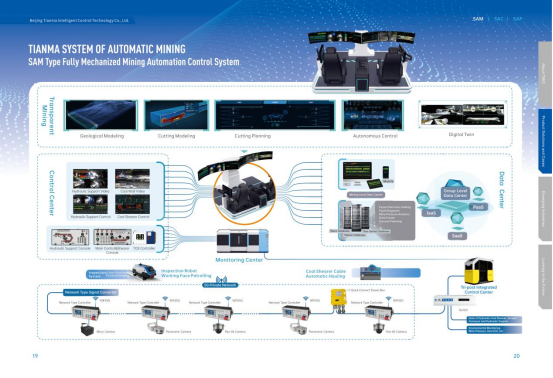
Comprehensive Mining Automation Control System
Beijing Tianma Intelligent Control Technology Co., Ltd.