en.Wedoany.com Reported - The switch belongs to the Quantum-X Q3450-LD series, based on the InfiniBand architecture, featuring a 4U form factor with 144 800G ports and a non-blocking switching capacity of 115.2 terabits per second (Tb/s). The device adopts a liquid cooling solution, equipped with two internal loops and four UDQ4 liquid cooling interfaces. NVIDIA employs silicon photonics technology this time to enhance bandwidth and improve connection performance between servers in large GPU clusters.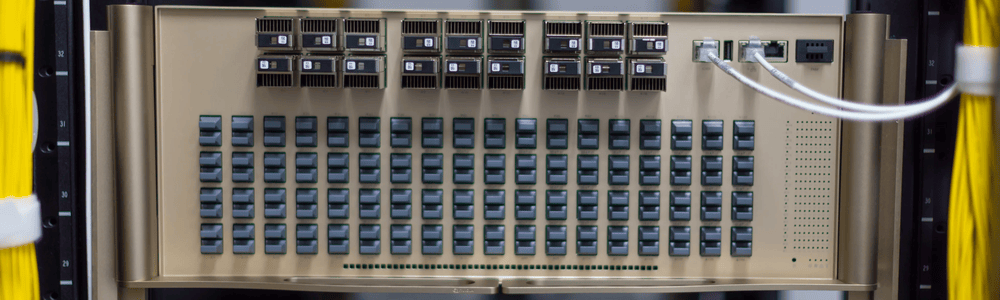
Lambda's engineering team noted that a key advantage of the CPO switch is energy efficiency. Traditional switches require a large number of pluggable transceivers, whereas the CPO switch integrates optical engines internally with four ASICs, eliminating the need for these components. The switch uses fiber array connections, with 18 detachable light source modules providing signals to MPO (Multi-Fiber Push-On) ports, significantly shortening the circuit path between optics and ASICs, thereby reducing latency and signal loss. Rich Underwood, Lambda's HPC system architect, cited an example: a traditional 72-port switch requires 72 transceivers, each consuming 25 watts, while the CPO solution can significantly reduce power consumption. Ashkan Seyedi, Director of Networking at NVIDIA, explained the working principle of CPO, noting that electrical signals are immediately converted to the optical domain on the package, reducing the length of electrical channels. He emphasized that reducing the number of lasers, eliminating digital signal processors (DSPs), and ensuring fiber cleanliness can accelerate system deployment.
Beyond power advantages, the Lambda team believes CPO technology can also improve network reliability by removing transceivers, thus eliminating a potential point of failure. Underwood estimated that in a 128k GPU-scale super intelligent cloud cluster, a traditional solution would require 5 million lasers, while the CPO solution would need only 1 million. The power savings directly translate into more available GPUs and computing time. TSMC is manufacturing CPO versions of NVIDIA's Quantum-X and Ethernet-based Spectrum-X switches, with both companies collaborating on photonic integrated circuits.
Despite adopting CPO, NVIDIA still plans to continue using copper cables. Its CEO, Jensen Huang, confirmed in a GTC keynote that copper cables will have a place in its interconnect solutions, including the next-generation Feynman architecture. Gilad Shainer, Senior Vice President of Networking at NVIDIA, explained that using both technologies is about "doing the right design," noting that copper cable transmission consumes zero power and is passive, so copper cables will be prioritized whenever possible.

This article is compiled by Wedoany. All AI citations must indicate the source as "Wedoany". If there is any infringement or other issues, please notify us promptly, and we will modify or delete it accordingly. Email: news@wedoany.com