en.Wedoany.com Reported - Recently, Australian wireless chip company Morse Micro launched the MM8108-M20 high-power Wi-Fi HaLow module for the U.S. and Canadian markets. Designed around the North American 902–928 MHz frequency band, the product targets industrial sites, smart buildings, utilities, and long-range IoT terminals, aiming to bring low-power, long-distance connectivity scenarios—where traditional Wi-Fi struggles—into the more mature Wi-Fi ecosystem.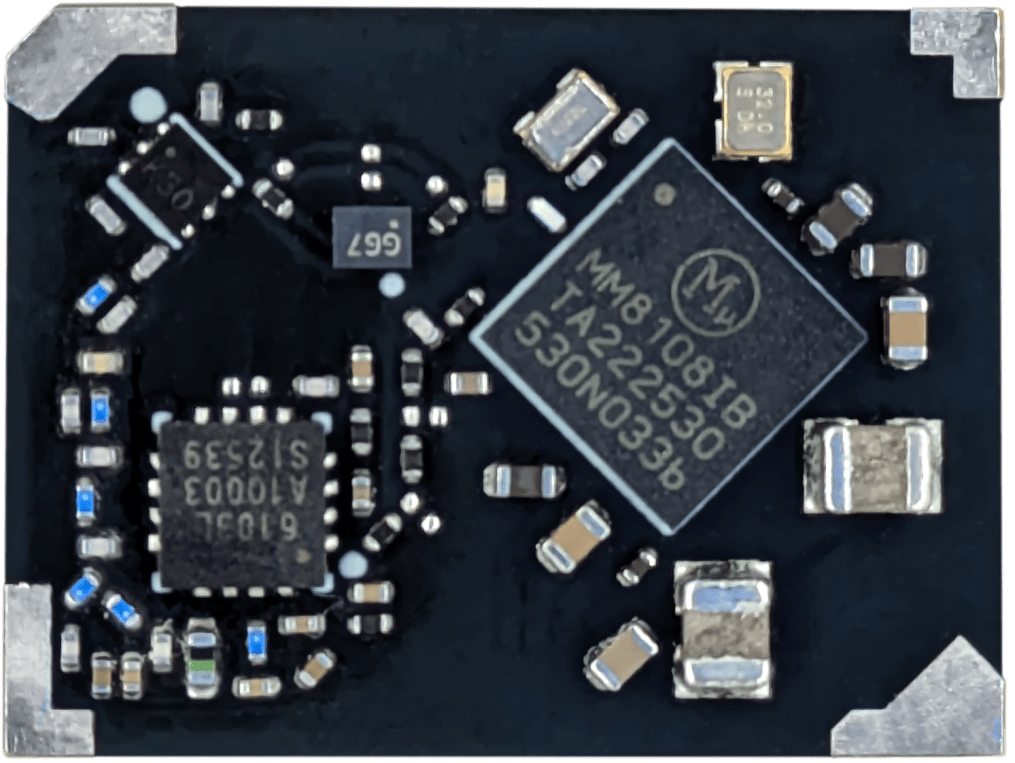
The MM8108-M20 is built on Morse Micro's second-generation MM8108 Wi-Fi HaLow system-on-chip, with module dimensions of 18.5 mm × 14 mm, supporting 1 MHz, 2 MHz, 4 MHz, and 8 MHz channel bandwidths. Unlike conventional short-range Wi-Fi connections, Wi-Fi HaLow is based on the IEEE 802.11ah standard and operates in the Sub-GHz frequency band, focusing on IoT devices that are more sensitive to coverage distance, penetration capability, and terminal power consumption. Morse Micro has integrated a high-power amplifier and a surface acoustic wave filter tuned for the North American frequency band into the module solution, achieving a maximum transmit output power of 28.5 dBm. This allows device developers deploying cameras, sensors, access points, metering equipment, and embedded gateways to reduce complexity in RF design, certification adaptation, and system integration.
This module has obtained FCC and IC certifications and can provide samples for device development processes in the United States and Canada.
From an application perspective, the MM8108-M20 is not just an additional wireless connectivity option for terminal manufacturers. Many warehouse parks, energy facilities, building spaces, agricultural scenarios, and urban infrastructure in North America face challenges such as long connection distances, numerous obstructions from walls or equipment, and scattered node counts. Traditional Wi-Fi has limited coverage, while cellular connectivity costs and power consumption may not be suitable for large-scale low-speed nodes. Wi-Fi HaLow can expand coverage radius under lower power consumption while continuing to leverage IP networking and the security, access, and management capabilities of the Wi-Fi ecosystem. This makes it more attractive to device manufacturers looking to upgrade legacy sensor networks into connectable, manageable, and mass-producible solutions. The MM8108-M20 supports a maximum single-stream physical layer rate of 43.3 Mbps and provides host interfaces such as USB 2.0 High-Speed, SDIO 2.0, and SPI, facilitating integration into industrial equipment, cameras, gateways, and other edge terminals.
Morse Micro positions this module as a pre-production platform for certified module partners, OEMs, ODMs, design houses, and embedded development teams. As IoT devices shift from single-point networking to campus-level, facility-level, and infrastructure-level deployments, competition among communication chip manufacturers is extending from single SoC parameters to modularization, certification, RF front-end, and development tool chains. With the MM8108-M20's launch in the North American market, whether Wi-Fi HaLow can further penetrate the supply chain of industrial automation, smart buildings, and utility equipment will depend on the productization speed of module partners, terminal cost control, and the adoption pace of long-range Wi-Fi solutions by system integrators.
This article is compiled by Wedoany. All AI citations must indicate the source as "Wedoany". If there is any infringement or other issues, please notify us promptly, and we will modify or delete it accordingly. Email: news@wedoany.com