en.Wedoany.com Reported - Recently, Swiss semiconductor company STMicroelectronics launched the IIS3DWB10IS intelligent vibration sensor, targeting industrial equipment condition monitoring and predictive maintenance scenarios. This device integrates MEMS vibration sensing, digital signal processing, and on-sensor AI inference into a single chip, aiming to provide an easier-to-integrate alternative to traditional piezoelectric sensors for rotating machinery, manufacturing production lines, and high-reliability industrial equipment.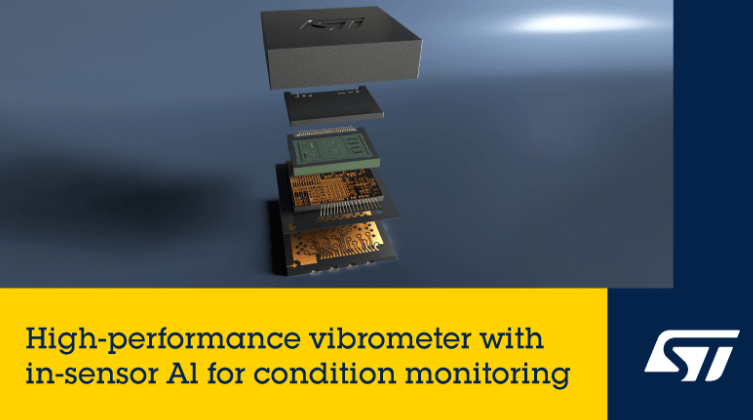
The key innovation of the IIS3DWB10IS lies in "local computing at the sensing end." Traditional equipment condition monitoring typically requires sensors to collect vibration data, which is then analyzed by an external processor or edge gateway. This system chain is lengthy, and factors such as power consumption, wiring, computational allocation, and latency can impact engineering deployment. STMicroelectronics integrates the ISPU 2.0 intelligent sensor processing unit into this sensor, enabling rapid processing and AI inference of vibration data close to the sensing element. Official data shows the product can measure vibrations and shocks at frequencies of 10kHz and above, with a dynamic range of up to 200g, a noise floor as low as 35µg/√Hz, and operation at temperatures up to 125°C. These specifications allow it to cover anomaly identification needs for motors, pumps, fans, compressors, drivetrains, machine tools, and other rotating or reciprocating equipment, helping factories detect risks early before bearing failure, mechanical wear, or abnormal vibrations escalate.
The device comes in a 4.5 mm × 4.5 mm × 1.5 mm 16-pin LGA package, with sampling planned for July 2026. Unit pricing for orders of one thousand pieces starts at $25.
From an industrial application perspective, vibration analysis remains one of the most mature and core technical paths for equipment condition monitoring. Numerous manufacturing, automotive, chemical, energy, and general equipment companies rely on rotating machinery for continuous production. A sudden shutdown of critical equipment not only affects the single machine but can also disrupt the entire production line rhythm, require temporary dispatch of maintenance personnel, consume spare parts, and cause delivery delays. The IIS3DWB10IS supports typical algorithms such as FFT, filtering, envelope analysis, velocity severity, and anomaly detection within its sensor ecosystem. This means equipment manufacturers can embed predictive maintenance capabilities into existing machines or next-generation smart devices with smaller size, lower power consumption, and fewer external circuits. For industrial sites with battery-powered, distributed installations, or limited space for retrofitting, such on-sensor AI solutions are more conducive to large-scale deployment than the traditional "sensor + external processor" structure.
This product also reflects the evolution of industrial sensors from simple data acquisition devices to edge intelligent nodes. STMicroelectronics states that the ISPU 2.0 offers 40 MIPS and 40 MFLOPS of digital signal processing capability, with up to a 4x improvement in processing performance over the previous generation and a 6x increase in data transfer speed between the sensor interface and MEMS circuitry. As factories increasingly prioritize equipment availability, remote monitoring, and production safety, the competitive focus among sensor manufacturers is shifting from measurement accuracy, temperature range, and packaging reliability to local algorithm execution, data preprocessing, energy consumption control, and connectivity with industrial software systems. If the IIS3DWB10IS enters mass production design with industrial equipment manufacturers, it will help drive AI condition monitoring from high-value critical equipment down to more common industrial assets.
The subsequent adoption of this product still depends on the integration pace of equipment manufacturers, algorithm adaptation costs, and field validation cycles. For industrial users, sensor performance itself is just the first step. Factors truly influencing purchasing decisions include false alarm rates, installation methods, long-term stability, ease of integration with existing PLCs or edge gateways, and whether the maintenance team can translate sensor outputs into actionable maintenance strategies. With the launch of the IIS3DWB10IS, STMicroelectronics demonstrates that industrial chip companies are further embedding AI capabilities into the sensing layer, and equipment condition monitoring is moving from periodic inspections towards more continuous, on-site intelligent judgment.
This article is compiled by Wedoany. All AI citations must indicate the source as "Wedoany". If there is any infringement or other issues, please notify us promptly, and we will modify or delete it accordingly. Email: news@wedoany.com