Duke University Develops 20-Legged Robot Capable of Instantaneous Multi-Directional Movement
en.Wedoany.com Reported - Duke University has developed a robot named Argus, capable of instantly looking and moving in any direction. Its design principles offer new insights into dynamic symmetry in robotics. The research findings were published online Wednesday in the journal Science Robotics.
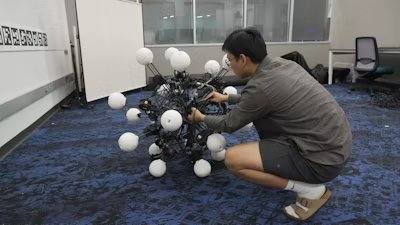
Engineering professor Boyuan Chen and his team did not attempt to mimic the symmetrical shapes found in nature, such as those of humans, dogs, or insects. Instead, they focused on uniformity of movement in all directions—what he calls "dynamic symmetry." This concept gave rise to Argus, named after the many-eyed giant of mythology. The robot has a rounded shape with 20 retractable legs radiating from a central core, each equipped with a depth-sensing camera. With no front, back, top, or bottom, Argus can instantly look and move in any direction.
In experiments, Argus successfully traversed sandy beaches and forest undergrowth, rolled over obstacles, and stabilized itself after being pushed. It can also climb by alternately bracing and propelling itself between parallel brick walls. Even if one or more motors fail or a leg breaks, it continues to function. Graduate student Jiaxun Liu, a co-author of the study, said: "Watching Argus move is completely different from watching any other robot we have ever studied. The first time we saw it navigate through trees and rugged terrain, moving freely even after violent collisions, we knew this was extraordinary."
As part of the research, the team proposed a new design principle called "dynamic isotropy," which scores robots on a scale from 0 to 1 based on how uniformly they can accelerate in all directions. Most current robots, including humanoid robots and drones, score below 0.6, while Argus achieved a score of 0.91.
Boyuan Chen stated that when a robot can accelerate equally well in all directions, it no longer needs to face the world in any particular orientation. He hopes this principle can guide the development of search-and-rescue robots, underwater or aerial vehicles, or robots capable of grasping objects. He said: "Instead of building a robotic hand that looks like a human hand... one idea is to consider Argus itself as a hand, capable of manipulating objects in any direction. The knowledge we can pass on to other fields is far more profound than building existing robots or replicating existing species."
This article is compiled by Wedoany. All AI citations must indicate the source as "Wedoany". If there is any infringement or other issues, please notify us promptly, and we will modify or delete it accordingly. Email: news@wedoany.com
Related Products


Pneumatic high-pressure wear-resistant ball valve
Zhejiang Deca Control Valve Meter Co., Ltd.
High-Speed Railway Lifting, Transporting, and Erecting Equipment: Integrated Transport and Erection Machine
Hanjiang Heavy Industry Co., Ltd. of China Railway 11th Bureau Group
Standard Nozzle Flowmeter
Jinggong Automatic Control Instrument Complete Technology Development Company

Industrial and Commercial Point-Type Gas Detector
Jinan Benan Technology Development Co., Ltd.

Strip Coating and Plating Production Line Equipment
MCC-SFRE HEAVY INDUSTRY EQUIPMENT CO., LTD.