en.Wedoany.com Reported - On June 5, at the 2026 Tencent Cloud AI Industry Application Conference, Tencent's Chief AI Scientist Yao Shunyu stated that the most important task in the second half of AI is to establish a long-term AGI organization in China. He summarized today's AI capability building into three parts: solidifying foundational work such as pre-training and post-training, transforming basic technologies into products with genuine social value, and continuously exploring new research paradigms and opportunities.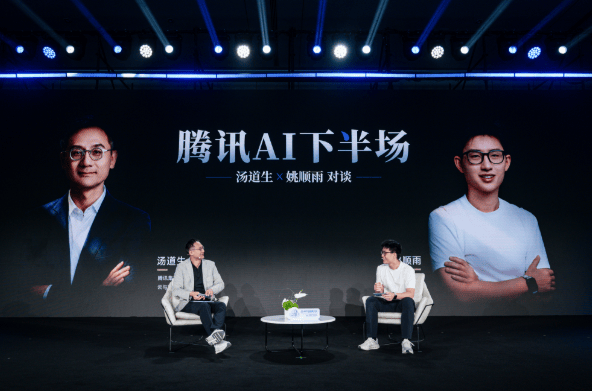
The core of this judgment is to shift AI competition from single model capabilities back to long-term organizational capabilities.
In the past few years, competition in the large model industry has been highly concentrated on parameter scale, training data, inference costs, benchmark performance, and the breakout of individual applications. The outside world has also been accustomed to judging a company's AI progress using short-cycle indicators. However, as pre-training, post-training, reinforcement learning, tool calling, multimodal understanding, and agent frameworks gradually mature, the challenges faced by technical teams have changed: the basic methods have formed a relatively clear path, and what is truly scarce is an organizational system that can continuously ask good questions, steadily deepen foundational capabilities, embed models into real products, and allow long-term exploration of cutting-edge research. Yao Shunyu breaks AI down into three parts: Foundation, Product, and Frontier. This essentially emphasizes that an AGI organization cannot focus solely on laboratory research, nor can it only engage in short-term, quick product packaging, nor can it be detached from real users and industrial problems. The foundation layer must solidify pre-training, post-training, data, infrastructure, and model engineering; the product layer must integrate models into social networking, office work, content, gaming, enterprise services, and industrial processes, forming a closed loop of user feedback and model iteration; the frontier layer needs to continue exploring new model paradigms, agent forms, multimodal capabilities, embodied intelligence, and potential future technological opportunities. If these three are imbalanced, an AI team can easily fall into states of "having models but no scenarios," "having products but no foundation," or "having exploration but difficulty in implementation."
Yao Shunyu's emphasis on a long-term AGI organization is also related to Tencent's own product structure. Tencent possesses a large number of high-frequency scenarios, including WeChat, QQ, Tencent Meeting, Tencent Docs, Tencent Cloud, gaming, content ecosystem, and enterprise services. These products can provide AI with real tasks, real contexts, and continuous feedback.
Competition in the second half of AI will increasingly rely on "problem density." The more general a model is, the more it needs to find sufficiently specific, sufficiently high-frequency, and sufficiently complex problems to verify and improve its capabilities. For Tencent, the dual scenarios of consumer internet and industrial internet mean that AI is not just an independent tool but could potentially enter the daily communication, search, creation, collaboration, customer service, R&D, marketing, and management processes of users. Yao Shunyu previously mentioned that finding problems becomes more difficult in the second half of AI, and Tencent has many good problems and good products, which echoes the construction of a long-term AGI organization. A mature AI organization needs to simultaneously understand models, products, and users. It must not only make pre-training and post-training a stable foundation but also continuously obtain new data, new feedback, and new tasks through product scenarios. It must serve current efficiency improvement needs while also reserving space for exploring future possible new interaction methods and new application forms. For large companies, the difficulty in making an AI organization long-term lies in avoiding being completely driven by short-term KPIs, while simultaneously not becoming a pure research department detached from business. The "long-term AGI organization" Yao Shunyu refers to is closer to a composite team that connects basic research, engineering systems, product scenarios, and frontier exploration.
This path also indicates that the AI industry is transitioning from a "model release cycle" to an "organizational building cycle." What truly determines the long-term competitiveness of an AI company may not be whether a particular model release is leading, but whether it can continuously build high-quality data, stable computing infrastructure, excellent research teams, strong product interfaces, real feedback loops, and open exploration mechanisms. Pre-training and post-training determine the height of the foundation, product transformation determines social value, and frontier exploration determines future possibilities. If Tencent wants to build sustainable capabilities in the second half of AI, it needs to keep these three parts within the same system for the long term, allowing model capabilities, user scenarios, and research paradigms to drive each other.
Key points for subsequent observation will focus on whether Tencent can translate this organizational thinking into specific products and technical results. This includes subsequent iterations of the Hunyuan large model, the implementation of the intelligent agent product matrix, the expansion of enterprise-level AI services, the advancement of AI programming and multimodal capabilities, and whether an efficient collaborative closed loop can be formed between the basic research team and Tencent's high-frequency products. The second half of AI will not only test model parameters and release speed but also test whether a company can identify and solve problems over the long term, and solidify technical capabilities into sustainable productivity.
This article is compiled by Wedoany. All AI citations must indicate the source as "Wedoany". If there is any infringement or other issues, please notify us promptly, and we will modify or delete it accordingly. Email: news@wedoany.com