China's Qianfan Constellation Increases In-Orbit Satellites to 200, Completes AIS Satellite System Networking
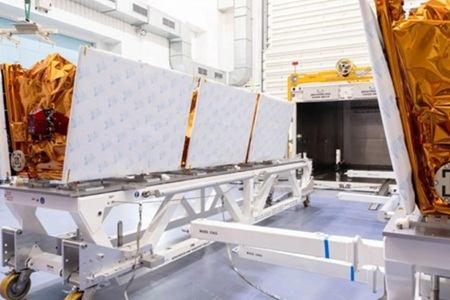
en.Wedoany.com Reported - At 14:34 on June 5, using a Long March 8 carrier rocket at the Hainan International Commercial Aerospace Launch Center, Yuanxin Satellite successfully sent 18 Qianfan satellites into their predetermined orbits, with all satellites operating normally. This brings the total number of in-orbit satellites in the Qianfan Constellation to 200, marking the completion of the AIS satellite system networking and achieving a new phased milestone in constellation construction.
The significance of this launch is concentrated on two levels: "scale networking" and "industry payload networking." The value of a low-orbit satellite internet constellation does not depend on the capability of a single satellite, but on whether continuous service capability can be formed among satellite quantity, orbital plane distribution, ground measurement, control and operation networks, gateway stations, terminal equipment, and industry applications. With the Qianfan Constellation reaching 200 in-orbit satellites, the constellation has moved from early batch deployment into a phase of accumulating network capabilities, providing a stronger engineering foundation for orbital resources, link coverage, satellite-ground coordination, and terminal access capabilities. The completion of the AIS satellite system networking extends this milestone from pure broadband communication to maritime sensing and shipping service directions. AIS, or Automatic Identification System, is primarily used for exchanging information such as vessel identity, position, course, and speed. When AIS capability is combined with a low-orbit satellite network, it can break through the coverage limits of coastal ground base stations, providing broader data acquisition capabilities for ocean-going vessels, offshore platforms, port and shipping transportation, fisheries regulation, and maritime emergencies. For an integrated space-air-ground-sea information network, broadband communication solves the "connectivity" problem, while the AIS system strengthens the "sensing" capability. Only when these two capabilities are combined can a low-orbit constellation approach a comprehensive infrastructure serving industry needs.
The Qianfan Constellation, constructed and operated by Shanghai Yuanxin Satellite, is a commercial constellation system for low-orbit satellite internet, primarily providing services such as broadband communication and internet access. According to information from the Ministry of Industry and Information Technology, the Qianfan Constellation uses Ku, Q/V and other frequency bands, and is positioned as a low-orbit satellite internet constellation independently developed, constructed, and commercially operated by Yuanxin Satellite.
In terms of construction pace, the Qianfan Constellation is transitioning from "batch launches" to "capability networking." Public launch records show that on August 6, 2024, the first batch of 18 networking satellites for the Qianfan Constellation was launched, marking the official entry into the commercial networking phase. Subsequently, multiple batches of satellites have continuously entered orbit. On May 17, 2026, Yuanxin Satellite used a Long March 8 carrier rocket at the Hainan Commercial Aerospace Launch Center to successfully send the ninth batch of 18 networking satellites into their predetermined orbits, with all satellites operating normally. On June 1, 2026, the tenth batch of networking satellites was launched using a Long March 12B carrier rocket. Behind this intensive launch schedule lies the systematic requirements of low-orbit constellation construction for batch manufacturing, rocket launch capacity, launch site scheduling, satellite in-orbit testing, and ground system integration. Unlike traditional single-satellite missions, a low-orbit internet constellation must gradually form stable service capabilities through continuous satellite replenishment, orbital plane deployment, and service validation. While 200 satellite nodes do not equate to a completed final network, they have already provided the Qianfan Constellation with stronger coverage density and application testing foundations, and also offer greater technical capacity for future scenarios involving maritime, aviation, emergency, low-altitude economy, remote area communications, and enterprise globalization.
The completion of the AIS satellite system networking is particularly important for maritime communications and ocean digitalization. Traditional AIS reception primarily relies on shore-based base stations, whose coverage is typically limited by geographical location and radio line-of-sight, leaving gaps in vessel dynamic data acquisition for open oceans, polar regions, offshore engineering areas, and remote sea areas. Satellite AIS, by receiving vessel AIS signals via low-orbit satellites, can extend maritime target identification capabilities to a much wider range, serving vessel scheduling, route optimization, maritime search and rescue, port coordination, fisheries regulation, marine environment monitoring, and maritime safety management. With the Qianfan Constellation completing its AIS satellite system networking, its application boundaries will no longer be limited to internet access, but will further extend to "communication + sensing + industry data services." For shipping companies, the combination of maritime position data and broadband connectivity helps improve fleet operations management, remote maintenance, and navigation safety. For emergency response departments, satellite AIS data can provide more timely maritime situational information when ground communications are limited or sea area coverage is insufficient. For the commercial aerospace industry chain, this also means that the profit model of low-orbit constellations can expand from single bandwidth services to industry data, platform services, and comprehensive solutions.
The key variables for the subsequent Qianfan Constellation will focus on the pace of continuous satellite launches, ground gateway station construction, terminal scaling, cross-border service compliance, and industry application transformation. The achievement of 200 in-orbit satellites and the completion of AIS networking provide a foundation for the constellation to enter higher-density coverage and more scenario validation. However, to truly form stable commercial services, progress must continue in network continuity, terminal costs, link quality, data products, and customer operations capabilities. With the growing demand for 6G, commercial aerospace, low-altitude economy, maritime communications, and emergency communications, low-orbit constellations are evolving from space infrastructure construction towards comprehensive industry-oriented information service platforms.
This article is compiled by Wedoany. All AI citations must indicate the source as "Wedoany". If there is any infringement or other issues, please notify us promptly, and we will modify or delete it accordingly. Email: news@wedoany.com
Related Products


Mine Explosion-proof and Intrinsically Safe Industrial Ethernet Ring Network (10 Gigabit/Gigabit)
Chongqing Mas Sci&Tech Co., Ltd.
20 Inch 1600*900 Full HD 60Hz TFT LED Monitor with VGA and DP Interfaces for Desktop Computers-Business Use
Guangzhou Zanying Optoelectronics Technology Co., Ltd.


KJD127(A) Mining Explosion-Proof and Intrinsically Safe Computer
Taiyuan Xiangming Intelligent Control Technology Co., Ltd.
Comprehensive Mining Automation Control System
Beijing Tianma Intelligent Control Technology Co., Ltd.