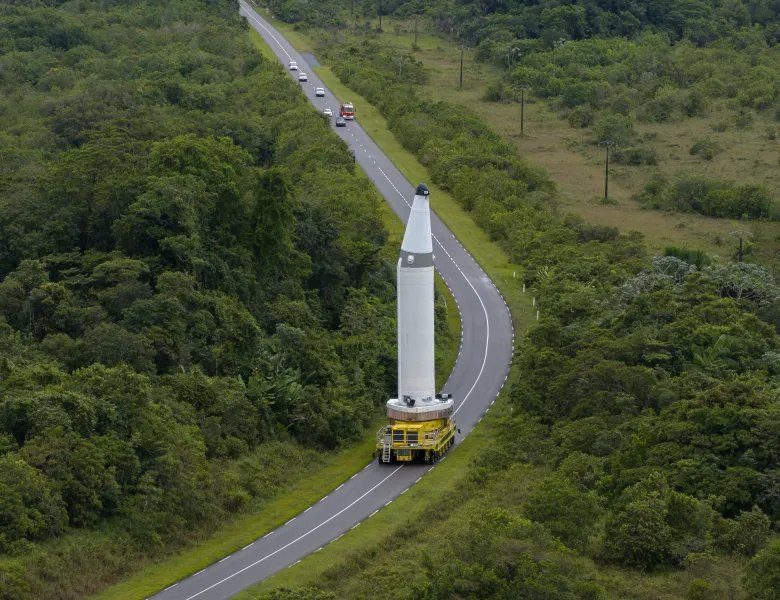
en.Wedoany.com Reported - Amazon will launch its largest batch of broadband satellites this month using an Ariane 6 rocket equipped with upgraded solid rocket boosters. The company announced on June 5 that it will launch 36 Amazon Leo satellites on June 17 from French Guiana using an Ariane 64 rocket. This mission, designated LE-03, will be the third consecutive launch of Amazon Leo satellites using the Ariane 6 rocket, following previous launches in February and April.
The LE-03 mission marks the first use of an Ariane 6 rocket equipped with P160C solid rocket boosters. The P160C is an upgraded version of the P120C booster used in previous Ariane 6 launches, with a length increase of one meter. The combined use of four P160C boosters increases the rocket's low Earth orbit payload capacity by more than two metric tons. With this enhancement, the launch can carry 36 satellites, compared to 32 satellites on each of the previous two Ariane 6 launches.
Melissa Weil, Director of Amazon Leo Launch Systems, stated in a press release that increasing the payload capacity to 36 satellites per mission was the result of extensive engineering collaboration between her team and Arianespace. The upgraded P160C booster provides the performance margin needed to achieve this goal, and the team is already looking ahead to further optimizations to continue building the Amazon Leo satellite constellation. David Cavayoles, CEO of Arianespace, also noted that the upgraded P160C booster delivers the performance improvements expected during its design phase, and LE-03 will be the most ambitious joint launch to date.
The LE-03 mission will carry more Amazon Leo satellites than any previous launch. The company previously launched 27 to 29 satellites per mission using the Atlas 5 rocket and 24 satellites per mission using the Falcon 9 rocket. Amazon had originally expected a launch this month by Blue Origin's New Glenn rocket (planned to carry 48 satellites) to set a record, but that rocket exploded on the launch pad during a static fire test on May 28, causing severe damage and grounding the rocket until at least the end of this year. Additionally, Amazon is awaiting the first Amazon Leo satellite launch by United Launch Alliance's (ULA) Vulcan rocket, which has not flown since a solid rocket booster anomaly during a mission for the U.S. Space Force in February.
ULA has been assembling a Vulcan rocket for the first Amazon Leo mission, which will use a new Centaur upper stage optimized for low Earth orbit missions. Neither Amazon nor ULA has announced a specific date for this launch. After launching an Atlas 5 rocket carrying Amazon Leo satellites on May 29, ULA stated that its next launch would be another Atlas 5 mission for Amazon Leo in July.
To date, the Amazon Leo satellite constellation has launched 331 satellites, just over 10% of the planned 3,232 satellites. The company is far from meeting the deadlines set by the Federal Communications Commission (FCC) license, which requires at least 50% of the constellation's satellites to be in orbit by July 30. Amazon submitted a request in January to extend this deadline by 24 months or receive a full exemption, citing launch delays. The FCC has not yet ruled on this request.
This article is compiled by Wedoany. All AI citations must indicate the source as "Wedoany". If there is any infringement or other issues, please notify us promptly, and we will modify or delete it accordingly. Email: news@wedoany.com