en.Wedoany.com Reported - US private company Antares has achieved first criticality for its Mark-0 microreactor at Idaho National Laboratory (INL), marking the first advanced reactor to reach this milestone under the U.S. Department of Energy (DOE) Reactor Pilot Program. Antares is one of five companies selected by DOE last year for the program, which aims to accelerate testing of advanced reactor designs with the goal of "using DOE authorization procedures to build, operate, and achieve criticality for at least three test reactors by July 4, 2026."
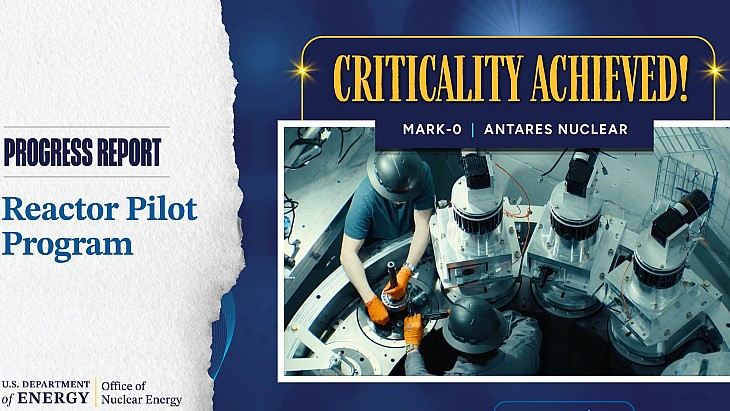
Criticality refers to the state where a reactor has achieved a sustained nuclear chain reaction, with each uranium atom fission releasing a sufficient number of neutrons to maintain a continuous series of reactions. In nuclear power reactors, the thermal energy generated from fission is used to produce steam and generate electricity. The Mark-0 is a demonstration reactor designed to validate key reactor physics parameters of Antares' sodium heat pipe-cooled microreactor technology. This technology uses tristructural isotropic (TRISO) fuel containing high-assay low-enriched uranium (HALEU).
DOE described the criticality test of the 53rd reactor built at INL since 1951 as a "tremendous achievement," validating the safety and operational performance of Antares' nuclear fission reactor, and called it one of the most significant technical achievements in nuclear energy in over 40 years. DOE stated that after further testing and licensing by the Nuclear Regulatory Commission (NRC), such microreactors are expected to be used for a variety of terrestrial and space applications, and to ensure the readiness of military facilities requiring reliable energy. The demonstration partners include DOE, INL, and BWX Technologies (BWXT), which provided TRISO fuel for the reactor, with integration and observation support from the U.S. Army, which is considered a future end-user of the technology.
Antares stated that in addition to meeting the government's goal of reforming advanced reactor testing methods, the demonstration also established a replicable licensing pathway that DOE and industry can use to accelerate future reactor demonstrations on commercial timelines. "Delivering on our promises is critical to us. U.S. nuclear energy has long been defined by delays and by companies that said they would do things but didn't," said Jordan Bramble, CEO of Antares.
The fuel used by Antares is modeled after the TRISO fuel kernels delivered by BWXT for Project Pele. Project Pele is a 1.5-megawatt transportable microreactor built by BWXT for the U.S. Army's Strategic Capabilities Office. Joe Miller, President of BWXT Government Operations, stated that the proven fuel specifications and manufacturing expertise matured through Project Pele directly supported this criticality milestone.
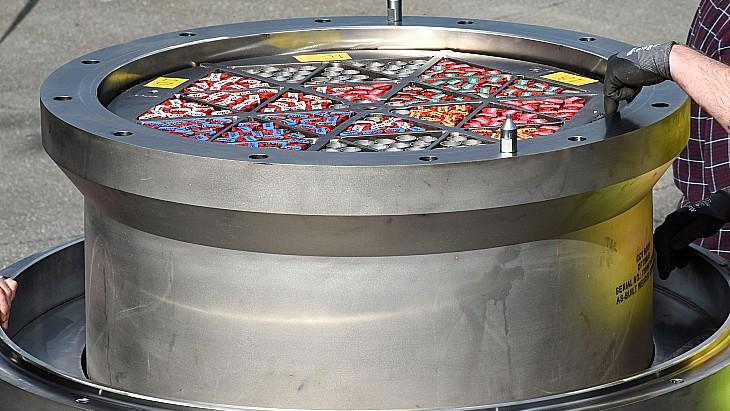
The HALEU feedstock used to manufacture Antares' TRISO fuel kernels came from scrap material provided by DOE's National Nuclear Security Administration. BWXT said it will continue to support Antares through ongoing TRISO fuel manufacturing, strengthening the company's ability to meet customer timelines and the growing national demand for advanced reactor fuel. "We are grateful for this partnership, which will continue as we move from neutrons to electrons," Bramble said.
Antares' timeline projects power generation in 2027, with the first customer deployment of a power-generating microreactor the following year. The company stated that this criticality demonstration and the licensing pathway it established are a key step toward deploying power-generating microreactors at U.S. military facilities by the end of September 2028. "We said we would achieve criticality in 2026, generate power in 2027, and power warfighters in 2028. Today is the first promise we have delivered on our own timeline. The President and DOE set ambitious timelines for reactor testing, and we met the challenge," Bramble said. "I want to thank our partners at the Department of Energy, Idaho National Laboratory, BWXT, and the U.S. Army. This is what happens when industry and government work together to accomplish big things." He added: "We went from concept to a critical reactor safely in less than 12 months. This did not happen by accident... and it would not have been possible without DOE's decades of investment in AGR-2 TRISO specifications and BWXT's Project Pele fuel supply chain. Our partners at Idaho National Laboratory and DOE-ID provided the design, regulatory, and facility support that made this schedule possible."
This article is compiled by Wedoany. All AI citations must indicate the source as "Wedoany". If there is any infringement or other issues, please notify us promptly, and we will modify or delete it accordingly. Email: news@wedoany.com