en.Wedoany.com Reported - A study on ancient Indian ironmaking techniques has revealed the complex mechanisms behind the exceptional corrosion resistance of iron produced through traditional methods. The research analyzed iron samples crafted by the Agaria tribe in Chhattisgarh, central India, and found that their corrosion resistance stems from a combination of factors—including ore, slag, surface mineral phases, oxidation processes, and hot hammering—rather than a single cause.
The analyzed samples came from Aamadandh in Korba district, Chhattisgarh, provided by members of the Agaria tribe. The research team also collected ore and slag from the same region to compare the final iron products with the raw materials used in their production. The Agaria people's technique of producing iron using bloomery furnaces may date back to before 1200 AD. Unlike blast furnaces, these furnaces produce sponge iron mixed with slag, which requires subsequent manual processing. The traditional furnace is bowl-shaped, often built underground, with a pit height of about 800 mm, a diameter of about 200 mm, a furnace shaft located below the 600 mm mark, and a bowl-shaped hearth about 240 mm in diameter and 100 mm deep. During production, air is blown to maintain a temperature of around 1150°C, and it takes 5 to 6 hours to produce one kilogram of iron.
After initial production, the sponge iron undergoes forging. Hot hammering helps compact the metal mass, reduce porosity, and remove some slag. Neutron tomography comparisons show that after hammering, the internal pores of the iron consolidate, inclusions decrease, and a thicker passive corrosion film forms. The study suggests that this thicker protective layer is one of the key factors explaining its superior corrosion resistance.
One of the core findings of the study is the presence of a thick layer of corrosion products on the iron surface, which not only represents degradation but also acts as a protective barrier hindering inward corrosion. Microscopic analysis reveals cracks about 4 to 5 micrometers wide in the surface film, but fewer cracks occur in areas where the film is thicker. The flakes formed on the surface are associated with atmospheric corrosion. Through grazing incidence X-ray diffraction analysis, the main components of the corrosion layer were identified as hematite (Fe2O3), quartz (SiO2), and calcite (CaCO3), with mass fractions of 70%, 19%, and 11%, respectively. Among these, hematite is the most stable phase of iron oxide observed, with a formation free energy of -744.4 ± 1.3 kJ mol⁻¹; maghemite was also identified as an unstable phase, with a formation free energy of -731.4 ± 2.0 kJ mol⁻¹ (at 298 K, 1 bar pressure). Neutron diffraction analysis further detected approximately 92% iron, 1.1% Fe3O4, and 1.7% Fe3C inside the sample, along with phases not yet fully identified, corresponding to unclassified peak positions at angles of 40.62°, 42.38°, 64.49°, 76.86°, 96.73°, and 115.34°.
Regarding the corrosion resistance mechanism, the study ruled out the role of phosphorus. In many discussions about ancient Indian iron artifacts, such as the famous Delhi Iron Pillar, phosphorus is considered one of the anti-corrosion factors. However, in the Agaria samples analyzed this time, no phosphorus was detected in either the iron or the corrosion layer within the detection limits of the techniques employed. This indicates that the corrosion resistance mechanisms of different ancient iron artifacts vary, and the protection of this sample primarily stems from the protective layer formed by oxides and mineral compounds, the hot hammering process, and the consolidated structure of the material.
The source of calcium was also traced. Analysis found no calcium in the ore, so researchers speculate that calcium may have come from the clay used in the furnace, coal dust, or the clay-coated bamboo platform used to slide the charge into the furnace. This suggests that the iron's resistance depends not only on the ore but is also closely related to the production environment and auxiliary materials.
The study's conclusion emphasizes that not all ancient iron is superior to modern steel. Iron produced through traditional techniques may form an effective anti-corrosion protective layer, but it should not be confused with chromium-containing stainless steel. The main contribution of this research lies in revealing that ancient metallurgy could produce materials with excellent performance through a complex combination of processes—iron-oxide-rich ore, slag, hot hammering, porosity reduction, and protective film formation—without relying on modern industrial control tools.
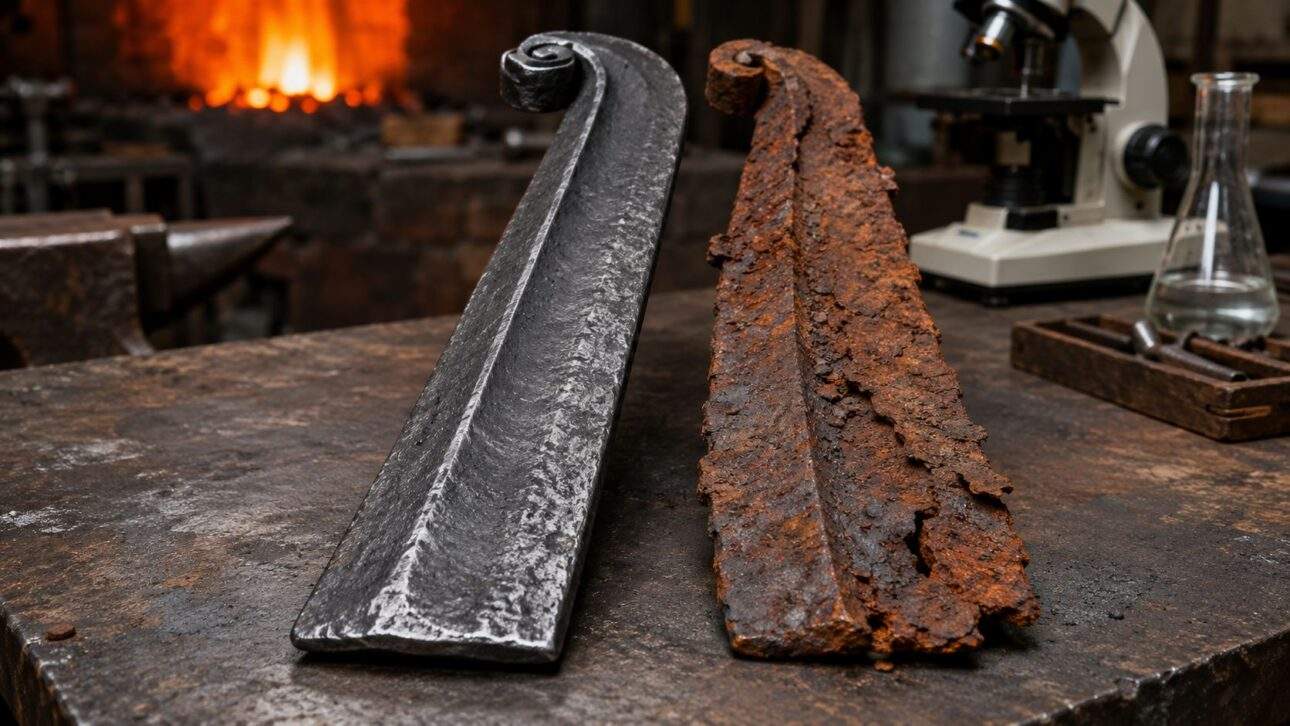
The research findings have been published in Scientific Reports, under the title "Uncovering the superior corrosion resistance of iron made via ancient Indian iron-making practice."
This article is compiled by Wedoany. All AI citations must indicate the source as "Wedoany". If there is any infringement or other issues, please notify us promptly, and we will modify or delete it accordingly. Email: news@wedoany.com