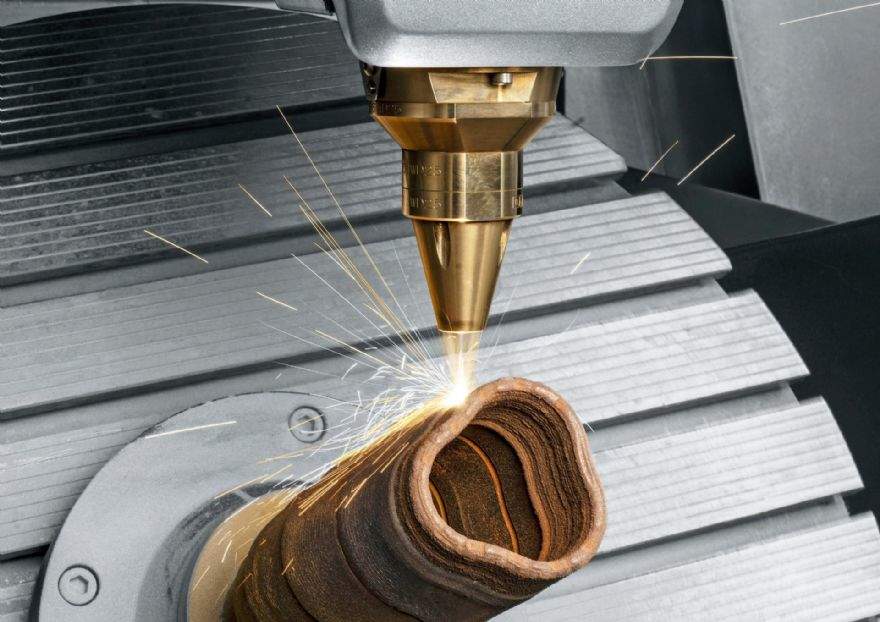
en.Wedoany.com Reported - The Oak Ridge National Laboratory (ORNL) in the United States recently unveiled a technical solution capable of identifying and repairing defects in real time during the 3D printing of large plastic parts. By continuously monitoring the process status and automatically adjusting parameters, this system aims to reduce scrap rates and lower manufacturing costs, thereby enhancing the economic viability of additive manufacturing in industrial scenarios.
Sensors and thermal imaging cameras are deployed around the printing nozzle to continuously collect temperature data of the deposited material. The controller uses computer vision—a subfield of artificial intelligence that enables machines to interpret images—to compare measured values against deviations from ideal production conditions. Once a layer's temperature is identified as falling outside the optimal range, the system automatically adjusts the printing speed to ensure adequate interlayer fusion and maintain part geometry. According to the development team, this mechanism effectively reduces forming defects and material waste.
Validation was conducted on a large industrial printer, producing a hexagonal part larger than a truck tire. During the experiment, researchers intentionally lowered the printing speed, causing the material's measured temperature to drop approximately 30% below the set value. The controller detected the anomaly and autonomously adjusted process parameters, bringing manufacturing conditions back to the normal range.
Project lead Kris Villez noted that the core innovation of this technology lies in the system's ability to observe the process during operation and respond instantly, an approach similar to how a human operator would handle the situation on-site. Another standout feature is its flexibility: the controller does not require specialized training for different machine models, plastic grades, or part geometries, making it adaptable to a variety of large printers and material combinations. The team also used machine learning to build a digital twin of the manufacturing process, enabling virtual trials of new materials and geometries before actual production.
The research team believes that by automating the monitoring process, skilled technicians can redirect their efforts toward higher-value tasks such as design optimization and process improvement. This technology is expected to drive the large-scale application of 3D printing in industrial fields such as refrigerated containers, ship molds, and building components.
This article is compiled by Wedoany. All AI citations must indicate the source as "Wedoany". If there is any infringement or other issues, please notify us promptly, and we will modify or delete it accordingly. Email: news@wedoany.com