US NX Atomics Partners with Sciaky EBAM for First Use in SMR Components
en.Wedoany.com Reported - U.S. startup NX Atomics has partnered with Chicago-based Sciaky to use its Electron Beam Additive Manufacturing (EBAM) technology to produce components for its high-temperature small modular reactors (SMRs). This marks the first large-scale application of this heavy industrial 3D printing technology in the commercial nuclear power sector.
NX Atomics, which publicly debuted in May, plans to integrate Sciaky's EBAM technology into the production line of its VELA reactor platform. The VELA reactor cluster is designed to bypass traditional power grids, providing localized direct baseload electricity and process heat specifically for heavy industrial plants and AI data centers, with a target cost of under $20 per megawatt-hour.
VELA employs a lead-cooled system combined with a highly stable liquid metal fuel core. This design achieves inherent passive safety, high fuel efficiency, and eliminates the risk of meltdown. This lead-cooled liquid metal fuel reactor dissolves nuclear fuel directly into a liquid metal matrix, rather than encapsulating solid fuel pellets within metal cladding tubes. The fluid core circulates directly through the reactor vessel and is cooled by a separate molten lead loop. With the combination of liquid metal fuel and pure lead coolant, the system operates at atmospheric pressure, relying on natural physical laws for safety, with no risk of high-pressure explosions or core meltdown.
The reactor's physical core is a monolithic structure, specifically designed for manufacturing via Sciaky's EBAM process, thereby avoiding the months-long production cycles of traditional metal forging and casting. This collaboration also allows for the intentional design of specific reactor components for periodic replacement rather than lifetime service. This approach reduces both initial capital expenditure and long-term operating costs.
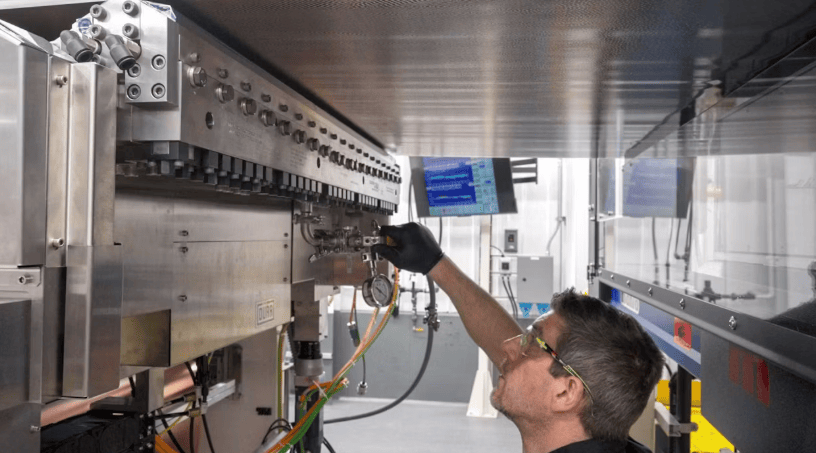
Transitioning to large-scale additive manufacturing enables NX Atomics to bypass the long lead times and retrofit bottlenecks associated with traditional metal forging and casting processes. Sciaky's EBAM process uses a fully articulated moving electron beam gun to deposit metal wire feedstock layer by layer within a vacuum chamber. The system boasts the world's largest 3D printing metal build envelope, capable of producing components up to 19 feet long, making it ideal for manufacturing large structural parts. The system is naturally compatible with highly durable nuclear-grade alloys such as titanium, Inconel, stainless steel, and tantalum.
"This is what nuclear manufacturing looks like in the modern era," said John Warden, CEO of NX Atomics. "3D printing allows us to produce nuclear-grade components faster and at lower cost, replace them over their lifecycle when appropriate, and significantly reduce the unit cost of every small modular reactor we build."
Through additive manufacturing, NX Atomics believes it can produce components faster and at lower cost, and design them for replaceability rather than permanent use when appropriate, thereby reducing the upfront capital and operating costs of its reactor clusters. Sciaky's EBAM system has already produced titanium and specialty alloy structural components for clients including Airbus, Lockheed Martin, the U.S. Navy, and NASA. In aerospace and defense, EBAM and related additive technologies have evolved from the prototype stage to full-rate production over the past decade.
"Sciaky has spent over eighty years building metal fabrication technology that the world's most demanding industries rely on," said John Criso, CEO of Sciaky. "Our EBAM process produces components used in commercial aircraft, naval vessels, and in orbit around the Earth. Partnering with NX Atomics to bring this capability into America's clean energy infrastructure is a natural next step, and we are proud that two Midwest companies are leading this transformation."
NX Atomics has set an aggressive timeline. The commercialization roadmap for the VELA reactor platform is divided into four key phases, from additive manufacturing validation to field deployment. By leveraging Sciaky's EBAM process, NX Atomics aims to compress the standard ten-year nuclear development cycle into a shorter timeframe.
Phase 1 (next 18 months) includes printing the first sub-scale structural core component using Sciaky's high-rate electron beam system to verify structural integrity under vacuum. The printed Inconel and titanium reactor structures will undergo thermal stress testing to simulate conditions in a lead-cooled system. Early digital twin manufacturing data will be submitted to nuclear regulators to establish a licensing pathway for 3D-printed containment boundaries.
Phase 2 (2 to 3 years) will include constructing a full-scale non-nuclear test loop using modular component architecture. Non-radioactive liquid lead coolant will circulate through the printed monolithic core structure at operating temperatures to test fluid dynamics performance. The modular replacement model will be validated by replacing printed components after periods of simulated high-wear stress.
Phase 3 (target: 4 to 5 years) will finalize the safety basis for the liquid metal fuel matrix within the Sciaky-printed vessel. The first fully operational, grid-ready VELA reactor module will be built. Local regulatory approvals for off-grid deployment at target industrial sites will be obtained.
Phase 4 (target: 6+ years) The first commercial VELA units will be deployed directly alongside AI data centers and heavy manufacturing facilities. A continuous 3D printing assembly line will be initiated to manufacture multiple VELA core structures simultaneously. Operations will scale to achieve the goal of providing low-cost energy for industrial microgrids.
Lead cooling technology faces numerous challenges. Lead-cooled reactors must operate at significantly higher baseline temperatures to prevent the coolant from solidifying. At the high temperatures required for pure lead, the liquid metal is highly corrosive, aggressively dissolving nickel and chromium from standard structural steels. Managing this requires a precise active oxygen control system to maintain a protective oxide layer on the metal surfaces.
Russia is building the world's first lead-cooled fast reactor, BREST-OD-300, with a planned operational date in the late 2020s. The six-year window envisioned by NX Atomics demands absolutely flawless execution, immediate capital support, and a paradigm shift at the regulatory level. Even achieving commercial power supply in the early 2030s under Phase 4 would be considered a historic engineering achievement.
The development of BREST did not start recently; it is the result of over 30 years of sustained research. To make it viable, Russia established an entire specialized industrial ecosystem, utilizing the BOR-60 and BN-600 test reactors and other specialized facilities over decades to validate its fuel and components. The project relies on billions of dollars in government funding for its development.
NX Atomics is essentially betting that using Sciaky's EBAM to print specialty materials like tantalum or Inconel can bypass the corrosion issue, and its "disposable or replaceable component" strategy eliminates the need for parts to survive over 30 years in a liquid lead environment. Whether private venture capital and modern additive manufacturing can replace decades of state-funded research remains a significant uncertainty.
This article is compiled by Wedoany. All AI citations must indicate the source as "Wedoany". If there is any infringement or other issues, please notify us promptly, and we will modify or delete it accordingly. Email: news@wedoany.com