en.Wedoany.com Reported - NASA's next-generation flagship observatory, the Roman Space Telescope, is set to depart from the Goddard Space Flight Center in Maryland for the Kennedy Space Center in Florida. The telescope is scheduled to launch as early as September this year aboard SpaceX's Falcon Heavy rocket.
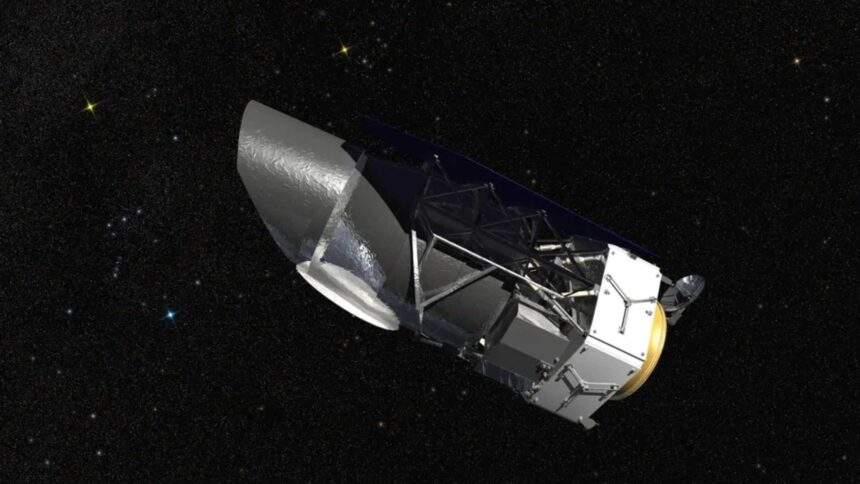
In a statement released on June 1, NASA announced that the newly completed Roman Space Telescope will travel aboard the agency's barge, Pegasus, with the final launch site designated as Launch Complex 39A. This journey marks the beginning of the final phase before the mission's launch, a mission that promises to significantly transform astronomers' understanding of the universe and planets within the Milky Way.
Named after NASA's first chief female astronomer, often called the "Mother of Hubble," the Roman Space Telescope features the same 2.4-meter diameter mirror as the Hubble Space Telescope, but with a field of view approximately 100 times larger. This unique combination will enable Roman to produce the first panoramic scans of the universe, helping scientists study dark energy, explore cosmic evolution, and search for planets beyond our solar system. One of Roman's primary goals is to discover a new type of exoplanet.
Unlike Hubble, which focuses on deep observations of specific celestial objects, Roman will scan vast areas of the sky, potentially revealing millions of previously invisible cosmic bodies. Scientists expect the mission to identify approximately 100,000 new planets, a massive leap in number compared to the nearly 6,300 exoplanets discovered to date. Many of these will be small worlds in long-period orbits, a type of exoplanet that has remained elusive to astronomers and resides in poorly explored regions of the Milky Way.
Elisa Quintana, an exoplanet researcher at NASA's Goddard Space Flight Center in Greenbelt, Maryland, stated in late May that the Milky Way hosts a variety of different environments, but in terms of exoplanet searches, scientists have effectively only explored the environment near our solar system. Roman will expand the search scope to encompass other galactic habitats, helping to understand how planet formation varies across different regions of the Milky Way.
Roman will search for planets using both the transit method and gravitational microlensing, with the latter technique capable of detecting worlds that are difficult or impossible to find by other means. Scientists expect the mission to discover a range of celestial bodies, from gas giants to rocky planets similar in size to Earth and Mars.
Once in space, Roman will become one of the most powerful astronomical survey instruments ever built. It is a more powerful successor to NASA's Kepler mission, which surveyed 100,000 stars and discovered thousands of exoplanets between 2009 and 2018. Jorge Martínez-Palomera, an astronomer at NASA Goddard, noted that Roman's survey of the Milky Way's galactic bulge will observe approximately 100 million stars and probe unexplored regions of the galaxy, providing a foundational dataset while revolutionizing our understanding of other worlds and our place in the universe.
Roman also complements the European Space Agency's Gaia probe. Between 2013 and 2025, Gaia conducted 3 trillion observations of 2 billion stars in the Milky Way using visible light. Roman will detect infrared light to penetrate interstellar dust, allowing astronomers to observe the densest parts of the Milky Way for the first time.
Roman's development has not been without challenges. Before being renamed in 2020, the mission was known as the Wide-Field Infrared Survey Telescope (WFIRST). The project faced an uncertain future, with the Trump administration proposing its cancellation in budget proposals for 2019 and 2020. Concerns at the time centered on the mission's cost and NASA's focus on completing the James Webb Space Telescope. Ultimately, Congress rejected the cancellation proposals and maintained development funding. The James Webb Space Telescope successfully launched on December 25, 2021. Roman is expected to become one of the most productive observatories ever, potentially transforming human understanding of exoplanets, dark energy, and the structure of the universe.
This article is compiled by Wedoany. All AI citations must indicate the source as "Wedoany". If there is any infringement or other issues, please notify us promptly, and we will modify or delete it accordingly. Email: news@wedoany.com