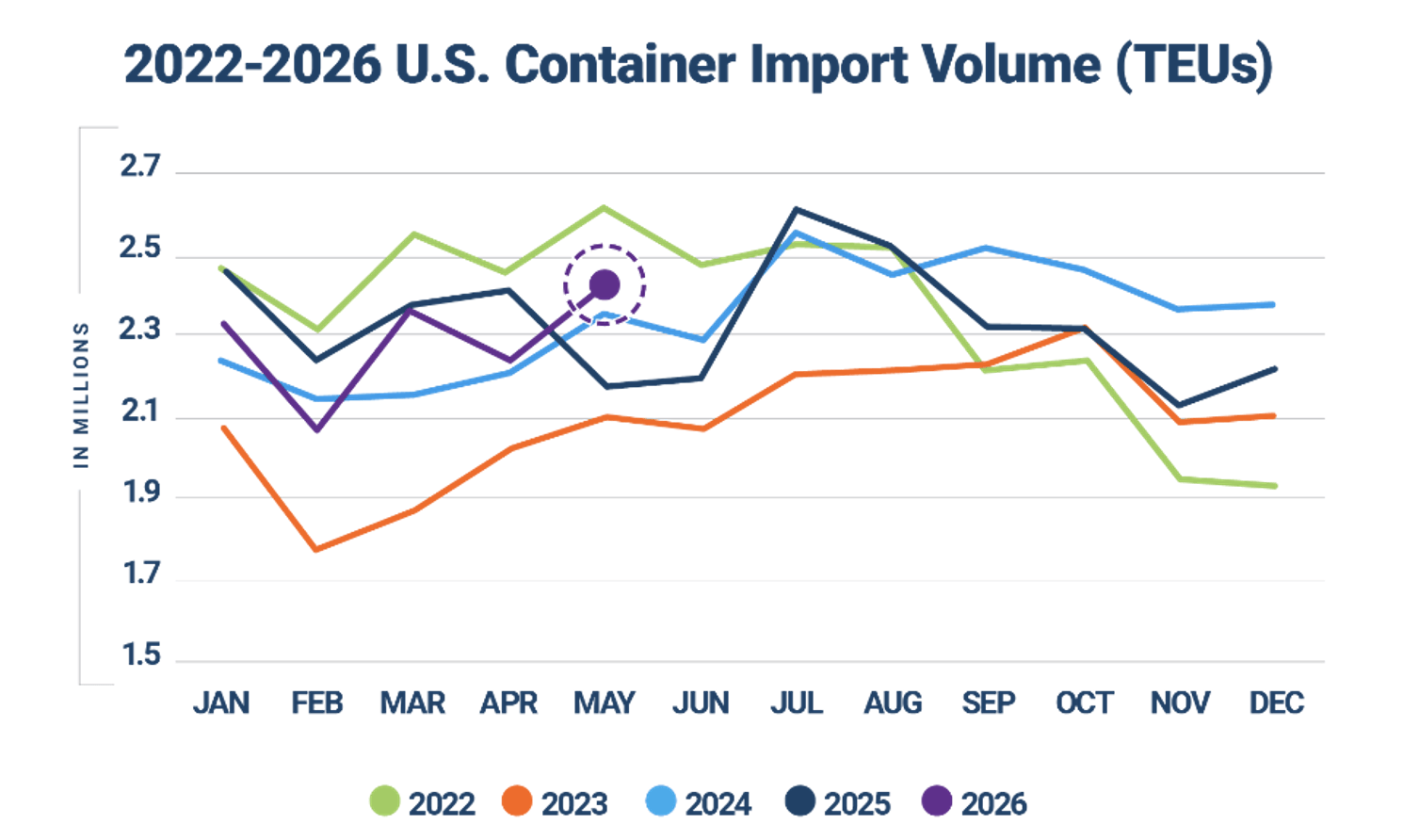
en.Wedoany.com Reported - The Global Shipping Report released by Descartes Systems Group shows that U.S. container imports in May 2026 reached 2,428,758 twenty-foot equivalent units (TEU), up 6.6% from April, indicating a rebound in import demand after the slowdown in April. Among them, imports from China surged 19.9% month-over-month and 28.1% year-over-year. The top ten U.S. ports collectively handled 89.9% of total import volume in May, the highest share since March 2023. The report notes that the global trade environment remains highly uncertain, with ongoing disruptions in the Strait of Hormuz and the Red Sea, new U.S. tariff proposals, and Sino-U.S. trade tensions collectively posing major risks to the logistics supply chain.
U.S. container imports in May showed typical seasonal growth, increasing 6.6% from April and 11.5% from May 2025. The month-over-month increase is consistent with the May growth pattern observed in most years since 2016, with May imports exceeding April levels in all years except 2020 and 2025. In the first five months of 2026, total imports were down 1.9% compared to the same period in 2025, but up 16.4% compared to the pre-pandemic period in 2019.
China-led growth drove an overall increase in imports from the top ten countries of origin (CoO). In May, U.S. container imports from the top ten CoOs rose 8.2% (129,528 TEU) month-over-month, with China increasing by 135,419 TEU (19.9%), India by 20,158 TEU (22.2%), Vietnam by 16,035 TEU (6.3%), and Hong Kong by 10,164 TEU (15.9%). Germany and Italy also recorded modest gains. Declining countries included Thailand, down 27,040 TEU (19.1%); Japan, down 15,438 TEU (23.9%); Indonesia, down 10,868 TEU (16.8%); and South Korea, down 5,382 TEU (5.3%).
Jackson Wood, Director of Industry Strategy at Descartes, stated that despite the highly uncertain global trade environment, U.S. container import trends in the first five months of this year remain positive. He noted that ongoing disruptions in the Strait of Hormuz, new U.S. tariff proposals, and Sino-U.S. trade tensions add complexity to procurement and cost management decisions, and U.S. importers need to continuously focus on supply chain risk management to remain agile amid volatility.
This article is compiled by Wedoany. All AI citations must indicate the source as "Wedoany". If there is any infringement or other issues, please notify us promptly, and we will modify or delete it accordingly. Email: news@wedoany.com