en.Wedoany.com Reported - On June 9, China's intelligent warehousing logistics system integrator and automatic loading/unloading equipment company Inge Intelligence launched the Messol-S embodied intelligent loading robot. The product targets scenarios involving multi-specification cardboard boxes, mixed-box palletizing, truck loading/unloading, and factory end-of-line logistics, focusing on solving issues such as inconsistent box types, messy palletizing, high labor intensity, and difficult equipment adaptation in non-standard mixed-box loading.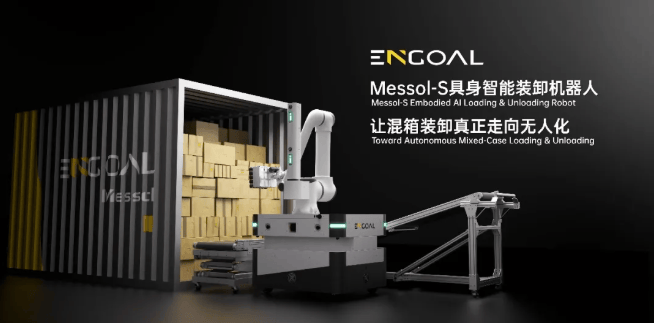
Mixed-box loading has long been a challenging aspect of factory logistics automation. Compared to standard pallets, uniform totes, or fixed packaging specifications, the dimensions, weight, placement angles, and stacking states of cardboard boxes in mixed-box scenarios frequently change. Additionally, the interior space of trucks often suffers from insufficient lighting, narrow aisles, cargo obstruction, and unstable loading/unloading rhythms. Traditional automation equipment is better suited for standardized conditions. When faced with boxes of inconsistent specifications and disorderly stacking, it is prone to issues such as inaccurate recognition, failed grasping, equipment stoppages, and increased cargo damage. The Messol-S is positioned to address these real-world conditions, aiming to enable a single device to complete the entire automatic loading/unloading process for cardboard boxes.
The robot is equipped with a dual 3D vision system and SLAM autonomous navigation capabilities. It can identify the position, contour, and stacking state of cardboard boxes of different specifications, and autonomously move between the truck, loading dock, and warehouse. The device supports continuous multi-piece grasping and can adjust its grasping actions based on the on-site box arrangement, reducing reliance on fixed palletizing patterns. Its smaller body size also makes it easier to enter the truck interior for operation, making it suitable for scenarios with high volumes of cardboard box flow, such as fast-moving consumer goods (FMCG), manufacturing, warehousing and distribution, retail, e-commerce, and third-party logistics.
The launch of such products indicates that the unmanned industrial logistics trend is extending further into the "last 30 meters." In the past, many AMRs, AGVs, conveyor lines, automated storage and retrieval systems (AS/RS), and sorting systems have been deployed inside warehouses. However, the loading/unloading process from the vehicle to the dock and from the dock into the warehouse still heavily relies on manual labor. Workers need to repeatedly move goods between the truck and the platform, resulting in high labor intensity, and operational efficiency is easily affected by personnel status, weather, shifts, and cargo structure. By integrating visual perception, motion control, grasping execution, and on-site scheduling, embodied intelligent loading robots entering this link can enhance the continuity of end-of-line logistics operations.
For the industrial chain, mixed-box loading robots will drive demand in areas such as machine vision, motion control, robotic arms, end effectors, mobile chassis, safety sensors, industrial software, and warehouse scheduling systems. The large-scale application of the product depends not only on single-grasp capability but also on recognition stability in complex environments, damage control, coordination with dock equipment, data connectivity with warehouse management systems, and sustained operational performance across different truck models, box specifications, and work rhythms.
Inge Intelligence has previously formed solutions around scenarios such as automatic material unloading, automatic storage, automatic line-side feeding, and automatic finished product outbound loading. With the launch of the Messol-S, its product line further covers the specific challenge of non-standard mixed-box loading. Subsequent milestones include the robot's test performance in more industry scenarios, customer site deployment cycles, continuous operation efficiency, failure rates, and return on investment periods. If this type of robot can maintain stable operation in complex mixed-box environments, it will provide manufacturing plants and warehousing and distribution centers with a new automatic loading/unloading option, driving the loading/unloading link from single-point equipment transformation towards a more complete unmanned logistics closed loop.
This article is compiled by Wedoany. All AI citations must indicate the source as "Wedoany". If there is any infringement or other issues, please notify us promptly, and we will modify or delete it accordingly. Email: news@wedoany.com