en.Wedoany.com Reported - Amid a backdrop of multinational fertilizer companies generally scaling back investments, freezing operations, or even seeking to sell factories, a Brazilian-founded, Australian capital-controlled fertilizer company has chosen to expand against the trend. After more than a decade of mineral research, environmental licensing, and product development, Águia Fertilizantes has initiated phosphate mining operations in Rio Grande do Sul and plans to invest a cumulative total of over 350 million reais by 2028.
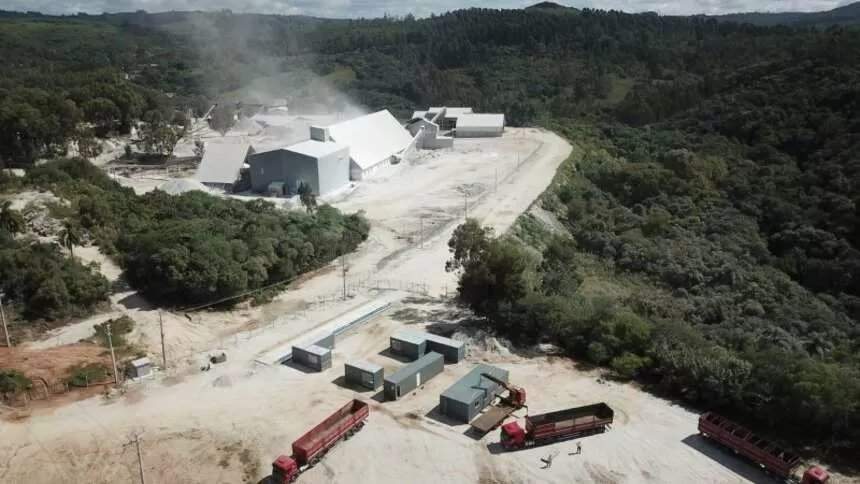
Controlled by Australian company Aguia Resources, listed on the Sydney Stock Exchange, the firm recently commenced phosphate mining in Lavras do Sul and plans to ramp up production capacity to 450,000 tons per year over the coming years. In an interview with AgFeed, Brazilian General Manager Diego Boeira stated that against a backdrop of increasing uncertainty in Brazil's fertilizer supply, Águia is attempting to provide the market with price and supply predictability.
The company began mining immediately after obtaining its operating license in May. To date, approximately 230 million reais have been invested in the project, with an additional 80 million reais planned for the construction of a new industrial plant adjacent to the mine, plus a reserve of 10 to 20 million reais for licensing and development of new areas. Boeira stated that the company is likely to invest over 350 million reais in total in Rio Grande do Sul by 2028, a figure that includes initial investments made over a decade ago.
Águia's operations in Rio Grande do Sul began over ten years ago. Founded in 2008, the company started mineral research in the region in 2011 after discovering phosphorus-rich rock in an area initially drilled for gold exploration. Its studies estimate the region contains approximately 105 million tons of "hard rock" (99 million tons of which) and saprolite. In 2015, the company completed the deposit assessment and initiated the environmental licensing process. The installation license was granted in 2022, construction was completed by the end of 2025, and the operating authorization was recently issued. In the initial years, the company plans to extract only about 6 million tons of surface material, sufficient to sustain operations for approximately 18 years.
To accelerate market entry, Águia chose to lease Dagoberto Barcelos' granulated fertilizer plant in Caçapava do Sul for a 20-year term. The plant, with an annual capacity of 120,000 to 150,000 tons, will produce a natural phosphate fertilizer named "Pampafos," using raw material from the Três Estradas mine in Lavras do Sul. In 2026, the company plans to produce approximately 70,000 tons of Pampafos. Starting in 2027, the company plans to build a new industrial plant with an annual capacity of 300,000 tons next to the Três Estradas mine. From 2028, the combined capacity of both facilities will reach 450,000 tons per year. The decision to retain both production facilities was partly based on the company's consideration of utilizing another phosphorite deposit near Caçapava do Sul. Boeira noted that the estimated lifespan of this deposit is approximately 15 years. In addition to these two mining sites, the company has identified four other mineral rights areas for further study.
The product, marketed under the Pampafos brand, is primarily aimed at crops such as soybeans, corn, rice, wheat, and pasture, which have been the target crops for agronomic tests since 2019. Boeira stated that the company conducted seven years of testing with good results; testing on the Caçapava do Sul deposit product began in 2024 and is currently in its third growth cycle. In terms of sales strategy, the company initially adopted a pre-sale model, offering only quantities that can be guaranteed for delivery by the end of this year, with escalating discounts for customers placing early orders. Beyond Rio Grande do Sul, the company has received inquiries from distributors and farmers in Santa Catarina and Paraná. The company has also initiated the registration process to sell its products in Uruguay, but its current focus remains on Rio Grande do Sul.
Although officially operating as a mining company, Boeira stated that the company is now closer to agriculture than traditional mining. In terms of shareholding structure, the company was founded by Brazilians but primarily financed from abroad. Boeira pointed out that Brazil lacks dedicated funding for new exploration in the mineral sector, making it necessary to seek international investors, with venture capital currently concentrated mainly in Toronto, Canada, and Sydney, Australia. Boeira himself has been involved in the project since the environmental licensing phase. In his early years, he worked for the Canadian consulting firm Golder Associates and led the environmental studies for this project, subsequently directly participating in operational development and joining the company. Currently, the company's board of directors is primarily composed of Australian executives, while Brazilian operations are managed by a local team. In addition to its phosphate operations in Brazil, the company holds gold, silver, and copper assets in Colombia, some of which are in advanced stages of development. The company also plans to explore for copper in Brazil.
This article is compiled by Wedoany. All AI citations must indicate the source as "Wedoany". If there is any infringement or other issues, please notify us promptly, and we will modify or delete it accordingly. Email: news@wedoany.com