Taiwan's TSMC Adopts NVIDIA AI, Boosting Lithography Efficiency by 20%-50%
en.Wedoany.com Reported - NVIDIA stated that TSMC is leveraging its accelerated computing and AI technology to advance semiconductor design and manufacturing, which is expected to improve wafer fab delivery times, energy efficiency, yield rates, and operational efficiency.
Global semiconductor demand is surging due to AI infrastructure, data centers, and advanced memory. TSMC Chairman and CEO Dr. C.C. Wei stated that the two companies, based on a long-term partnership, are jointly driving technological development to enable next-generation computing.
NVIDIA's CUDA-X libraries and AI models have been applied across various process steps on GPUs. In computational lithography, TSMC's use of NVIDIA cuLitho has improved cost efficiency or cycle time by 20% to 50% compared to CPU-based solutions. cuEST, a GPU-accelerated electronic structure simulation library in TSMC's toolkit, is said to achieve chemical simulations that are on average 50 times faster in material design. In advanced process control, cuML is used to accelerate large-scale analysis. NVIDIA noted that using CUDA for GPU-accelerated scheduling computation has brought significant improvements in wafer fab productivity for TSMC.
With advanced node wafer costs reaching up to $20,000 per wafer, even minor defects can lead to millions of dollars in losses, and nanoscale defects can scrap an entire wafer. NVIDIA's Metropolis and TAO Toolkit are used to improve defect classification within the fab, helping TSMC enhance quality inspection effectiveness and reduce the need for repeated labeling and retraining.
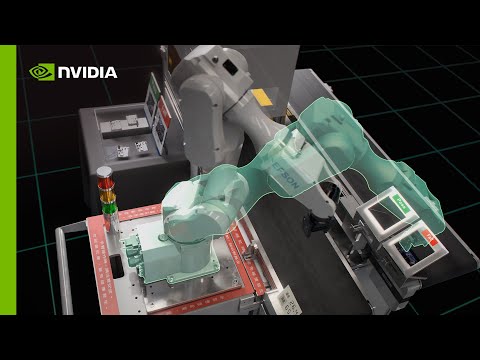
Advanced semiconductor fabs require precise coordination among personnel, robots, tools, materials, and building systems. NVIDIA stated that TSMC is using its Omniverse libraries to build a digital twin fab environment called FabTwin, supporting the evaluation of process tool layouts and related simulation workflows to identify potential configuration constraints early.
NVIDIA founder and CEO Jensen Huang noted that the two companies have collaborated for nearly three decades, jointly pushing the limits of computing. In May this year, the Semiconductor Industry Association (SIA) announced that global semiconductor sales in the first quarter of 2026 reached $298.5 billion, a 25% increase from the fourth quarter of 2025. SIA President and CEO John Neuffer stated that global chip sales are expected to reach $1 trillion by 2026, driven by strong sales in the Asia-Pacific region, the Americas, and China. Only about 30 to 40 major companies worldwide own and operate actual wafer fabs, with TSMC, as the largest pure-play foundry, manufacturing chips for companies such as Apple, NVIDIA, and AMD.
This article is compiled by Wedoany. All AI citations must indicate the source as "Wedoany". If there is any infringement or other issues, please notify us promptly, and we will modify or delete it accordingly. Email: news@wedoany.com
Related Products


Automatic Aiming Laser Remote Obstacle Removal Robot
Pinggao Group Weihai High-Voltage Apparatus Co., Ltd.

Mine Explosion-proof and Intrinsically Safe Industrial Ethernet Ring Network (10 Gigabit/Gigabit)
Chongqing Mas Sci&Tech Co., Ltd.
One-Stop Steward Service for the Entire Logistics System Integration Chain
Zhongding Intelligent (Wuxi) Technology Co., Ltd.


G.652.D Wavelength-extended Non-dispersion Shifted Single-mode Optical Fiber
HONGAN GROUP CO., LTD.