en.Wedoany.com Reported - Air cargo prices remain elevated, and despite a steady recovery in capacity, airlines, freight forwarders, and shippers are adapting to a market landscape reshaped by the Iran conflict, surging fuel costs, and sustained demand in the artificial intelligence sector.
Data from Rotate shows that global freighter capacity increased by 4% month-on-month in May and by another 2% in early June, with the Asia-to-US network continuing to recover. Cathay Cargo stated that its global capacity has now "almost returned to pre-incident levels," but disruptions persist in the Middle East, with its services to Dubai and Riyadh still suspended.
However, rates remain well above historical norms, as shown by the Freightos Terminal FAX. According to data from TAC Index, the global Baltic Air Freight Index fell only 2.1% in the four weeks to June 1, but was still 32.7% higher than the same period last year. Despite signs of stabilization, the index was still up 33.4% year-on-year in the first week of June.
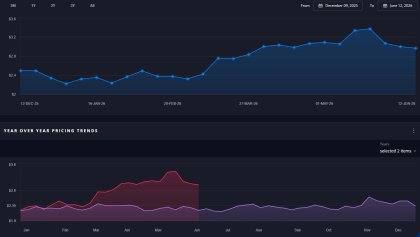
WorldACD data highlights market imbalances: global cargo volume growth slowed to just 3% year-on-year in May, but average rates were still 36% higher than last year's levels. This disconnect suggests that while capacity is returning, the market is still operating under significant constraints. Asok Kumar, CEO of Morrison Express, told The Loadstar that airlines still have 30% of capacity not yet back in the market, and Gulf region airlines affected by the conflict, such as Qatar Airways, Emirates, and Etihad Airways, are major cargo carriers, so the impact on capacity persists. He added that up to 70% of capacity has been restored, and airlines have added direct capacity to compensate for reduced Middle East connectivity. The market is no longer in crisis mode, but prices remain significantly higher than before the conflict erupted.
Fuel remains a key factor. TAC noted that jet fuel prices fell nearly 25% between April and May, helping to ease rate pressure. However, fuel costs are still more than 57% above the average level of last year. The situation is similar for fuel surcharges in Hong Kong. Cathay Cargo has reduced its long-haul fuel surcharge by about 14% for the second half of June, from HKD 11.8 per kg (USD 1.50) to HKD 10.1 per kg. While this is nearly 46% lower than the April peak, it is still more than three times higher than pre-conflict levels. Frank Yau, Head of Cargo Sales for Hong Kong and Greater Bay Area at Cathay Cargo, stated that the big issue remains oil prices, especially jet fuel.
Kumar said that volatility poses challenges for shippers, preventing customers from accurately forecasting their costs and creating significant uncertainty. Despite the ongoing impact of the Iran conflict on the market environment, demand remains notably resilient, particularly in technology supply chains. WorldACD reported that chargeable weight from the Asia-Pacific region has grown 8% year-to-date, while rates to Europe and the US are 39% and 36% higher year-on-year, respectively. This demand is primarily driven by the continued build-out of AI infrastructure. Kumar, speaking from Taiwan, noted that semiconductor manufacturers, memory chip producers, and equipment makers are still reporting full order books for years to come. Some companies say orders are booked through the end of next year, others even through the end of 2028, and many indicate this situation will continue until 2030. The only vertical market showing exceptional growth is artificial intelligence.
This boom supports strong intra-Asia and transpacific routes. The strength of AI-related cargo also helps explain why rates remain high even as overall volume growth slows. TAC Index shows that rates originating from Asia continued to outperform the broader market in May, particularly on transpacific routes, driven by semiconductor and technology goods. Nevertheless, there are increasing signs that the frantic repricing seen in March and April has ended. WorldACD reported a 9% month-on-month decline in global chargeable weight at the end of May, mainly due to holidays including Memorial Day, Pentecost, and Eid al-Adha. However, average rates still rose by 2%, highlighting the market's ongoing sensitivity to capacity constraints.
For now, most industry participants seem to agree that the market has stabilized at a higher level rather than returning to normal. Cathay stated that capacity is recovering and rates have begun to soften, while TAC described May as a period when airlines and shippers stopped reassessing risks weekly and instead learned to operate under new constraints. Kumar believes that eventually, market fundamentals will prevail. If things return to the state before the war started, market dynamics will self-correct, and rates cannot remain high. But for now, incomplete capacity recovery, high fuel costs, and massive demand for AI-related goods seem sufficient to keep air cargo prices well above historical norms.
This article is compiled by Wedoany. All AI citations must indicate the source as "Wedoany". If there is any infringement or other issues, please notify us promptly, and we will modify or delete it accordingly. Email: news@wedoany.com