en.Wedoany.com Reported - The Nepal Railway Company officially issued an international Expression of Interest (EOI) in early June 2026, planning to prepare a Detailed Project Report (DPR) for a 27.5-kilometer circular rail transit line in the Kathmandu Valley. This marks the formal restart of the Kathmandu Metro project, which had been shelved for six years, as the highland city takes another substantive step towards modern rail transit construction.
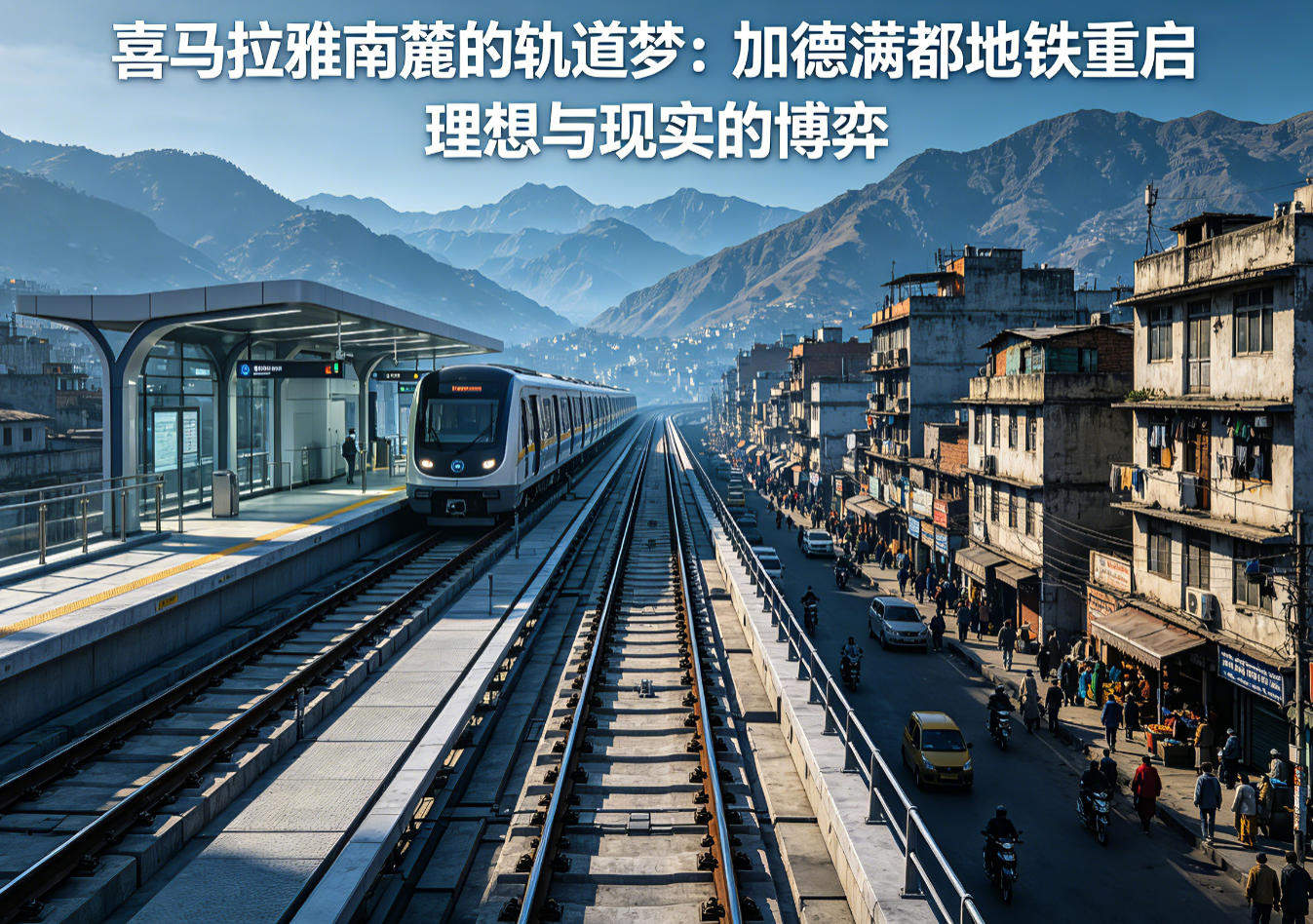
Traffic congestion has long plagued the approximately 4 million residents of the Kathmandu Valley. Narrow old city streets, an annual increase in private vehicles, and insufficient public transport capacity have led to low commuting efficiency in this millennia-old city, constraining its urban development.
The concept of building an urban metro in Kathmandu dates back over thirty years. In the 1990s, Nepali authorities initially proposed the idea of rail transit for the capital. In 2011, the government commissioned a South Korean company to conduct feasibility studies for five metro lines, and in 2012, a 77-kilometer rail transit network plan was finalized. At the 2019 International Investment Summit, the project was promoted under a BOT model with an estimated total investment of $4 billion, but ultimately stalled due to practical obstacles. An attempt to restart the project in 2020 failed to progress due to insufficient preliminary studies and immature implementation conditions.
Harikumar Pokhrel, Director General of the Nepal Railway Company, stated in an interview with the *Kantipur Daily* that the 2020 preparatory work had obvious flaws. The technical justification was not rigorous enough, the spatial conflicts between underground lines and urban religious buildings and residential areas were not properly addressed, and coupled with land acquisition disputes, a hasty push forward was unlikely to succeed.
The planning for this restart is more pragmatic. The authorities have confirmed the initial phase as constructing a 27.5-kilometer circular track along the Kathmandu Ring Road. It will connect core commercial areas and residential zones such as Narayangopal Chowk, Chabahil, Koteshwor, Satdobato, and Ratna Park, forming a closed-loop commuter corridor. Three construction modes—metro, light rail, and monorail—are under evaluation, with the final plan to be determined based on subsequent feasibility study results.
Regarding funding, the Nepali government has allocated NPR 323.4 million (approximately $2.1 million) for preliminary feasibility work. The winning bidder must complete the full DPR within 18 months, covering engineering design, financial estimation, and environmental assessment. According to the official timeline, civil construction could start as early as 2028, with the entire line requiring at least 5 to 8 years to complete.
The core reason for restarting the Kathmandu Metro project is the increasingly severe congestion problem. As Nepal's political, economic, and cultural center, the Kathmandu Valley has a highly concentrated population. Most urban roads are centuries old, and the road network's carrying capacity is saturated. A special traffic survey published by *The Republica Nepal* in May 2026 showed that the annual growth rate of motor vehicles exceeds 10%, the average speed on main roads during peak hours is less than 5 km/h, and a single commute often takes citizens two to three hours. Traffic paralysis hampers logistics, raises living costs, and restricts urban economic development.
Nepali infrastructure expert Surya Acharya wrote in his *Ratopati* column that the worsening traffic problem is weakening Kathmandu's function as a capital. Rail transit is not an option but a necessary answer for urban development. The Nepali government has designated the ring rail project as a core project for modernizing the capital. Besides alleviating traffic pressure, it also aims to optimize the urban layout and enhance the city's image, while laying the groundwork for future connections with the China-Nepal Railway and building a Himalayan inland land port hub.
The Kathmandu Metro faces multiple practical challenges. According to a report by *Hamro Nepal Patro* in October 2025, the total investment for the entire rail project will exceed $4 billion. Nepal's national budget for fiscal year 2026 is only $18 billion, and the national debt ratio exceeds 70%, making it unable to independently finance the project. Former Nepali Finance Ministry official Binod Adhikari pointed out that the government will not fully fund the project; it must rely on international loans and foreign BOT cooperation to proceed.
Geological risks are extremely high. Kathmandu is located in the core area of the Himalayan seismic belt, a global earthquake-prone zone. A geological feature analysis in the *Kantipur Daily* mentioned that the valley has soft soil and dense underground faults. Tunnel construction needs to withstand earthquakes above magnitude 8, and the cost of seismic-resistant construction is three times higher than in ordinary cities. Technical challenges such as rock bursts, surrounding rock deformation, and groundwater seepage currently lack mature universal solutions.
Land acquisition resistance is prominent. The Kathmandu Valley is densely populated with strong private land ownership, and land prices along the route are high. A field survey by *Nepal News* in February 2026 showed that the first phase ring line involves over 3,000 private land parcels, with 70% of owners rejecting compensation standards below three times the market price. Complex land ownership, cumbersome approval processes, and high compensation demands can easily trigger social conflicts and slow down construction progress.
Operational shortcomings are evident. Nepal has never built or operated urban rail transit, lacking local professional talent and technical reserves. A *Ratopati* opinion poll in June 2026 showed that 68% of the public doubt the government's ability to operate the metro. Even if the project is completed, subsequent operation, maintenance, and safety management will likely require long-term external assistance. Additionally, Nepal's frequent political changes and weak policy continuity add uncertainty to the project's long-term progress.
Among many potential partners, Chinese companies have relatively prominent advantages in suitability. State-owned enterprises like China Railway Construction Corporation (CRCC) and China Railway 25th Bureau Group have participated in Nepal's rail planning. In 2018, China Railway 25th Bureau signed a memorandum for preparing the DPR for the Kathmandu Monorail project, accumulating local practical experience. Leveraging projects like the Qinghai-Tibet Railway and Sichuan-Tibet Railway, China has mastered mature technologies for rail construction in high-altitude, strong seismic, and complex mountainous areas. Former technical advisor to the Nepal Railway Company, Rajan Thapa, wrote in the *Kantipur Daily* that China is one of the few global partners capable of both solving difficult mountainous rail technical challenges and offering flexible financing solutions. Meanwhile, regional competition is intensifying. India's feasibility study for the Raxaul-Kathmandu cross-border railway is progressing steadily, creating a competitive dynamic with the Chinese-led cross-border and urban rail systems.
Industry analysts believe that if the Kathmandu Metro is successfully implemented, it will link with the China-Nepal Railway to form a three-dimensional rail network of "cross-border trunk lines + urban internal networks," helping Nepal transition from a "landlocked country" to a "land-linked country." In the short term (1-2 years), the project will only advance feasibility study preparation, partner selection, and plan evaluation. In the medium term (3-5 years), if financing and land acquisition proceed smoothly, the authorities may prioritize constructing elevated light rail or monorail lines, which are less technically challenging. In the long term (5-10 years), if the project is implemented in phases, it will reshape Kathmandu's traffic landscape. However, risks such as land acquisition disputes, financing interruptions, and political changes could still cause the project to stall again.
This article is compiled by Wedoany. All AI citations must indicate the source as "Wedoany". If there is any infringement or other issues, please notify us promptly, and we will modify or delete it accordingly. Email: news@wedoany.com