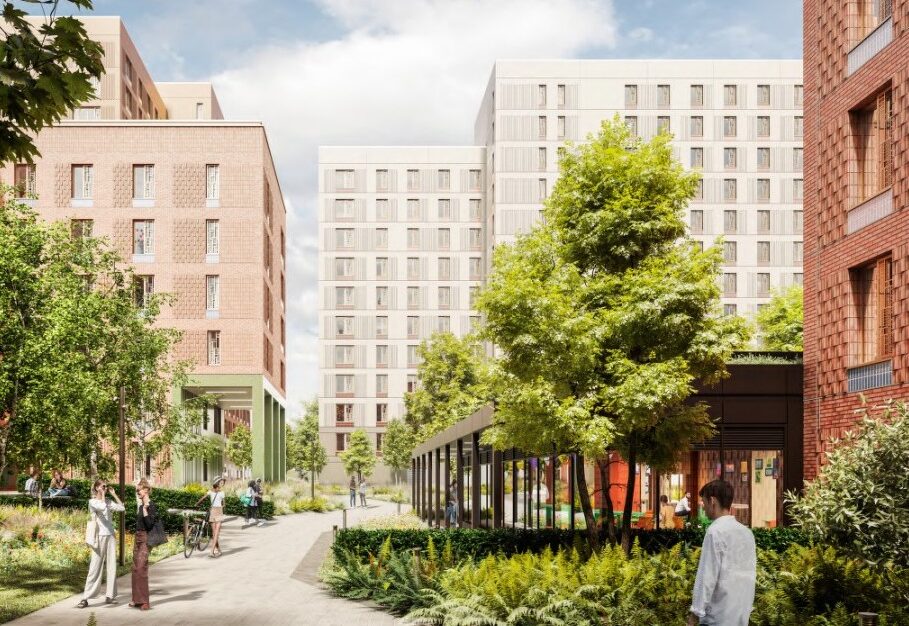
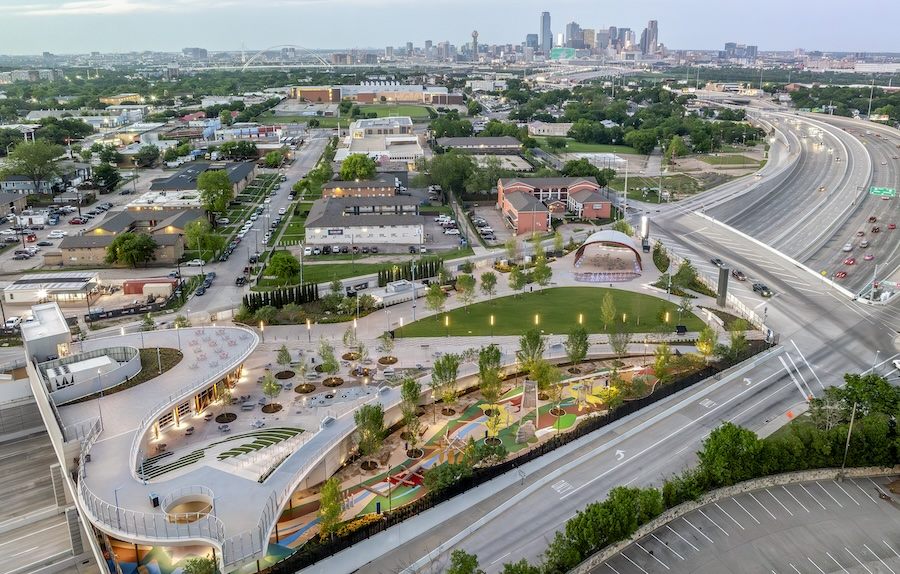
en.Wedoany.com Reported - SWA and HKS are advancing the design of Halperin Park Phase II above Interstate 35E in Dallas, following the opening of the park's 2.8-acre first phase last month. This $300 million highway cap park aims to reconnect the Oak Cliff community, which was divided by interstate highway construction in the 1950s. The project includes widening the highway and the bridge cap above it. Phase II, with landscape design by SWA and architectural elements by HKS, will expand the park to over 5 acres.
Community input has played a leading role in shaping the park's vision. Russell Crader, Director and Principal of Global Cultural Practice at HKS, stated that in coordinating with the Texas Department of Transportation (TxDOT), the team carried the community's hopes and dreams, fine-tuning weights and materials, with community input even extending to the placement of every tree. When TxDOT initiated a full reconstruction of I-35E in 2017, community leaders identified the opportunity to reverse historical issues by building a park above the highway, creating unprecedented public land and reconnecting a divided community. According to a joint press release from the design firms, Halperin Park's design is rooted in Oak Cliff's unique landscape, history, and daily life. Sculptural topography echoes the area's cliffs and terrain, while diverse functional spaces support recreation, performance, learning, and relaxation.
Key park features include a 12th Street Promenade spanning the bridge deck north-south, forming a main pedestrian spine lined with trees, seating, and cultural elements; a "Great Lawn"; a wooden amphitheater performance space; planned water features; perennial gardens; a wooden pavilion and shaded plaza accommodating vendors and performances; a series of steps forming an outdoor venue for 300 people; a playground with wooden structures, stone benches, and a future grove; and a rooftop terrace to be expanded in Phase II. The terrain rises from the bridge deck to form abstract cliffs using glass fiber reinforced concrete panels, designed to reference the chalk, shale, and limestone strata beneath the Oak Cliff community, providing visual identity while buffering views and noise from the interstate below.
As TxDOT began the I-35E expansion, the Southern Gateway Public Green Foundation established an Equitable Development Plan Task Force, led by Dr. Lorin Carter of C-Suite Equity Consulting. The task force engaged over 500 residents, businesses, and organizations to develop a "Community Priorities Plan" covering six key areas: history and culture, economic development, health and well-being, education, housing stability, and community safety. April Allen, President and CEO of the Foundation, stated that after a year of developing the plan, the board wanted community concepts at the core of the work, initiating a new RFP process to identify and select a design team composed of people who understand the community. The Foundation established a public-private partnership to raise funds, including philanthropic donations, bonds, and a $25 million IIJA grant. The cap project led by TxDOT costs approximately $47 million. A preliminary analysis by the University of North Texas at Dallas estimates that Phase I alone could attract over 2 million visitors annually and generate over $1 billion in economic impact within the first five years, including increased property tax revenue and retail activity.
Todd Strawn, Principal at SWA, noted that despite the pandemic, community engagement continued. The team collected as much information as possible, ultimately forming 15 design options. The project is being implemented in phases, with key elements such as "water features, playground, green space, amphitheater, and multi-purpose facilities" completed in Phase I. Phase II will add more playgrounds and gathering spaces. WSP analyzed various loads involved in the cap and park, including a 250,000-pound canopy and other structures. Mofid Nakhaei, Lead Structural Engineer, stated that the team could not analyze it like a typical bridge. Instead, they collaborated with designers to modify loads to fit the existing bridge superstructure, using geofoam weighing 2.5 pounds per cubic foot for soundproofing. McCarthy, in a joint venture with EJ Smith, installed 450,000 cubic feet of geofoam within five months under an approximately $58 million contract. Thomas Shepheard, Senior Project Manager, explained that the team waterproofed the bridge deck, creating a 4.5-foot-deep bathtub-like space between adjacent roads and laying utilities. Working above the interstate, about 65 feet below, the team had to build to the edge without compromising safety. TxDOT permitted 30 nights of nighttime work, with a maximum of two lanes closed. The team collaborated with BakerTriangle Prefab to prefabricate wall panels, with 13 cold-formed metal panels ranging in height from 20 to 32 feet and width from 8 to 10 feet. KSC Inc., as the metal panel fastener manufacturer, provided services for the building facade of three panels. Equity Glass and Glazing worked with Baker to install windows horizontally in a shop environment. Workers also installed glass fiber reinforced cornices for the elevated zoo landing structure. The park has an elevation change of about 8 feet, essentially a two-story space with the promenade as the central spine. Crader added that the multi-purpose building, hyperbolic amphitheater entrance, and play equipment together represent one of the largest uses of mass timber in Dallas. The multi-purpose building is primarily made of Southern Yellow Pine from Alabama, prefabricated in Tennessee. Workers installed 12 Douglas fir columns at the front, with roof panels weighing 3,000 pounds and beams weighing 2,000 pounds. The cross-laminated timber roof consists of three layers, each 4.5 inches thick.
The amphitheater canopy consists of seven German larch arches, designed, procured, and installed turnkey by StructureCraft. Each arch has three hyperbolic glulam components forming a saddle shape. The arches have clear spans ranging from 45 to 55 feet, with a rear height of 20 feet and a front height exceeding 27 feet, secured with circular metal purlins. These arches were manufactured and pre-assembled in Germany, shipped, and hoisted using a crane weighing over 200 tons. The park's planting design emphasizes resilient species capable of withstanding North Texas' seasonal temperature fluctuations and periodic droughts. Over 100 trees representing approximately ten species are beginning to form a canopy, with evergreens providing year-round structure. More than a dozen species of flowering perennials and shrubs introduce seasonal color, while six native grass species add texture and movement, supporting habitat and ecological health. Phase II design will add 2.4 acres to the park, potentially taking about two years, and may include a dog park, a second pavilion, and a bridge connecting to the Dallas Zoo. Nakhaei noted that due to the extended cover over the highway, fire life safety will be a significant design item, potentially requiring jet fans, lighting, and electrical systems. Both WSP and McCarthy have worked on Dallas' similar Klyde Warren Park project, which is also set to expand by about two acres. As other highway expansion projects, such as the I-30 Canyon project—an $888 million, 2.3-mile stretch between I-35E and I-45 in downtown Dallas—move forward, more projects similar to Halperin Park are expected in the region.
This article is compiled by Wedoany. All AI citations must indicate the source as "Wedoany". If there is any infringement or other issues, please notify us promptly, and we will modify or delete it accordingly. Email: news@wedoany.com