en.Wedoany.com Reported - At the HDC 2026 Huawei Developer Conference, the HarmonyOS ArkAF (Ark Agentic Framework) was released. Through three standardized development access systems—the Intent Framework, Skills Framework, and On-Device A2A Framework—it helps enterprises achieve intelligent APP transformation in a layered manner. The conference showcased the "one-sentence task execution" capability of mainstream applications such as Tencent Video and China Merchants Bank based on this framework, covering high-frequency scenarios in daily life, finance, entertainment, and travel.
Technological evolution and user demands are driving APPs to accelerate their evolution toward agents. According to QuestMobile data, AI is becoming a new variable in the traffic landscape, with traffic entry points extending from single APPs to "unbounded intelligent agents." However, traditional applications face challenges such as high development barriers, inconsistent protocols, cumbersome multi-device adaptation, and high costs of self-developed agents when integrating capabilities like voice-activated direct interaction and cross-application collaboration, necessitating systematic productivity restructuring.
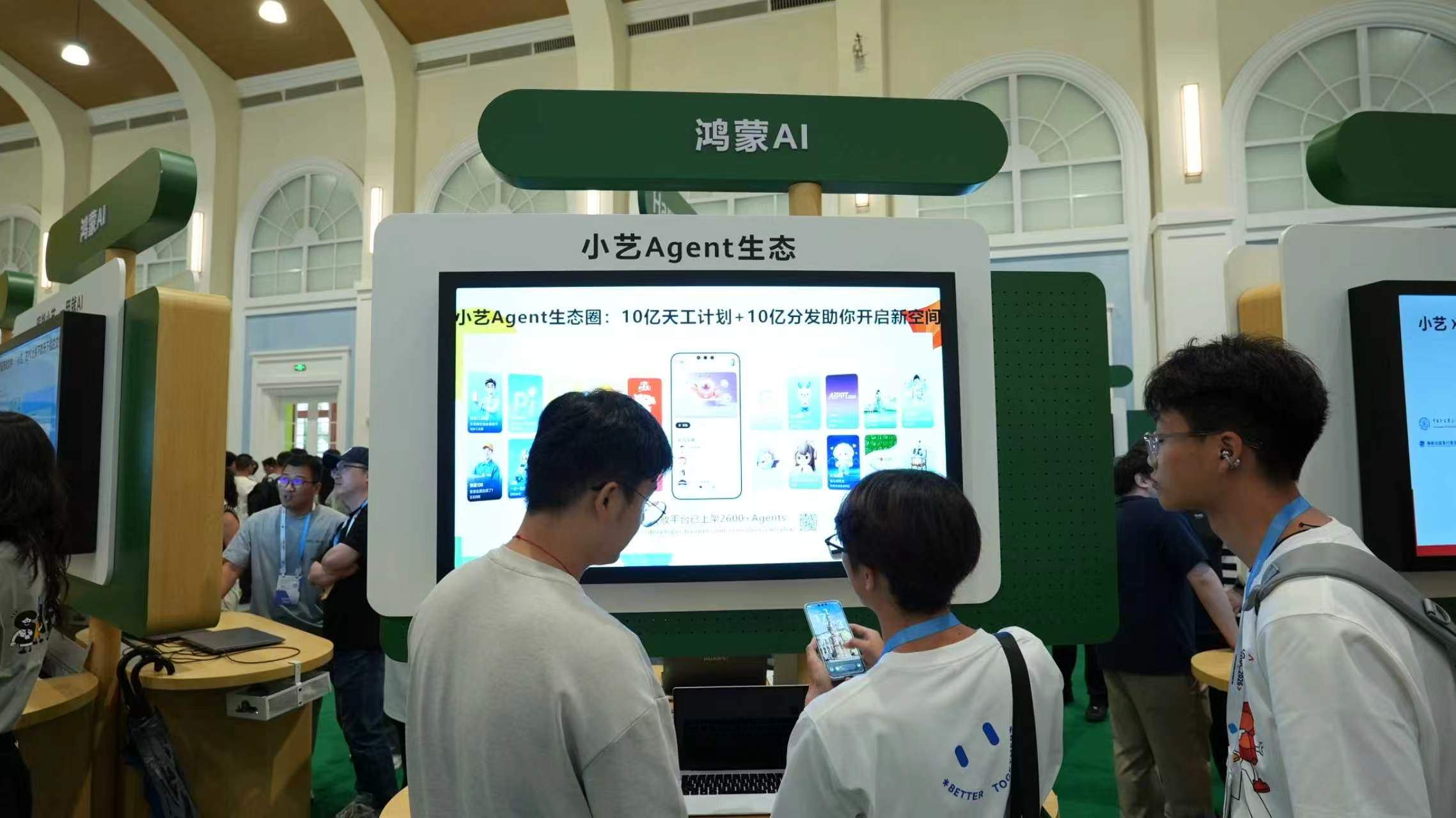
In the three-layer architecture of HarmonyOS ArkAF, the first layer, the Intent Framework, provides standardized intent access and scheduling management capabilities. By integrating intents, developers can enable apps to be directly awakened by Xiaoyi or the system to execute specific business functions, achieving intelligent "point" operations for basic APP services. This framework introduces AI-assisted coding, encapsulating rich intent development experience into multiple intent Skills, helping developers automatically generate intents with a single sentence.
The second layer, the Skills Framework, provides standardized Skills access and management capabilities. By developing and publishing Skills, developers can enable them to be recognized and invoked by agents. Through a unified SKILL.md description and standardized runtime, this framework exposes application capabilities in the form of skills, allowing the system agent to understand user commands, schedule applications, and execute tasks in a closed loop, achieving intelligent "line" operations for APP business functions.
The third layer, the On-Device A2A Agent Framework, provides standardized agent access and scheduling management capabilities. Developers can use this framework to develop on-device agents for applications. This layer achieves intelligent "surface" operations for APP business functions by integrating application-level agents with system-level agents to complete more complex tasks. Applications such as Tencent Video and China Merchants Bank have achieved efficient access based on this framework.
To lower the development barrier, Huawei released the programming agent DevEco Code, which integrates expert experience in product, architecture, development, and testing into DevEco Studio, assisting developers in generating code with one click. Additionally, HarmonyOS supports online drag-and-drop development of Skills on the open platform, reuses existing open-source Skills from the GitCode community, is compatible with the industry A2A protocol, and provides cloud-based supporting ecosystems such as unified Huawei account authorization, Huawei Push, and IAP payment checkout.
In terms of entry points and traffic support, HarmonyOS offers three major channels: system entry points, system agent entry points, and in-app entry points, supporting enterprises in distributing Skills and agents. Data shows that Xiaoyi has 180 million daily active users, with an average of over 3 billion daily wake-ups.
This article is compiled by Wedoany. All AI citations must indicate the source as "Wedoany". If there is any infringement or other issues, please notify us promptly, and we will modify or delete it accordingly. Email: news@wedoany.com