en.Wedoany.com Reported - At the Ericsson Forum China 2026 media briefing, Ericsson China President Fang Ying stated that the telecommunications industry is embracing AI and Token operations as new growth drivers, with networks becoming a critical foundation for large-scale AI deployment.
Ericsson recently partnered with China Mobile to deploy end-to-end 5G-A network slicing for the first time in a large-scale cultural tourism scenario, establishing an intelligent network foundation to help domestic operators transition to Token-based operations. The company, celebrating its 150th anniversary this year, is leveraging AI technology to reshape network evolution pathways, creating differentiated connectivity capabilities to support the AI economy.
In late May, China Mobile Shandong Dezhou Branch collaborated with Ericsson to conduct on-site verification at the Dezhou New Youth Music Festival, using 5G-A network slicing technology to deliver deterministic, premium network experiences to targeted users on a live network. Previously, Ericsson and China Mobile had completed the operator's first consumer-oriented user-level network slicing on a 5G SA commercial live network in Dezhou, Shandong.
Zhang Qixuan, Technical Director and Senior Research Specialist at the Wireless Research Institute of China Mobile Design Institute, stated that this test marks a strong start for China Mobile's wireless experience operations. The company is currently building a 5G-A differentiated assurance system centered on network slicing technology. During technical verifications of network slicing and resource reservation in Dezhou, Shandong, test scenarios covered high-load areas with dense crowds, as well as key services requiring high uplink throughput and low latency. Test results aligned with theoretical expectations. High-value users configured with wireless slicing received enhanced service experience guarantees. This differentiated connectivity can unlock growth potential in traffic and commercial monetization. Future directions such as low-altitude economy drone assurance, embodied intelligence support, and AI Token operations can be explored based on differentiated connectivity.
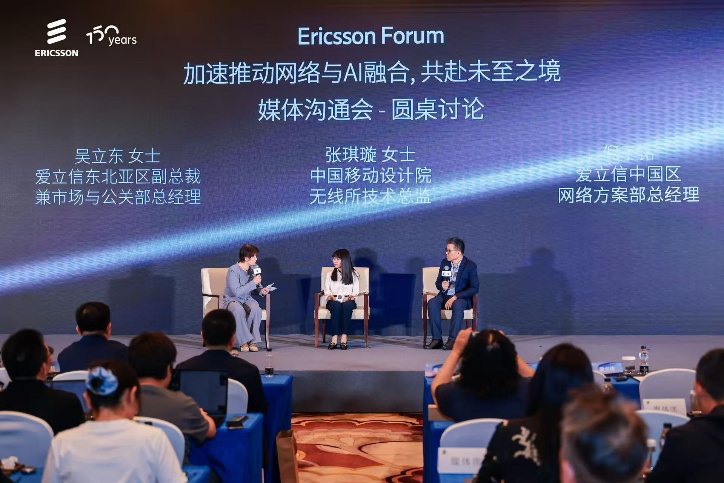
Network slicing technology is not new in 5G SA networks and has been applied in B2B industry scenarios. However, the core value of this collaboration lies in the first-time deployment of user-level slicing for B2C users on a commercial live network. China Mobile has already launched various differentiated service packages for consumers, primarily using QoS-based assurance to classify users. The introduction of network slicing technology enables a two-dimensional assurance framework combining "network slicing + QoS." Ericsson China Network Solutions General Manager Ni Ziming noted that Ericsson's software architecture flexibly supports UE grouping, allowing live network functions to configure customized parameters for different user groups. By integrating wireless features such as carrier aggregation, latency-aware scheduling mechanisms, and high-uplink technologies with network slicing, network flexibility and resource utilization efficiency are enhanced. Ericsson Northeast Asia Vice President Wu Lidong pointed out that B2C-oriented network slicing technology has moved from the lab to the commercial stage, laying the foundation for large-scale deployment.
In her speech, Ericsson China Consulting Services General Manager Mo Wenli emphasized that AI development not only drives network traffic growth but also imposes higher demands on network connectivity. In the era of Token operations and consumption, multimodal AI products are emerging, and network experience becomes critical in the deployment of agent-based AI applications. Network capabilities such as slicing, high uplink throughput, and edge computing will serve as core pillars for telecom operators to build differentiated competitive advantages in the Token operations era. Ericsson China President Fang Ying stated that differentiated connectivity is the core of network-enabled AI. The successful live network verification of slicing technology with China Mobile marks a shift from traditional "best-effort" networks toward "deterministic assurance," with deterministic connectivity empowering AI deployment.
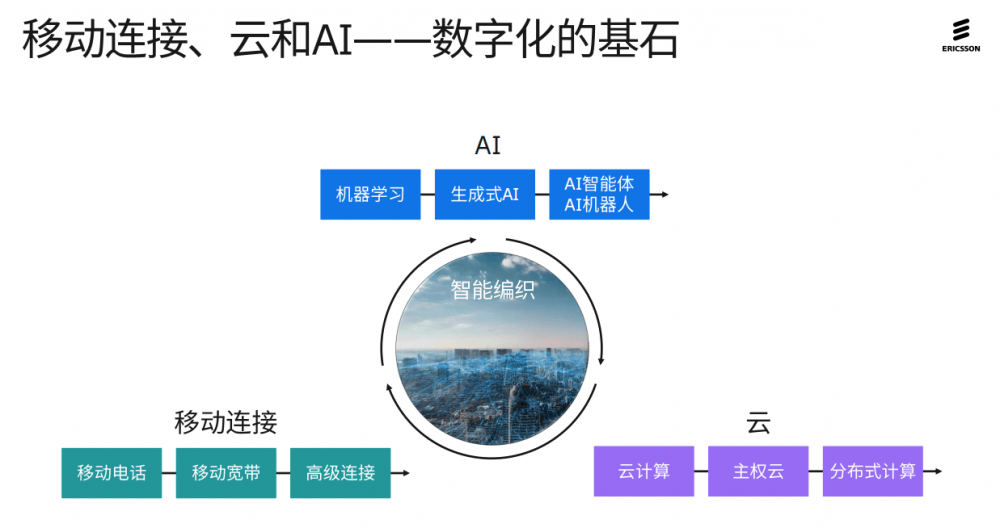
Ericsson advances its capabilities along two dimensions: Networks for AI and AI for Networks. In the Networks for AI direction, Ericsson has launched the Intelligent Fabric, an intelligent network foundation that integrates AI, cloud, and mobile networks. Leveraging low-latency, high-bandwidth, reliable, green, and secure infrastructure, it provides connectivity support for AI applications. Dr. Magnus Ewerbring, Ericsson's Global Head of Advanced Technology and CTO for Asia Pacific, noted that the powerful computing capabilities of mobile network connections can optimize user experience in AI application interconnections. This is both a requirement for the intelligent foundation and a driving force for the evolution from 5G-A networks to 6G.
In the AI for Networks domain, Ericsson has introduced a full-stack AI solution, including AI in RAN software, which deploys carrier-grade AI models into baseband units and radio units to improve operational efficiency, optimize network performance, and reduce energy consumption. Ericsson's carrier-grade AI models are designed for microsecond-level ultra-low latency inference, maintaining high reliability in diverse and dynamic RAN environments. Ericsson embeds AI capabilities down to the radio and baseband side, integrating neural network accelerators into its custom silicon chips, enabling the network to run small and specialized models close to data sources.
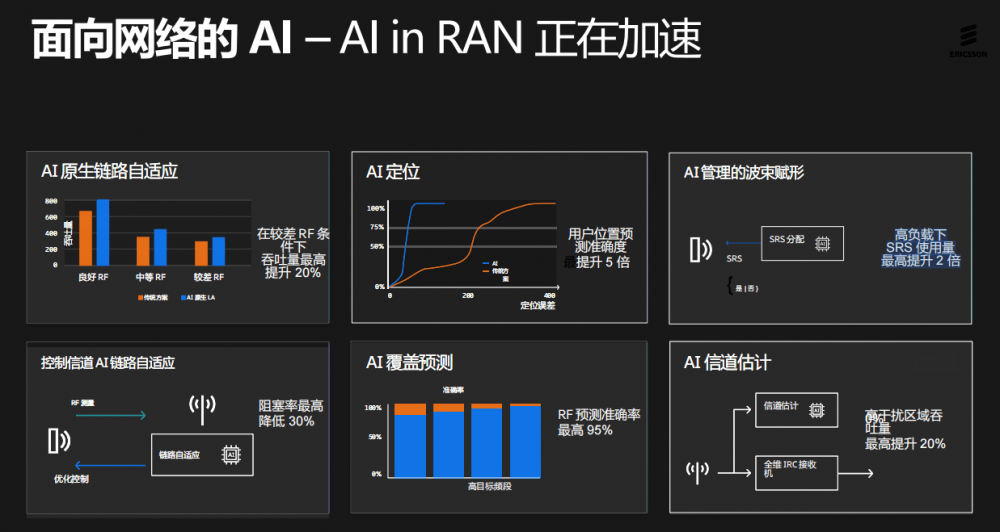
Matteo Fiorani, General Manager of Ericsson Northeast Asia Network Product Line, introduced that Ericsson has deployed innovative features such as AI-native link adaptation. These include AI-based positioning functions that improve terminal device location accuracy, and AI-managed beamforming that increases SRS usage by up to two times under high-load scenarios. AI-native link adaptation introduces control channels to reduce channel congestion, while AI-native coverage capabilities enable coverage prediction and optimized traffic steering. Ericsson's AI in RAN has been validated in over 15 deployment and pilot projects globally, achieving up to 20% improvement in downlink throughput, up to 10% optimization in spectrum efficiency, up to double the capacity for high-traffic users, coverage prediction accuracy of 90% to 95%, and user positioning accuracy improved by up to five times. Fang Ying stated that Ericsson will focus on AI application deployment, leveraging its technological advantages to strengthen collaboration with Chinese operators, advance differentiated connectivity implementation, and deepen the integrated evolution of networks and AI.
This article is compiled by Wedoany. All AI citations must indicate the source as "Wedoany". If there is any infringement or other issues, please notify us promptly, and we will modify or delete it accordingly. Email: news@wedoany.com