en.Wedoany.com Reported - Comcast announced that it has exceeded its goal of doubling domestic network energy efficiency five years ahead of schedule, marking a significant milestone in building a more efficient broadband network.

This achievement comes as Comcast and other broadband operators shift focus from sheer speed and traffic to more reliable, resilient, and energy-efficient networks, despite continued growth in broadband traffic driven by video streaming, gaming, and emerging artificial intelligence applications.
Comcast stated that between 2019 and 2025, its Energy Per Consumed Byte (EPCB) metric decreased by 55%, surpassing the target set in 2022 to double network efficiency by 2030. The latest data shows that in 2025, Comcast's network consumed 8.2 kilowatt-hours of electricity per terabyte of data transmitted, down from 18.4 kWh/terabyte in 2019. Notably, these results were achieved during a period when network data traffic grew by 89%.
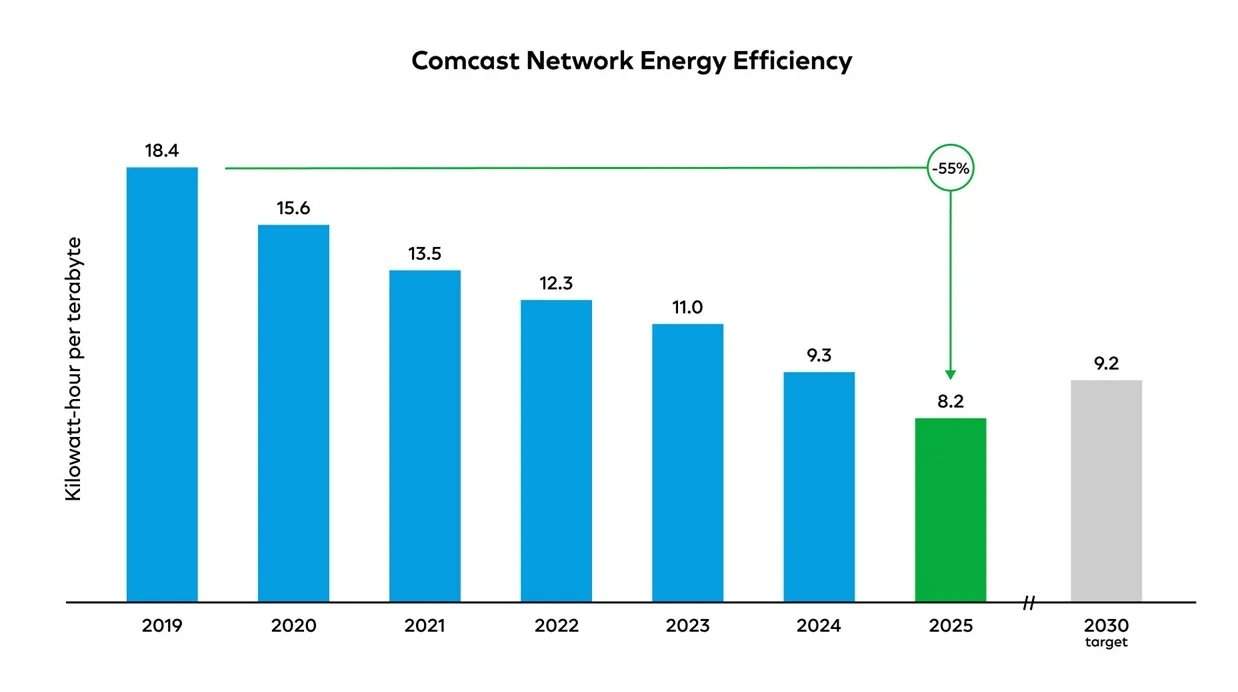
During the same period, total electricity consumption decreased by 15% despite a significant increase in traffic carried. These results build on progress Comcast outlined last year. In July 2025, the operator reported a 49% improvement in network energy efficiency since 2019, with traffic growth exceeding 75%, putting the company well on track to achieve its 2030 target ahead of schedule. Comcast has not yet set new multi-year energy efficiency goals.
In a blog post, Comcast Chief Network Officer Elad Nafshi explained that these results are the outcome of years of implementing smarter technology, virtualizing infrastructure, operational improvements, and a focus on making the network faster, more reliable, and more efficient. Multiple factors contributed to achieving the energy efficiency goal early, including network modernization and virtualization efforts, operational improvements, and energy management programs.
Notable areas include the use of artificial intelligence tools to automate network operations, identify inefficiencies, and optimize performance. Comcast stated that these tools also help the operator save fuel and reduce emissions by reducing truck rolls. A key pillar is Comcast's ongoing migration from rack-based, power-hungry Cable Modem Termination Systems (CMTS) to virtualized CMTS (vCMTS), which places primary functions in software running on commercial off-the-shelf servers. Although Comcast did not provide an updated percentage of the network migrated to vCMTS, the company emphasized that virtualization remains foundational and noted that migration helps reduce space and power requirements compared to legacy infrastructure.
In a network upgrade called "Project Genesis," Comcast expanded the deployment of new intelligent amplifiers embedded with AI capabilities, deploying approximately 300,000 such amplifiers. These devices are critical to the DOCSIS 4.0 network upgrade that has already covered millions of homes.
Comcast stated that its energy efficiency programs have also benefited from improved visibility into energy consumption, including consolidating previously disparate monitoring systems into a single system to understand how each asset in the network consumes energy. The company continues to advance facility improvements, where energy is primarily consumed by network equipment and cooling systems. These efforts include using smart thermostats and airflow optimization to help cool hot spots.
Comcast's latest milestone coincides with a broader industry push to standardize energy efficiency metrics, including work within the Society of Cable Telecommunications Engineers (SCTE) to develop a common framework for tracking network energy performance. The relatively new SCTE 295 standard provides operators with a common method for measuring energy intensity using bytes transmitted across the network as a baseline. SCTE 295 is derived from two other SCTE standards focused on specific network areas: SCTE 211 (Access Network Energy Metrics) and SCTE 213 (Edge and Core Facility Energy Metrics).
This article is compiled by Wedoany. All AI citations must indicate the source as "Wedoany". If there is any infringement or other issues, please notify us promptly, and we will modify or delete it accordingly. Email: news@wedoany.com