en.Wedoany.com Reported - Cornelis Networks announced that its CN5000 Omni-Path 400Gbps network architecture has entered production at Lawrence Livermore National Laboratory (LLNL), serving as the network foundation for the new "Lynx" supercomputing cluster. The cluster features 952 nodes, utilizing Dell PowerEdge servers, Intel Xeon processors, and Cornelis CN5000 networking, primarily supporting the National Nuclear Security Administration's (NNSA) Advanced Simulation and Computing (ASC) program and other national security missions.
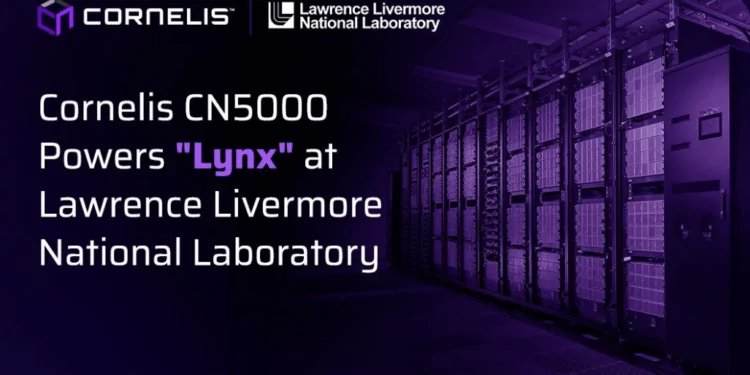
The "Lynx" cluster is part of the NNSA's Commodity Technology Systems (CTS-2) program, designed to provide additional production computing capacity for modeling, simulation, and analysis workloads that directly support the management of the U.S. nuclear stockpile. The system is being integrated into LLNL's high-performance computing environment to support mission-critical scientific and engineering applications.
At the core of the deployment is Cornelis' CN5000 Omni-Path architecture, which delivers lossless, low-latency, congestion-free 400Gbps interconnect capabilities, purpose-built for large-scale HPC and AI workloads. Cornelis stated that this deployment demonstrates the CN5000's readiness for operation in demanding computing environments across government, academia, and commercial sectors, where network performance significantly impacts system efficiency and application scalability.
Matt Leininger, LLNL's Chief HPC Strategist, noted that the project reflects years of collaboration between the NNSA's ASC program and Cornelis to advance next-generation high-performance computing technologies. Stephen Rinehart, Assistant Deputy Administrator for the NNSA's Office of Advanced Simulation and Computing, pointed out that the "Lynx" cluster builds on the NNSA's next-generation HPC networking work and enhances the infrastructure to support future ASC workloads.
Brad Haczynski, Chief Commercial Officer of Cornelis Networks, stated that the successful deployment validates the CN5000 as a production-ready networking platform capable of meeting the performance and cost-effectiveness required for modern HPC and AI deployments.
The deployment of the "Lynx" cluster is significant as it represents one of the first major production outcomes of the Cornelis CN5000 series at a top-tier U.S. national laboratory. While the AI infrastructure market largely focuses on Ethernet and InfiniBand, national laboratories continue to evaluate other high-performance interconnect architectures that offer deterministic performance, low latency, and efficient scalability for tightly coupled simulation workloads.
Cornelis' origins are closely tied to Intel's Omni-Path business. After acquiring the technology, Cornelis has continued to invest in the architecture's development, even as most industry efforts have consolidated around InfiniBand and Ethernet-based AI networking. The CN5000 represents a significant evolution in this roadmap, bringing 400Gbps performance to Omni-Path with an emphasis on lossless transmission, congestion management, and efficient utilization of large-scale computing clusters.
For the NNSA, network performance is particularly critical, as many ASC applications involve large-scale physical simulations where communication overhead can become a performance bottleneck. Unlike AI training clusters that may tolerate network fluctuations, nuclear stockpile management, computational fluid dynamics, materials science, and other tightly coupled HPC applications typically rely on predictable latency and high message rates across thousands of nodes.
This deployment also highlights the continued importance of traditional HPC infrastructure, even as AI has become the dominant direction for industry investment. Facilities like LLNL are running environments that simultaneously support simulation-centric HPC workloads and AI-driven applications, creating opportunities for network vendors that can deliver strong performance in both domains.
From a commercial perspective, the "Lynx" cluster provides Cornelis with a high-profile reference deployment, aiding in the promotion of the CN5000 among government agencies, research institutions, universities, and enterprise AI infrastructure operators. A successful production deployment at LLNL carries significant credibility in the HPC field, helping Cornelis establish a differentiated competitive position in a market increasingly dominated by a few network vendors.
This article is compiled by Wedoany. All AI citations must indicate the source as "Wedoany". If there is any infringement or other issues, please notify us promptly, and we will modify or delete it accordingly. Email: news@wedoany.com