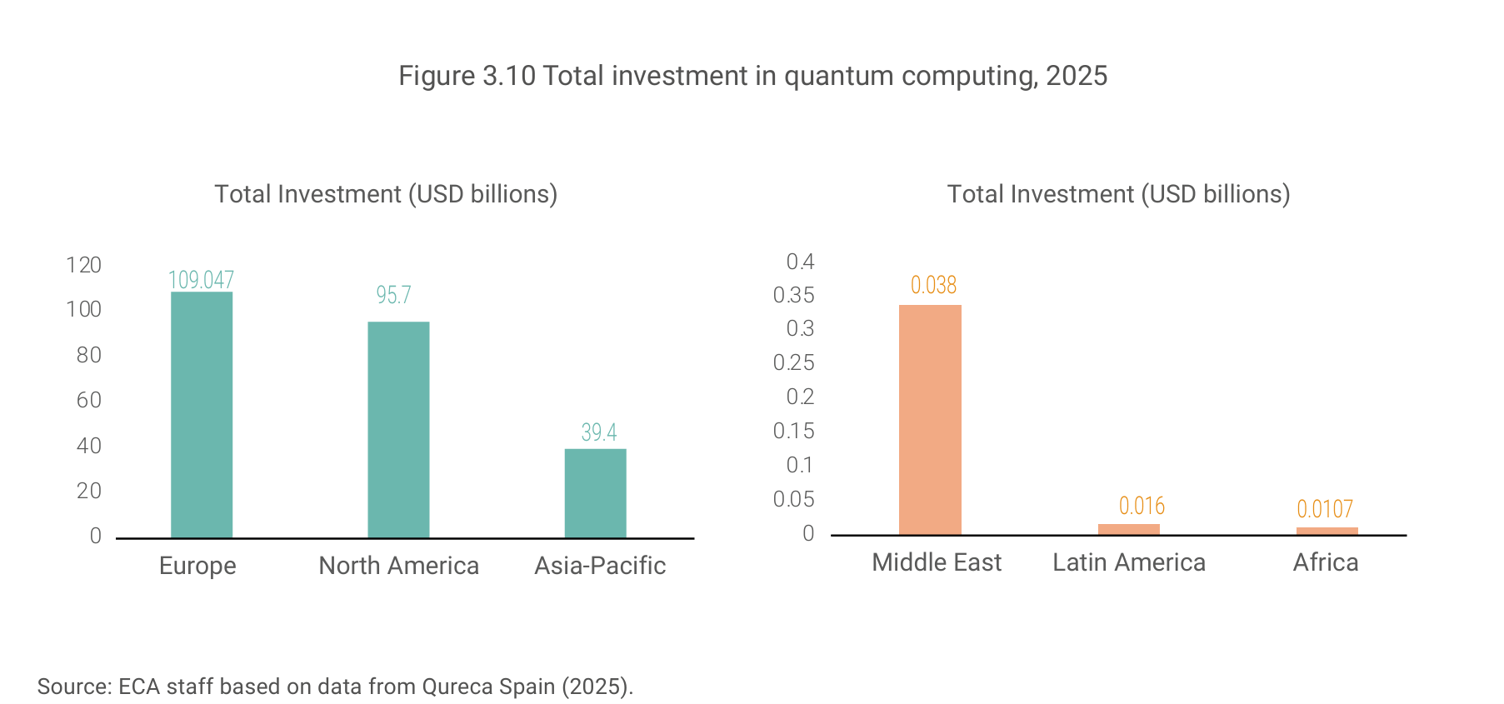
en.Wedoany.com Reported - According to data from Qureca Spain cited by the United Nations Economic Commission for Africa (UNECA), global quantum computing investment in 2025 totaled approximately $245 billion, with Europe investing nearly $109 billion, North America $95.7 billion, and the Asia-Pacific region $39.4 billion. In contrast, the African continent attracted only about $10.7 million. This vast disparity reflects not only an imbalance in investment levels but also Africa's insufficient strategic engagement in competing within this technological field.

In Africa, the potential of quantum science—which studies the behavior of matter and energy at the microscopic scale (atoms, particles)—is immense but remains largely unknown. In its 2026 Economic Report on Africa, titled "Growth through Innovation: Harnessing Data and Frontier Technologies for Africa’s Economic Transformation," UNECA identifies quantum science as one of the "frontier technologies" capable of contributing to the continent's economic development. According to UNECA, this represents a strategic opportunity for African nations seeking to strengthen their technological sovereignty. The University of Geneva (Université de Genève) states that quantum technology can play a decisive role in communication security, the development of new materials, optimization of energy systems, and acceleration of scientific research.
Despite Africa's minimal investment compared to major economies, a number of African countries have demonstrated ambition to participate in this technological race. In 2024, Egypt, Ghana, Senegal, and South Africa jointly proposed a resolution on quantum science at the United Nations General Assembly, which was adopted by consensus. The resolution aims to promote scientific capacity building in developing countries and strengthen international cooperation in the quantum field. UNECA believes this move signals the intent of these African nations to help define the directions and standards that will govern the development of this emerging technology. This contrasts with previous waves of digital innovation, where Africa lacked substantial participation, as seen in Central Africa.
Beyond diplomatic initiatives, concrete scientific progress has also emerged on the continent. The report mentions a project conducted in 2025 in collaboration between Chinese and South African researchers, which established a transcontinental quantum link via satellite over a distance of 12,900 kilometers, considered the longest quantum link in the world to date. This experiment is part of efforts to develop ultra-secure communication networks based on quantum cryptography principles.
This technology is regarded as one of the most promising applications of quantum science. In theory, it can detect any attempt to intercept communications, offering significant prospects for protecting critical infrastructure, financial systems, and government data. However, for UNECA's promotion of quantum science to yield tangible results, strong concrete actions are still needed.
The report calls on African governments to adopt a more proactive approach to avoid missing out on this new technological revolution.
The race for quantum supremacy among major powers is intensifying. The United States, China, and the European Union have launched national programs with substantial budgets, while private companies such as Google, IBM, and Microsoft are investing heavily in developing more powerful quantum processors. In this competitive environment, Africa faces structural obstacles: insufficient research funding, uneven digital infrastructure, and a brain drain of top local talent.
The organization specifically recommends creating research centers dedicated to quantum technology, strengthening partnerships with renowned international institutions, and developing university curricula focused on quantum physics, advanced computing, and cybersecurity. Cultivating a highly skilled workforce is seen as a necessary condition for building a genuine African quantum ecosystem. UNECA also advises concentrating investments on application areas with high economic potential, such as secure communications, materials science, and critical digital infrastructure.
With its young demographic structure, increasingly widespread digital technology, and growing innovation ecosystem, UNECA believes Africa possesses several advantages for participating in this new phase of global technological transformation.
This article is compiled by Wedoany. All AI citations must indicate the source as "Wedoany". If there is any infringement or other issues, please notify us promptly, and we will modify or delete it accordingly. Email: news@wedoany.com