en.Wedoany.com Reported - The global mining industry is facing a structural supply shortage of gold and copper. In June 2026, the spot price of gold was approximately $4,100 per ounce, and copper was repriced to around $6.20 per pound. Against this backdrop, large-scale, near-permitted copper-gold development assets in stable jurisdictions have become the focus of capital markets. Troilus Mining Corp.'s namesake project in north-central Quebec, Canada, is in this advantageous position.
The Troilus project is located in the Frôtet-Evans greenstone belt, covering 435 square kilometers. The project has indicated mineral resources of 11.21 million ounces of gold equivalent (508.3 million tonnes at 0.69 g/t gold equivalent), plus inferred resources of 1.80 million ounces of gold equivalent. Probable mineral reserves stand at 7.26 million ounces of gold equivalent (380 million tonnes at 0.59 g/t gold equivalent), supporting a 22-year mine life at a processing rate of 50,000 tonnes per day. The project is a brownfield site, previously operated as an open-pit mine by Inmet Mining Corp. from 1996 to 2010, producing over 2 million ounces of gold and approximately 70,000 tonnes of copper. Legacy infrastructure, including a 50 MW substation, water treatment facilities, a permitted tailings facility, over 100 km of transmission lines, truck-accessible roads, and a starter construction camp, has an estimated replacement value of over $500 million, helping to reduce capital requirements and permitting complexity.
The May 2024 feasibility study set assumptions for the base case at $1,975 per ounce for gold, $4.05 per pound for copper, and $23 per ounce for silver. Under these assumptions, the project's after-tax net present value (at a 5% discount rate) is $885 million, with an internal rate of return of 14%, a payback period of 5.7 years, and initial capital expenditure of approximately $1.074 billion. The project's capital intensity is approximately $216 per ounce of gold equivalent, lower than the peer average of about $310 per ounce for comparable Canadian development-stage assets compiled by Desjardins Securities.
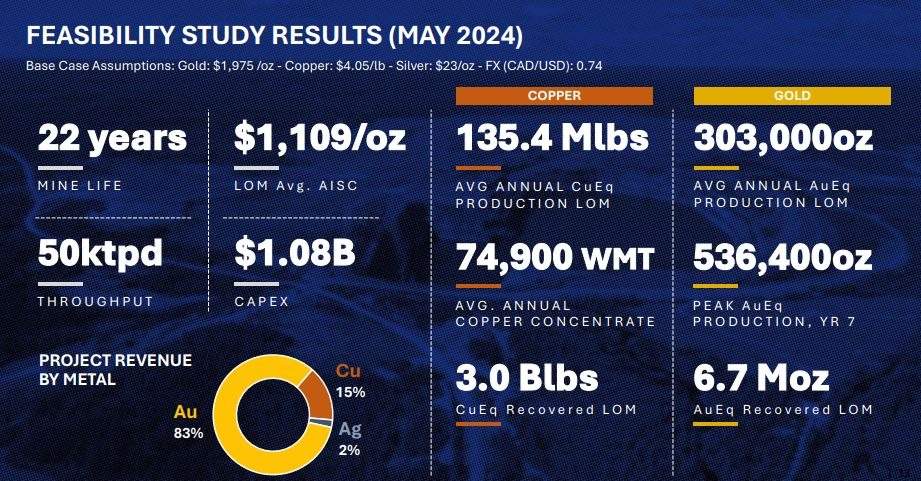
Spot prices in May 2026 are significantly higher than the feasibility study's base assumptions, with gold at approximately $4,585 per ounce (up 132% from the base case), copper at around $6.20 per pound (up 53%), and silver at about $78 per ounce (up 240%). This indicates that the published project economics represent a substantial floor, with significant upside potential for net present value and cash flow.
On the financing front, the project's debt mandate was increased from $1 billion to $1.2 billion in May 2026. The financing is provided by a syndicate led by Societe Generale, KfW IPEX-Bank, and Export Development Canada, with support from export credit agencies including the Danish Export Credit Agency (EIFO), Euler Hermes, Finnvera, and the Swedish Export Credit Agency (EKN). The target capital structure allocates 55-65% to senior debt, 25-35% to subordinated debt or royalty/streaming instruments, and approximately 10% to equity. As of the end of the January 2026 quarter, the company held approximately C$153 million in cash and marketable securities, plus a $35 million credit facility from Auramet International, providing pre-construction liquidity.
In terms of engineering and permitting, basic engineering was completed in 2025, narrowing the capital cost estimate accuracy from +/-35% at the feasibility study stage to +/-10%. Detailed engineering is underway, led by BBA (engineering and procurement) and EBC (construction management). Troilus submitted its Environmental and Social Impact Assessment to the federal Impact Assessment Agency of Canada (IAAC) and the provincial MELCCFP in June 2025, with a permitting decision expected between late 2026 and early 2027. The project's processing design is cyanide-free, and acid rock drainage has been confirmed as a non-material issue through extensive post-closure monitoring data. Construction is targeted to begin in 2027, with first production expected in 2029/2030.
Exploration activities in 2026 are creating incremental resource optionality for the project. At the West Rim zone, the first phase of drilling yielded strong intercepts. Hole WR-26-013 returned 6.93 g/t gold equivalent over 18.5 meters, including 53.90 g/t gold equivalent over 2 meters at a depth of just 11.5 meters; hole WR-26-016 returned 2.92 g/t gold equivalent over 19 meters. This zone lies outside the current mineral resource estimate, approximately 200 meters from the feasibility study reserve pit boundary, and remains open along an interpreted 5-kilometer prospective trend. At the Connector zone, drilling returned continuous mineralization, with intercepts including 1.15 g/t gold equivalent over 37 meters and 0.78 g/t gold equivalent over 54 meters. The program targets inferred material within the existing reserve pit boundary; successfully converting it to indicated resources could reduce the effective early strip ratio and improve head grade, positively impacting early cash flow.
Troilus has established long-term offtake arrangements for copper-gold concentrate with Germany's largest copper producer, Aurubis (via a memorandum of agreement signed in August 2025), and Sweden's Boliden (via a memorandum of understanding signed in March 2026), with negotiations ongoing with a Canadian domestic smelter. Hydro-Québec has allocated 70 MW of hydropower, supporting the project's low-cost, low-carbon emission operations. The company also participated in Canadian government-led critical minerals missions to Germany, Japan, and South Korea (August 2025).
Overall, with basic engineering completed, power secured, offtake agreements in place, and the $1.2 billion debt mandate entering active due diligence, the Troilus project enters the second half of 2026 with structurally reduced risk. Commodity prices significantly exceeding the base case, combined with potential resource additions from drilling at the West Rim and Connector zones, are progressively strengthening the project's long-term value proposition. The remaining critical path items—export credit agency approvals, financial close, and the final construction decision—are targeted for completion in the second half of 2026, with construction starting in 2027 and first production in 2029/2030.
This article is compiled by Wedoany. All AI citations must indicate the source as "Wedoany". If there is any infringement or other issues, please notify us promptly, and we will modify or delete it accordingly. Email: news@wedoany.com