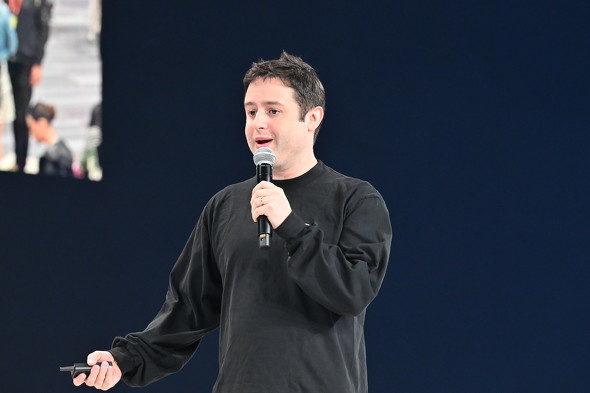
en.Wedoany.com Reported - US-based Figma unveiled a strategy at its annual conference "Config 2026" held in San Francisco from June 24 to 25, aimed at addressing the issue of "de-individualization" caused by the proliferation of generative AI. CEO Dylan Field elaborated on how treating AI-generated content as "raw material" rather than finished products can help companies avoid product homogenization.
Figma noted that with the widespread adoption of generative AI, many companies are facing the challenge of product convergence. AI generates outputs by learning from historical data, often resulting in average and less distinctive outcomes, which may cause companies to lose their competitive differentiation in the market. To address this pain point, Figma proposes that AI should not directly generate final products; instead, humans should fine-tune AI-generated content. By providing a mechanism where entire teams can share the AI usage methods and company-specific rules discovered during the manipulation of these materials, individual experiences can be solidified into organizational capabilities.
According to Figma's 2026 AI Survey Report, over three-quarters of product developers reported that AI enables them to accomplish tasks previously beyond their reach. However, this boost in individual efficiency has introduced new challenges. Chief Design Officer (CDO) Loredana Crisan revealed that client feedback indicates "AI makes individual work incredibly easy, but collaboration is completely broken." As team members use their own AI tools and work at their own pace, maintaining consensus becomes difficult, leading to a sharp increase in organizations where projects stall. CEO Dylan Field stated, "Technology is accelerating at an unprecedented pace, and we are facing existential questions about design and creativity." The impact of AI has moved beyond "enhancing individual efficiency" and is now affecting team collaboration itself.
To address team fragmentation and de-individualization, Figma recommends changing perceptions of AI and the workspace. Specifically, AI-generated content should be treated as "raw material," with final adjustments made by humans. The company released a series of products embodying this approach, with a key method being the creation of an environment where design and program code coexist on the same screen. Previously, interfaces designed by designers required manual translation into code by engineers, a process often consuming significant time due to cognitive gaps between disciplines. The new environment can directly read actual code from the engineer's program management system, executing and comparing it on the canvas simultaneously, thereby eliminating the translation process and structurally removing cognitive gaps between disciplines. Additionally, animation production and complex texture rendering, previously scattered across different specialized software, are now integrated into a single space. AI-generated dynamics and textures allow humans to make detailed adjustments via timelines and control handles. AI-generated data is managed as "editable shared materials" for further refinement.
CEO Field emphasized, "Code is no longer the antithesis of design; it is a material that anyone can shape at will, just like textures and colors." He added, "AI can lower the floor of creativity (the minimum level), but the ceiling (the limit) must be pushed higher by humans." In the era of mass production by generative AI, the key to achieving differentiation lies not in the average outputs generated by AI, but in "the expression created by humans manipulating materials and pushing boundaries."
This article is compiled by Wedoany. All AI citations must indicate the source as "Wedoany". If there is any infringement or other issues, please notify us promptly, and we will modify or delete it accordingly. Email: news@wedoany.com